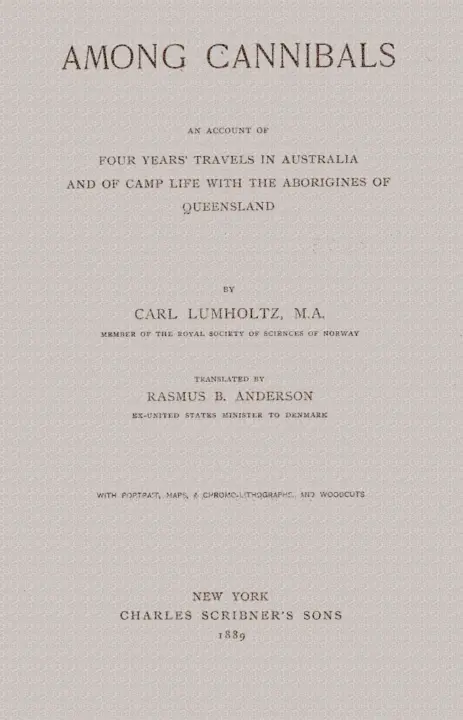
Among Cannibals: An Account of Four Years’ Travels in Australia and of Camp Life With the Aborigines of Queensland
Carl Lumholtz
THE CLASSIC COLLECTION · 1920
"Through Central Borneo" by Carl Lumholtz is an ethnographic and travel account written during the early 20th century. The book chronicles Lumholtz's journey through the largely uncharted territories of Borneo between 1913 and 1917, focusing on his interactions with various indigenous tribes, including the headhunting cultures of the Dayaks. The narrative provides insights into the sociocultural dynamics, flora, and fauna of the region while reflecting on the broader themes of civilization versus primitivism, showcasing Lumholtz's admiration for the perceived simplicity and richness of life among the “savages” he encounters. The opening of the book introduces readers to Lumholtz's ambitious expedition and sets the stage for his explorations. After receiving funding and planning the journey, he embarks on a race against time to catch a glimpse of the eastern territories before the outbreak of World War I alters his plans. He shares vivid impressions of his travels through Japan and Singapore, before arriving at Batavia, Java, where he expresses eagerness for his forthcoming adventures in Borneo. This segment establishes the purpose of his expedition, which includes research on various tribes, specimen collection, and observation of the natural environment, immediately immersing readers in his adventurous spirit and anticipation of discovery in the unknown lands of Borneo.
Introduction adapted from the source catalogue; source summaries may be automatically generated.
Free to read · English · 131,369 words · No account needed
MAKE TIME FOR A GOOD BOOK
On by default. Untick to stop anonymous reading totals. Each page counts after 10 seconds in view. How this works.
Anonymous counting is on unless you have switched it off.
Samba River, the, fish in;
houses on;
an expedition up;
passing the rapids of;
night on;
first European to visit;
gold in;
data from, concerning natives
Sambil goreng (native stew)
Samoan tribe. See Tamoans
Sampit, village of;
start for;
return to;
beri-beri at;
banquet given by controleur of
Sampit River, the
Sand-bars, at mouth of Pembuang River
Sand, white
Sandpiper, the
Sandung (funeral house)
Sangiang, the (antoh)
Sankuvai, the (bird that calls antoh)
Sapundo, the (memorial post)
Saputans, the;
characteristics of;
number of;
the women and children of;
habits and customs of;
marriage customs of;
food of;
belief of, about disease and its cure;
funeral customs of;
piercing of ears of;
shy about being photographed;
makers of the sumpitan;
headhunting of;
the Ulu-Ots;
folklore of;
governed formerly by Penihings;
tuba-fishing practised by;
derivation of the name;
four villages of;
customs of, regarding childbirth;
included in Orang Bahau
Sarawak, James Brooke made raja of;
success of government of, under white rajas;
five groups of people in;
fires at
Schouten, H.P.
Schreuder, R.
Schwaner Mountains, the, mineral possibilities of;
exploration of;
the natives in
Sea, water from, reaches Mandumei
Sea Dayaks, the
Seat, plank used as
Segai, the, Kayan sub-tribe
Selatan, government steam-launch;
rough weather on board
Semang, the Bad Boy, folk-tale
Sembulo, Lake, an expedition to;
description of;
visit to, postponed;
the Dayaks on;
legend of the tailed people of;
second expedition to;
storms on;
depth of;
no evidence of tailed men found at
Sembulo, village of, arrival at;
mosque and cemetery of;
legend of the tailed people of;
population, Malay;
rubber gathering, chief occupation of;
natives from Bangkal brought to;
epidemic of beri-beri at;
Tamoans superseded by Malays at
Senamang River, the, natives of
Serpent, huge, man-eating;
legends of golden-horned.
See also Snake
Serrata
Shelters, in the jungle
Shield: blian's, used as musical instrument;
picture of antoh on warrior's;
of the Penihings
Shyness of natives
Siangs, the;
tatuing of
Singapore;
climate of
Singing, of Kayan women;
of head-hunters;
to cure disease;
folk-tales;
of Penyahbong chief;
of the Penyahbong men;
of blian at funeral ceremonies;
of Katingan women
Sins, kinds of, among Katingans
Skin, colour of natives';
diseases;
formations on thighs
Skins, animal, drying of;
spoiled by weather conditions
Skulls, natives unwilling to sell;
used as drinking-vessels
Slave, formerly sacrificed to attract antoh;
buried alive under houses;
stones thought to be;
debtors as;
killing of, for wealthy man's funeral;
formerly sacrificed at tiwah feast;
cuts inflicted on, when raja dies
Smallpox
Snake, poisonous;
curious adventure with;
deadly bite of black;
a fight with;
as food;
caught and set free;
huge, man-eating;
bite of cobra;
cure for bite of;
folk-tales about
Snake-bird
Snares, for catching birds
Social classes, among tribes
Your reading position is saved on this browser. Take it to another device with a library code. Reading pages adapt to text, rather than matching a printed edition.
BEHIND THE BOOK
This eBook is for the use of anyone anywhere in the United States and most other parts of the world at no cost and with almost no restrictions whatsoever. You may copy it, give it away or re-use it under the terms of the Project Gutenberg License included with this eBook or online at www.gutenberg.org. If you are not located in the United States, you will have to check the laws of the country where you are located before using this eBook. Read the source licence.
The original source file, including credits and licence, is retained by this library. Request an original-format copy at no charge. Please include the book title and Project Gutenberg identifier #7489.
KEEP YOUR CURIOSITY GOING
Wilfrid Scawen Blunt
Wilfrid Scawen Blunt

E. W. (Edgar Watson) Howe
Cécile Tormay

Moritz Busch
John L. Ransom