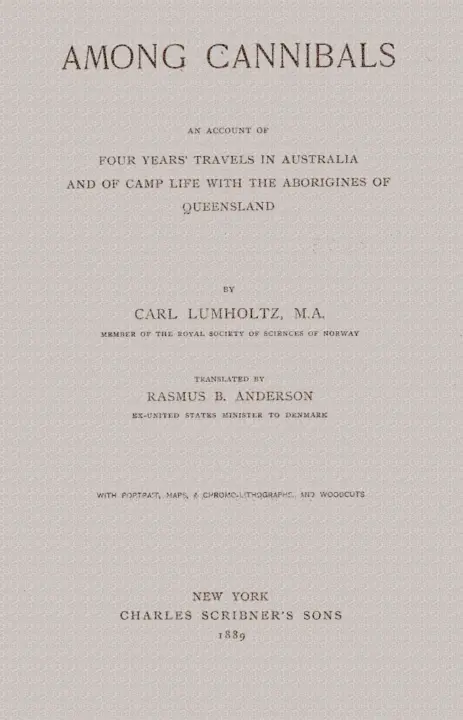
Among Cannibals: An Account of Four Years’ Travels in Australia and of Camp Life With the Aborigines of Queensland
Carl Lumholtz
THE CLASSIC COLLECTION · 1920
"Through Central Borneo" by Carl Lumholtz is an ethnographic and travel account written during the early 20th century. The book chronicles Lumholtz's journey through the largely uncharted territories of Borneo between 1913 and 1917, focusing on his interactions with various indigenous tribes, including the headhunting cultures of the Dayaks. The narrative provides insights into the sociocultural dynamics, flora, and fauna of the region while reflecting on the broader themes of civilization versus primitivism, showcasing Lumholtz's admiration for the perceived simplicity and richness of life among the “savages” he encounters. The opening of the book introduces readers to Lumholtz's ambitious expedition and sets the stage for his explorations. After receiving funding and planning the journey, he embarks on a race against time to catch a glimpse of the eastern territories before the outbreak of World War I alters his plans. He shares vivid impressions of his travels through Japan and Singapore, before arriving at Batavia, Java, where he expresses eagerness for his forthcoming adventures in Borneo. This segment establishes the purpose of his expedition, which includes research on various tribes, specimen collection, and observation of the natural environment, immediately immersing readers in his adventurous spirit and anticipation of discovery in the unknown lands of Borneo.
Introduction adapted from the source catalogue; source summaries may be automatically generated.
Free to read · English · 131,369 words · No account needed
MAKE TIME FOR A GOOD BOOK
On by default. Untick to stop anonymous reading totals. Each page counts after 10 seconds in view. How this works.
Anonymous counting is on unless you have switched it off.
Temple. See Balei
Tent, preferred to house;
the rot-proof
Teong, the bird
Teroian tribe, the
Terpsiphone
Tevang Karangan, Upper Katingans at
Throat, sick in his, Saputan expression
Thunder-storms
Tiger-cat, representation of, as protection;
not eaten;
image of, on flying prahu;
image of, guarding house;
soul of
Tigers, Indian
Tin;
cans, stolen by natives
Tinea imbricata
Tingan, interpreter
Tipang Tingai
Tiwah feast (second funeral feast)
Tjehan River, the
Tobacco;
native;
asked for by women;
chewing;
given to natives
Togallan, time for planting rice determined by
Top-spinning, omens taken by
Torch
Trade in Borneo, mainly conducted by Chinese
Traders, native, from Apo Kayan
Tragulus
Traps, fishing
Travellers, and omens
Travelling, Malay outfit for;
Penihing custom of travelling at night
Tree of which Antoh is Afraid, The, folktale
Trees, of Borneo;
felling of;
hardwood, of the jungle;
methods of climbing tall;
poison from;
fruit-bearing;
falling, and head-hunting raids;
fallen but still living;
punishment of, when man is killed by falling from;
antohs in;
sacrifices made on falling of;
the crevaia;
the durian;
the lansat;
the tapang;
folk-tales about
Tribes, native, of Borneo: classification of;
intermingling of;
friendly relations among;
characteristics and capabilities of;
the Bahau;
Basap;
Bato-Pola;
Bukats;
Bukits;
Busang;
Duhoi;
Ibans;
Katingans, Upper and Lower;
Kayans;
Kenyahs;
Long-Glats;
Mehalats;
Murungs;
Muruts;
Oma-Lokvi;
Oma-Palo;
Oma-Sulings;
Oma-Tapi;
Oma-Tepe;
Orang Bahau;
Ot-Danums;
Penihings;
Penyahbongs;
Punans;
Saputans;
Siangs;
Tamoans
Triennial feast, the great;
the purpose of;
building of place of worship;
food regulations at;
service imparting health and strength at;
dance of blians at;
dance of the people;
killing and preparation of pigs for;
the banquet;
practical joking at;
rice-throwing at;
wrestling;
march of blians;
end of
Trumpets, as accompaniment to singing
Trunk, steel
Trustworthiness of natives
Truthfulness of natives
Tuak. See Brandy
Tuan Allah
Tuba-fishing
Tumbang Djuloi, village of
Tumbang Mantike, iron ore at
Tumbang Marowei, village of;
return to;
data from, concerning Murungs
Tumingki, village of
Turtle;
supposed to be poisonous
Twins, among children of the Dayaks
Two Orphans, The, folk-lore tale
Ugga River, the
Uljee, J.A.
Ulu-Ots, supposed to be cannibals;
habitats of;
believed to have tails and to sleep in trees;
number and appearance of;
inveterate head-hunters;
collective name for several tribes
Ulung Ela, the fatherless boy
Ulung Tiung, the motherless boy
Umbrellas, carried by Malays;
useful for travel in Borneo
Upper Kahayan River, the, folk-lore from
Vaccinateur, the
Vancouver, arrival at
Van Dijl, Lieutenant J.
Varanus,
Vegetables, used in cure of diseases;
stew of
Vegetation in the jungle, change in denseness of;
rapid growth of
Vendetta among the Katingans
Vergouwen, J.C.
Villages, custom of changing location of
Voices, shrill
Von Luschan colour scale
Wages, paid to boatmen
Your reading position is saved on this browser. Take it to another device with a library code. Reading pages adapt to text, rather than matching a printed edition.
BEHIND THE BOOK
This eBook is for the use of anyone anywhere in the United States and most other parts of the world at no cost and with almost no restrictions whatsoever. You may copy it, give it away or re-use it under the terms of the Project Gutenberg License included with this eBook or online at www.gutenberg.org. If you are not located in the United States, you will have to check the laws of the country where you are located before using this eBook. Read the source licence.
The original source file, including credits and licence, is retained by this library. Request an original-format copy at no charge. Please include the book title and Project Gutenberg identifier #7489.
KEEP YOUR CURIOSITY GOING
Wilfrid Scawen Blunt
Wilfrid Scawen Blunt

E. W. (Edgar Watson) Howe
Cécile Tormay

Moritz Busch
John L. Ransom