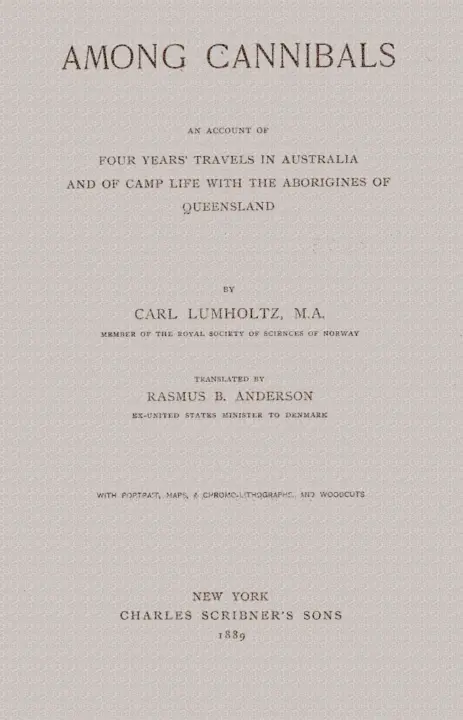
Among Cannibals: An Account of Four Years’ Travels in Australia and of Camp Life With the Aborigines of Queensland
Carl Lumholtz
THE CLASSIC COLLECTION · 1920
"Through Central Borneo" by Carl Lumholtz is an ethnographic and travel account written during the early 20th century. The book chronicles Lumholtz's journey through the largely uncharted territories of Borneo between 1913 and 1917, focusing on his interactions with various indigenous tribes, including the headhunting cultures of the Dayaks. The narrative provides insights into the sociocultural dynamics, flora, and fauna of the region while reflecting on the broader themes of civilization versus primitivism, showcasing Lumholtz's admiration for the perceived simplicity and richness of life among the “savages” he encounters. The opening of the book introduces readers to Lumholtz's ambitious expedition and sets the stage for his explorations. After receiving funding and planning the journey, he embarks on a race against time to catch a glimpse of the eastern territories before the outbreak of World War I alters his plans. He shares vivid impressions of his travels through Japan and Singapore, before arriving at Batavia, Java, where he expresses eagerness for his forthcoming adventures in Borneo. This segment establishes the purpose of his expedition, which includes research on various tribes, specimen collection, and observation of the natural environment, immediately immersing readers in his adventurous spirit and anticipation of discovery in the unknown lands of Borneo.
Introduction adapted from the source catalogue; source summaries may be automatically generated.
Free to read · English · 131,369 words · No account needed
MAKE TIME FOR A GOOD BOOK
On by default. Untick to stop anonymous reading totals. Each page counts after 10 seconds in view. How this works.
Anonymous counting is on unless you have switched it off.
paddi, rice.
parang, Dayak short sword (= mandau).
pasang-grahan, public lodging-house.
pisau, small knife.
plandok, mouse-deer (tragulus).
prahu, native boat.
pumbakal, chief (= kapala).
raja, a native chief, or noble.
raja besar, big raja.
ringit, the Dutch coin of f. 2.50.
rupia, florin, guilder.
rusa, deer.
sambir, mat made from palm leaves.
sarong, a cloth wound around the loins.
sayur, vegetable stew.
sumpitan, blowpipe.
takut, timid.
ticcar, mat made from rattan.
tin, five-gallon tin can.
tingang, great hornbill.
tingeling, scaly ant-eater.
tuak, native rice brandy.
tuan, master, lord.
tuan besar, great master or lord.
tuba, root used for poisoning the water for fishing purposes.
utan, jungle, woods.
wah-wah, gibbon, a long-armed monkey.
wang, coin, money.
Aaton Kohang (antoh), tale of
Acidosis, cure of
Ado, harvest festival at
Adventures in Pursuit of Magic, folk-tale
Agility, of natives
Agriculture, vast possibilities for
Ah Sewey, photographer
Airplane, foreshadowed in folk-tale
Ajo River, the
Akieh, Doctor Tjon
Alcohol, from rice and from sugar-cane
Alfurs of Central Celebes, resemblance of Katingans to
Amban Klesau, boatman
Amenaran, folk-tale about
Amon Amang, the fatherless boy
Aneitjing, legend of
Angkipi
Animals, of Borneo;
of the jungle;
of Central Borneo;
laughing at, feared by Long-Glats;
Mrs. Meyer's collection of;
Dayak belief concerning souls of.
See also Blood of sacrificed animals
Annandale, Doctor N.
Ant-eater, the scaly;
supposed to bring good luck
Anthracite coal
Antimony
Antiquities, Hindu
Antoh Who Married a Saputan, The, folktale
Antohs (good and evil spirits), various designations for;
shape usually assumed by;
kinds of;
haunts of;
sacrifices to attract good;
attracted by music and dancing;
the nagah;
the sangiang;
three birds that call;
disease caused by evil;
at ear-piercing operation;
singing to attract;
food offered to;
evil, ejected by singing;
represented on kapatongs;
flying prahu presented to;
sacrifice to, at rice-planting;
at harvest feast;
at funeral feast;
guarding the dead;
in crocodiles;
in trees;
representation of, on the sapundo;
evil;
placed in the world by, belief of natives;
the nagah in decorative designs;
names given to nagah by different tribes;
drawing of flying prahu presented to;
folktales about
Ants, in the jungle;
a raid by;
along Busang River
Apes
Apo Kayan
trading expedition from;
the garrison in;
head-hunting in;
relics from;
Oma-Sulings from;
home of the Long-Glats;
Kenyahs of;
the Oma-Lakans of
Aptitude, of natives
Arabs, in Borneo;
conversion of Java by
Artistic character of natives
Artocarpus integrifoha
Asia: Borneo, Java and Sumatra formerly parts of
Astronomical device for determining best time for rice-planting
Auguries. See Omens.
Australia, sun disregarded by blacks of
Baggage, story of excessive charge for carrying;
opening of many pieces of
Bahandang, arrival at
Bahau River, the;
inhabited at source only;
tribes from
Bahau tribes, the
Bahau-Kenyah tribe
Bakas (hereditary rajas)
Bakkaang River, the
Your reading position is saved on this browser. Take it to another device with a library code. Reading pages adapt to text, rather than matching a printed edition.
BEHIND THE BOOK
This eBook is for the use of anyone anywhere in the United States and most other parts of the world at no cost and with almost no restrictions whatsoever. You may copy it, give it away or re-use it under the terms of the Project Gutenberg License included with this eBook or online at www.gutenberg.org. If you are not located in the United States, you will have to check the laws of the country where you are located before using this eBook. Read the source licence.
The original source file, including credits and licence, is retained by this library. Request an original-format copy at no charge. Please include the book title and Project Gutenberg identifier #7489.
KEEP YOUR CURIOSITY GOING
Wilfrid Scawen Blunt
Wilfrid Scawen Blunt

E. W. (Edgar Watson) Howe
Cécile Tormay

Moritz Busch
John L. Ransom