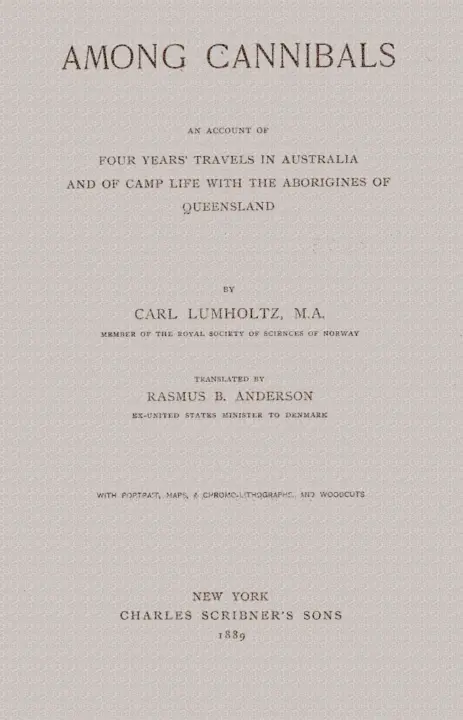
Among Cannibals: An Account of Four Years’ Travels in Australia and of Camp Life With the Aborigines of Queensland
Carl Lumholtz
THE CLASSIC COLLECTION · 1920
"Through Central Borneo" by Carl Lumholtz is an ethnographic and travel account written during the early 20th century. The book chronicles Lumholtz's journey through the largely uncharted territories of Borneo between 1913 and 1917, focusing on his interactions with various indigenous tribes, including the headhunting cultures of the Dayaks. The narrative provides insights into the sociocultural dynamics, flora, and fauna of the region while reflecting on the broader themes of civilization versus primitivism, showcasing Lumholtz's admiration for the perceived simplicity and richness of life among the “savages” he encounters. The opening of the book introduces readers to Lumholtz's ambitious expedition and sets the stage for his explorations. After receiving funding and planning the journey, he embarks on a race against time to catch a glimpse of the eastern territories before the outbreak of World War I alters his plans. He shares vivid impressions of his travels through Japan and Singapore, before arriving at Batavia, Java, where he expresses eagerness for his forthcoming adventures in Borneo. This segment establishes the purpose of his expedition, which includes research on various tribes, specimen collection, and observation of the natural environment, immediately immersing readers in his adventurous spirit and anticipation of discovery in the unknown lands of Borneo.
Introduction adapted from the source catalogue; source summaries may be automatically generated.
Free to read · English · 131,369 words · No account needed
MAKE TIME FOR A GOOD BOOK
On by default. Untick to stop anonymous reading totals. Each page counts after 10 seconds in view. How this works.
Anonymous counting is on unless you have switched it off.
Other tribes speak of three souls. The Kenyahs, according to Dr. J.M. Elshout, have only one brua, located at times in the head, at times in the heart; and the tiger-cat and the orang-utan have stronger brua than man. The Katingans likewise recognise but one, called liao in life, and after death. They also give the same name to the soul of an animal, but the more common usage in the tribes is to call the ghost liao, by the Malays named njava.
In regard to the practice of incision, which is used in Southwest Borneo, Chapter XXXV, I am able to furnish some details gathered in Sampit from three Dayaks who had been operated upon. A cut is made in the praeputium lengthwise with a knife (further east a sharpened bamboo is used), a piece of iron wood being used as a support, and the operation which in Katingan is called habálak is performed by the father of the father's brother when the boy is coming of age. Before the event he must go into the river up to his navel seven days in succession, morning, midday, and evening, and stand in the water for an hour. All boys must undergo the operation, which is not sanguinary, the leaves of a tree called mentawa being applied to the wound. They could give no reason why they follow this practice any more than the ordinary Dayak can explain the purpose of tatuing.
With the Kayans, and, indeed, all the tribes I met in Dutch Borneo, it is the custom to urinate in a sitting position.
To the observer it is strikingly evident that the mammae of both Dayak and Malay women retain firmness and shape much longer than is the case with white women.
adat, precept, regulation, religious observance. antoh, spirit, good or evil. atap, a shelter, consisting of a mat resting on upright saplings, often erected in the boats on long journeys.
babi, pig.
badak, rhinoceros.
balei, a general name for a house of worship.
barang, goods, things, belongings.
blanga, large, valuable jar, usually of Chinese manufacture.
blian, priest-doctor.
bom, custom-house.
brua, soul.
chavat, loin-cloth.
company (the), the government.
cranyang, basket.
damar, resin.
gutshi, large jar.
inlander, native.
ipoh, poison for the dart of the blowpipe, also the tree from
which it is secured (the upas tree).
kali, river.
kampong, native village.
kapala, chief (= pumbakal).
kidyang, a small kind of deer.
kiham, rapids.
kuala, mouth of a river.
ladang, paddi field.
laki, man, male.
lombok, red pepper.
mandau, Dayak short sword (= parang).
mandur, overseer.
nagah, fabulous animal, the apparition of a spirit.
onder, native subdistrict chief.
orang, man.
Your reading position is saved on this browser. Take it to another device with a library code. Reading pages adapt to text, rather than matching a printed edition.
BEHIND THE BOOK
This eBook is for the use of anyone anywhere in the United States and most other parts of the world at no cost and with almost no restrictions whatsoever. You may copy it, give it away or re-use it under the terms of the Project Gutenberg License included with this eBook or online at www.gutenberg.org. If you are not located in the United States, you will have to check the laws of the country where you are located before using this eBook. Read the source licence.
The original source file, including credits and licence, is retained by this library. Request an original-format copy at no charge. Please include the book title and Project Gutenberg identifier #7489.
KEEP YOUR CURIOSITY GOING
Wilfrid Scawen Blunt
Wilfrid Scawen Blunt

E. W. (Edgar Watson) Howe
Cécile Tormay

Moritz Busch
John L. Ransom