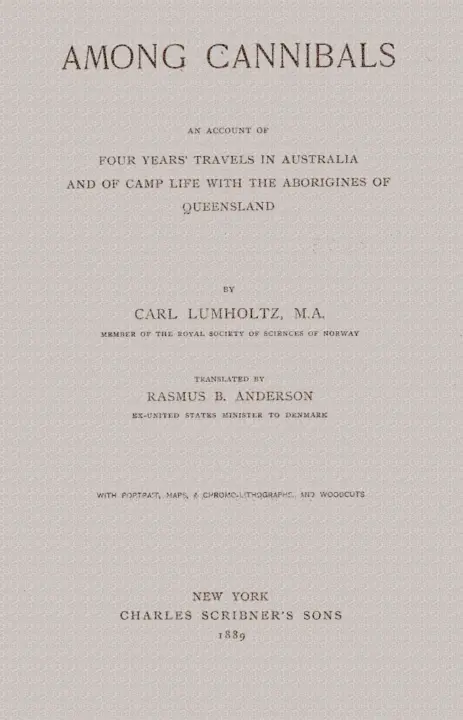
Among Cannibals: An Account of Four Years’ Travels in Australia and of Camp Life With the Aborigines of Queensland
Carl Lumholtz
THE CLASSIC COLLECTION · 1920
"Through Central Borneo" by Carl Lumholtz is an ethnographic and travel account written during the early 20th century. The book chronicles Lumholtz's journey through the largely uncharted territories of Borneo between 1913 and 1917, focusing on his interactions with various indigenous tribes, including the headhunting cultures of the Dayaks. The narrative provides insights into the sociocultural dynamics, flora, and fauna of the region while reflecting on the broader themes of civilization versus primitivism, showcasing Lumholtz's admiration for the perceived simplicity and richness of life among the “savages” he encounters. The opening of the book introduces readers to Lumholtz's ambitious expedition and sets the stage for his explorations. After receiving funding and planning the journey, he embarks on a race against time to catch a glimpse of the eastern territories before the outbreak of World War I alters his plans. He shares vivid impressions of his travels through Japan and Singapore, before arriving at Batavia, Java, where he expresses eagerness for his forthcoming adventures in Borneo. This segment establishes the purpose of his expedition, which includes research on various tribes, specimen collection, and observation of the natural environment, immediately immersing readers in his adventurous spirit and anticipation of discovery in the unknown lands of Borneo.
Introduction adapted from the source catalogue; source summaries may be automatically generated.
Free to read · English · 131,369 words · No account needed
MAKE TIME FOR A GOOD BOOK
On by default. Untick to stop anonymous reading totals. Each page counts after 10 seconds in view. How this works.
Anonymous counting is on unless you have switched it off.
Bakompai, the;
characteristics of
Balei, the (house of worship)
Bali
Balik Papan, oil-producing centre
Balok tribe, the
Bamboo, abundance of, in Borneo;
sumpitan darts carried in cases made of;
food cooked in;
uses of split;
tent protected by;
bandage made from;
baskets
Banana, rice wrapped in leaves of;
omens taken with leaves
Bandjermasin, population of;
founding of;
principal town in Dutch Borneo;
meaning of the name;
the hotel in;
climate of;
church and museum in;
Protestant and Catholic missionaries in;
departure for;
return to;
epidemic of cholera at;
final start from;
a journey through the country northeast of;
the cats and dogs in
Bangkal, natives from;
different tribes in;
the Tamoans of;
epidemic of cholera at
Banglan, fight of, with crocodile
Bangsul, boatman
Banquet, given by controleur at Sampit
Baren, Controleur, heads presented to
Barito River, the;
the journey up;
rapids of
Basap tribe, the
Baskets, bamboo, designs on
Batavia, arrival at;
departure from;
return to;
Hindu statues presented to museum at
Bathing, in the tropics;
frequent, of natives;
a visit from native women at time for
Batokelau
Bato-Pola tribe, the
Bats, in the jungle;
in caves of Kong Beng
Batu Boa
Bayumbong
Beads, necklaces of;
cradle decorated with;
valuable old
Bear;
as food;
strange animal resembling;
gall of, used as medicine
Beards, on natives
Bees
Belimbing, village of
Berg, Dr. Afred
Berger, Mr., experience of, with ironwood floors
Beri-beri;
green peas used to counteract;
polished rice as cause of;
curing of crew of Kronprinz Wilhelm stricken with;
epidemic of, at Sembulo;
in prison at Sampit
Beringan, the pasang grahan at;
elevation at
Betel, chewing of;
betel box on kapatongs
Biha, the Murungs at
Birds, of Borneo;
kept in houses;
caught in snares;
worship of;
antoh called and fed by;
seen along Busang River;
argus pheasant;
hornbills;
omen;
the punai;
white-tail pheasant;
the raja;
snake;
the teong;
Mrs. Meyer's collection of;
folktales about
Blacksmiths, Dayaks, skilful;
art of, dying out among Saputans
Blangas, valuable old
Blarey, Penihing chief
Blatei River, the
Blians (priest-doctors), male and female;
possessed by good antohs;
constant occupation of;
shield of;
dress of Murung;
dance of;
among the Penyahbongs;
Saputan belief in;
at great triennial festival;
rice-throwing by;
march of;
funeral of;
methods practised by, for cure of disease;
singing of;
juggling of;
the usual remuneration of;
wooden statues used by Murung
Blood of sacrificed animals,
smeared on principals of any feast or ceremony;
on kapatongs;
on stones;
at marriage ceremony;
at rice-planting;
at harvest feast
Blow-pipe. See Sumpitan
Blu River, the
Boat, native keelless. See also Prahu.
Your reading position is saved on this browser. Take it to another device with a library code. Reading pages adapt to text, rather than matching a printed edition.
BEHIND THE BOOK
This eBook is for the use of anyone anywhere in the United States and most other parts of the world at no cost and with almost no restrictions whatsoever. You may copy it, give it away or re-use it under the terms of the Project Gutenberg License included with this eBook or online at www.gutenberg.org. If you are not located in the United States, you will have to check the laws of the country where you are located before using this eBook. Read the source licence.
The original source file, including credits and licence, is retained by this library. Request an original-format copy at no charge. Please include the book title and Project Gutenberg identifier #7489.
KEEP YOUR CURIOSITY GOING
Wilfrid Scawen Blunt
Wilfrid Scawen Blunt

E. W. (Edgar Watson) Howe
Cécile Tormay

Moritz Busch
John L. Ransom