
Last letters from the living dead man
David Patterson (Spirit) Hatch
THE CLASSIC COLLECTION · 1921
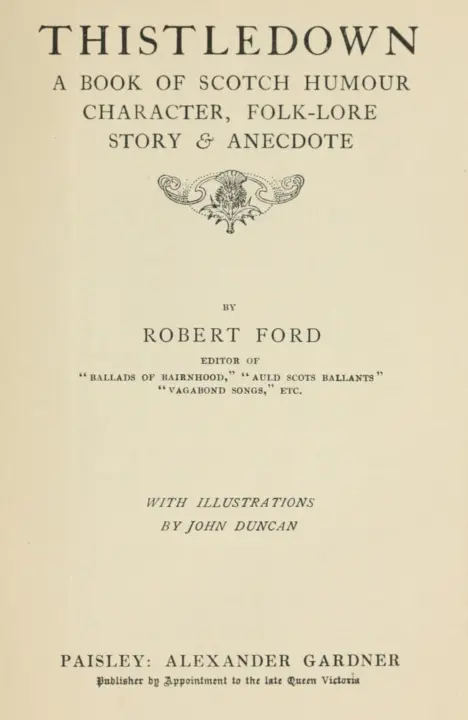
"Thistledown: A Book of Scotch Humour, Character, Folk-lore, Story & Anecdote" by Robert Ford is a collection of humorous essays and anecdotes reflecting Scottish culture and character, likely written in the late 19th century. The work delves into various aspects of Scottish life, capturing the quirks and nuances of the Scottish tongue, and showcasing the unique blend of pathos and humor inherent to the people. Through a wide range of stories, it aims to provide not just laughter but also insight into the heart of Scottish identity. The opening of the book establishes the significance of the Scottish language, asserting that its richness and expressiveness are vital to understanding Scotland’s history and culture. Ford argues against the idea that the language is fading from the upper echelons of society, emphasizing that humor is ingrained in the Scottish character, appearing in the most unexpected places and situations. He introduces anecdotes that illustrate the intricacies of dialects across Scotland, highlighting both the charm and the humor found in its everyday use. As he lays the groundwork for the themes of the book, Ford positions Scotch humour not just as a source of entertainment but as a reflection of the nation’s spirit and resilience.
Introduction adapted from the source catalogue; source summaries may be automatically generated.
Free to read · English · 111,279 words · No account needed
MAKE TIME FOR A GOOD BOOK
On by default. Untick to stop anonymous reading totals. Each page counts after 10 seconds in view. How this works.
Anonymous counting is on unless you have switched it off.
“There is good whusky, and there is better whusky,” said an old Highlander, “but there never yet was bad whusky.” Many Lowlanders act as if they held the same opinion.
“You’re just a sot, man, John,” once said a wife to her tippling husband; “ye ha’e drucken a hoose in your time.”
“Ah, weel, Kate, I think its been a thack ane,” was the reply; “an’ there’s some o’ the stoure in my throat yet.”
“It’s an awful thing that drink,” exclaimed a clergyman, when the barber, who was visibly affected, had drawn blood from his face for the third time.
“Ay,” replied the tonsorial artist, with a wicked leer in his eye, “it mak’s the skin tender.”
Told that whisky was a slow poison; “It maun be awfu’ slow, then,” said an old veteran, “for I’ve toothfu’d an’ toothfu’d awa’ at it this saxty year, an’ I’m aye livin’ yet.”
Neil Gow honestly declared that, when in a certain condition, “it wasna the length o’ the road, but the breadth o’t,” that bothered him. Another, “wha leeward whiles against his will” was taking “a bicker,” on being asked by a passing acquaintance if he was getting home, eloquently replied in the word, “Whiles.”
“You are reeling, Janet,” remarked a country parson, meeting one of his parishioners carrying more sail than ballast, as a preliminary to lecturing her on the evils of her conduct.
“Troth, an’ I canna aye be spinnin’, sir,” returned she, casting anchor in the middle of the road, and leering blandly up into the face of her interrogator.
“You do not seem to catch my meaning clearly, Janet,” continued the divine. “Do you know where drunkards, go?”
“Indeed, they generally gang whaur they get the whisky cheapest and best,
sir.”
“Yes, Janet, but there is another place where they go. They go where there is weeping and wailing and gnashing of teeth.”
“Humph!” sneered the case-hardened old sinner. “They can gnash teeth that have teeth to gnash. I hav’na had but a’e stump this forty year.”
A Perthshire village tradesman, recently deceased, as a rule “took a drappie mair than was gude for him” when he visited the county town. Indeed, he occasionally got “on the batter” and did not return home until after the lapse of several days. Returning from one of these “bouts” his wife met him in the door with the question, “Whaur ha’e ye been a’ this time?”
“Perth,” was the sententious reply.
Your reading position is saved on this browser. Take it to another device with a library code. Reading pages adapt to text, rather than matching a printed edition.
BEHIND THE BOOK
This eBook is for the use of anyone anywhere in the United States and most other parts of the world at no cost and with almost no restrictions whatsoever. You may copy it, give it away or re-use it under the terms of the Project Gutenberg License included with this eBook or online at www.gutenberg.org. If you are not located in the United States, you will have to check the laws of the country where you are located before using this eBook. Read the source licence.
The original source file, including credits and licence, is retained by this library. Request an original-format copy at no charge. Please include the book title and Project Gutenberg identifier #67576.
KEEP YOUR CURIOSITY GOING
David Patterson (Spirit) Hatch

David Patterson (Spirit) Hatch

David Patterson (Spirit) Hatch

Ralph Waldo Emerson

Maurice Baring

Oscar Wilde & James McNeill Whistler