
Last letters from the living dead man
David Patterson (Spirit) Hatch
THE CLASSIC COLLECTION · 1921
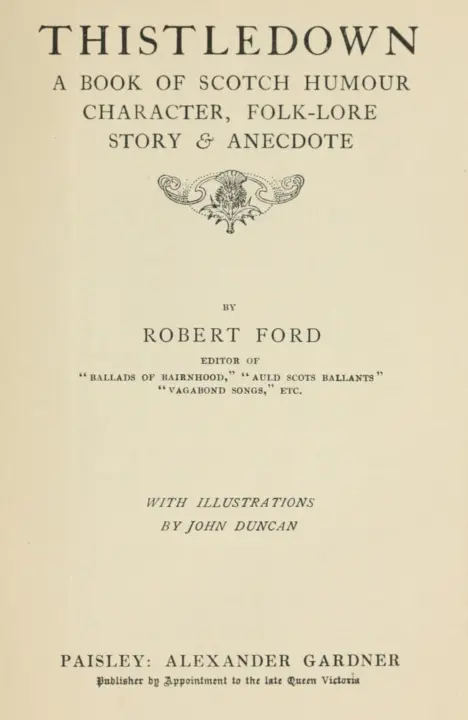
"Thistledown: A Book of Scotch Humour, Character, Folk-lore, Story & Anecdote" by Robert Ford is a collection of humorous essays and anecdotes reflecting Scottish culture and character, likely written in the late 19th century. The work delves into various aspects of Scottish life, capturing the quirks and nuances of the Scottish tongue, and showcasing the unique blend of pathos and humor inherent to the people. Through a wide range of stories, it aims to provide not just laughter but also insight into the heart of Scottish identity. The opening of the book establishes the significance of the Scottish language, asserting that its richness and expressiveness are vital to understanding Scotland’s history and culture. Ford argues against the idea that the language is fading from the upper echelons of society, emphasizing that humor is ingrained in the Scottish character, appearing in the most unexpected places and situations. He introduces anecdotes that illustrate the intricacies of dialects across Scotland, highlighting both the charm and the humor found in its everyday use. As he lays the groundwork for the themes of the book, Ford positions Scotch humour not just as a source of entertainment but as a reflection of the nation’s spirit and resilience.
Introduction adapted from the source catalogue; source summaries may be automatically generated.
Free to read · English · 111,279 words · No account needed
MAKE TIME FOR A GOOD BOOK
On by default. Untick to stop anonymous reading totals. Each page counts after 10 seconds in view. How this works.
Anonymous counting is on unless you have switched it off.
We are frequently told—and now and again receive unwelcome scraps of evidence in confirmation of the scandal—that our dear old mother tongue is falling into desuetude in our native land. Already, it must be confessed, it has been abrogated from the drawing-rooms of the ultra-refined upper circles of Scottish society. The snobbish element amongst the great middle-class, ever prone to imitate their “betters,” affect not to understand it, and blush (the sillier of them) when, in an unguarded moment, a manifest Scotticism slips into their conversation. There is a portion of the semi-educated working population, again, who, imitating the snobbish element of the middle grade, speak Scotch freely only in their working clothes. On Sundays, and extra occasions, when dressed in their very best, there is just about as much Scotch in their talk as will show one how poorly they can speak English, and just about enough English to render their Scotch ridiculous. Observing all this, and taking it in conjunction with the other denationalising tendencies of the age, there are those who predict that the time is not far distant when Burns’s poems, Scott’s novels, and Hogg’s tales will be sealed books to the partially educated Scotsman. That there is a growing tendency in the direction indicated is quite true, but the disease, I believe, is only skin deep as yet, and the bone and sinew of the country remain quite unaffected. That there will be a sudden reaction in the patient must be the sincere desire of every patriotic Scot. If the prediction of obsoletism is ever to be realized, then, “the mair’s the pity.” Scotland will not stand where she did. For very much—oh, so much—of what has made her glorious among the nations of the world will have passed away, taking the sheen of her glory with it. What Scotsmen, as Scotsmen, should ever prize most is bound up inseparably with the native language. Ours is a matured country, and the stirring scenes of her history on which the mind of the individual delights to dwell, are so frequently enshrined in spirited ballad and song, couched in the pithy Scottish vernacular, that, to suppose these latter dead—they are not translatable into English—is to suppose the best part of Scottish history dead and buried beyond the hope of resurrection. For its own sake alone the Scottish tongue is eminently deserving of regard—of cultivation and preservation. Scotsmen should be—and so all well-conditioned Scotsmen surely are—as proud of their native tongue as they are of their far-famed native bens and glens. For why, the rugged grandeur of the physical features of our country are not more worthy of admiration than the language in which their glories have been most fittingly extolled. They have characteristics in common; for rugged grandeur is as truly a feature of the Scottish language as it is the dominant feature of Scottish scenery. True, its various dialects are somewhat tantalising. The Forfar man is vividly identified by his “foo’s” and his “fa’s,” and his “fat’s” and his “fans”; and the Renfrewshire man by his “weans,” his “wee weans,” and his “yin pound yin and yinpence,” etc. Taking a simple phrase as an example—(Anglice):—“The spoon is on the loom.” The Aberdonian will tell you that “The speen’s on the leem.” The Perthshire man will say “That spun’s on the luim”; and the Glasgow citizen will inform you that “The spin’s on the lim.” In a fuller example, a Renfrewshire person will vouchsafe the information that he “Saw a seybo synd’t doon the syvor till it sank in the stank.” A native of Perthshire will only about half understand what the speaker has said, and may threaten to “rax a rung frae the boggars o’ the hoose and reeshil his rumple wi’t,” without sending terror to the soul of his West country confederate. Latterly, an Aberdonian may come on the scene and ask, “Fa’ fuppit the loonie?” and neither of the forenamed parties will at once perceive the drift of his inquiry. To illustrate how difficult it may be for the East and the West to understand each other, I will tell a little story. An Aberdonian not long ago got work in Glasgow where they used a quantity of tar, and was rather annoyed to see his fellow-workmen wash the tar off their hands while he washed and rubbed at his in vain. His patience could stand it no longer, and going up to the foreman, and, stretching out his hands, he asked:—“Fat’ll tak’ it aff?” “Yes,” replied the foreman, “fat’ll tak’ it aff.” “Fat’ll tak’ it aff?” “Yes, I said fat would tak’ it aff.” “But fat’ll tak’ it aff?” persisted the Aberdonian. The foreman pointed to a tub, and roared: “Grease, you stupid eediot!” “Weel than,” retorted the Aberdonian, “an’ fat for did you no say that at first?”
Your reading position is saved on this browser. Take it to another device with a library code. Reading pages adapt to text, rather than matching a printed edition.
BEHIND THE BOOK
This eBook is for the use of anyone anywhere in the United States and most other parts of the world at no cost and with almost no restrictions whatsoever. You may copy it, give it away or re-use it under the terms of the Project Gutenberg License included with this eBook or online at www.gutenberg.org. If you are not located in the United States, you will have to check the laws of the country where you are located before using this eBook. Read the source licence.
The original source file, including credits and licence, is retained by this library. Request an original-format copy at no charge. Please include the book title and Project Gutenberg identifier #67576.
KEEP YOUR CURIOSITY GOING
David Patterson (Spirit) Hatch

David Patterson (Spirit) Hatch

David Patterson (Spirit) Hatch

Ralph Waldo Emerson

Maurice Baring

Oscar Wilde & James McNeill Whistler