
Last letters from the living dead man
David Patterson (Spirit) Hatch
THE CLASSIC COLLECTION · 1921
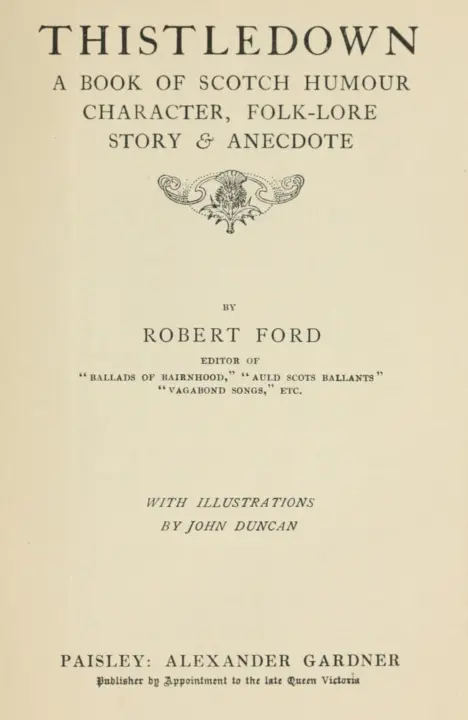
"Thistledown: A Book of Scotch Humour, Character, Folk-lore, Story & Anecdote" by Robert Ford is a collection of humorous essays and anecdotes reflecting Scottish culture and character, likely written in the late 19th century. The work delves into various aspects of Scottish life, capturing the quirks and nuances of the Scottish tongue, and showcasing the unique blend of pathos and humor inherent to the people. Through a wide range of stories, it aims to provide not just laughter but also insight into the heart of Scottish identity. The opening of the book establishes the significance of the Scottish language, asserting that its richness and expressiveness are vital to understanding Scotland’s history and culture. Ford argues against the idea that the language is fading from the upper echelons of society, emphasizing that humor is ingrained in the Scottish character, appearing in the most unexpected places and situations. He introduces anecdotes that illustrate the intricacies of dialects across Scotland, highlighting both the charm and the humor found in its everyday use. As he lays the groundwork for the themes of the book, Ford positions Scotch humour not just as a source of entertainment but as a reflection of the nation’s spirit and resilience.
Introduction adapted from the source catalogue; source summaries may be automatically generated.
Free to read · English · 111,279 words · No account needed
MAKE TIME FOR A GOOD BOOK
On by default. Untick to stop anonymous reading totals. Each page counts after 10 seconds in view. How this works.
Anonymous counting is on unless you have switched it off.
“Yes, yes, my friend, but if whisky administered to him in any quantity
will not cure him?”
“Ou, weel, then, sir,” gravely replied the roadman, “if whisky winna cure a man, he’s no worth curin’, an’ may weel be latten slip.”
Oh, they had sublime confidence in the “dram” as a revivifying agent, and no mistake about it! Indeed, it was regarded in some quarters as a necessity to existence. And “be carefu’ o’ the mercies” was a stock phrase relating to it. The Highlander, content to pray for “a mountain of snuff,” wanted “oceans o’ whisky.” It was called in to act as “an eye-opener,” and to serve also as “a night-cap.”
So regularly had a certain Scotch laird used it in the latter capacity, that once in his lifetime—so he said himself—he “got an awfu’ fricht.” “We ran short o’ the mercies,” said he, “and I had to gang to my bed sober. I dinna feel ony the waur the day; but, Lodsake, man, I got an awfu’ fricht.”
A well-known Scotch laird of the old school, Dean Ramsay tells us, expressed himself with great indignation when someone charged hard drinking with having actually killed people. “Na, na,” said he; “I never knew onybody that was killed wi’ drinking, but I hae kenned some that dee’d in the training.”
So have we all, laird—a great many! And yet the students have been numerous and persistent. That Highlander who, when the minister shook his reverend head towards him, and said, “Whisky is a bad, bad thing, Donald,” replied, “Ay, sir, especially bad whisky,” thought, no doubt, that he had made a concession in opinion that would greatly mollify his clerical mentor. Many of your tipplers possessed a rough and ready wit, and from that fact no little humour has sprung. A Perthshire blacksmith, whom I myself knew intimately, was once remonstrated with by the Free Church minister who lived near by anent his frequent and excessive indulgences.
“Was ye ever drunk, sir?” inquired the smith.
“No, Donald,” said the minister, “I am glad to say I never was.”
“I thocht as muckle,” said the smith; “for, man, if ye was ance richt drunk, ye wad never like to be sober a’ your days again.”
“There’s death in the cup!” exclaimed a violent teetotal lecturer as he rushed up to where an old farmer was carefully toning his dram with water from a huge decanter. More of the pura had flowed forth than was intended, and eyeing his glass critically, “Hech, an’ I think ye’re richt, freend,” was the response, “for I’ve droon’d the miller.”
Your reading position is saved on this browser. Take it to another device with a library code. Reading pages adapt to text, rather than matching a printed edition.
BEHIND THE BOOK
This eBook is for the use of anyone anywhere in the United States and most other parts of the world at no cost and with almost no restrictions whatsoever. You may copy it, give it away or re-use it under the terms of the Project Gutenberg License included with this eBook or online at www.gutenberg.org. If you are not located in the United States, you will have to check the laws of the country where you are located before using this eBook. Read the source licence.
The original source file, including credits and licence, is retained by this library. Request an original-format copy at no charge. Please include the book title and Project Gutenberg identifier #67576.
KEEP YOUR CURIOSITY GOING
David Patterson (Spirit) Hatch

David Patterson (Spirit) Hatch

David Patterson (Spirit) Hatch

Ralph Waldo Emerson

Maurice Baring

Oscar Wilde & James McNeill Whistler