
Last letters from the living dead man
David Patterson (Spirit) Hatch
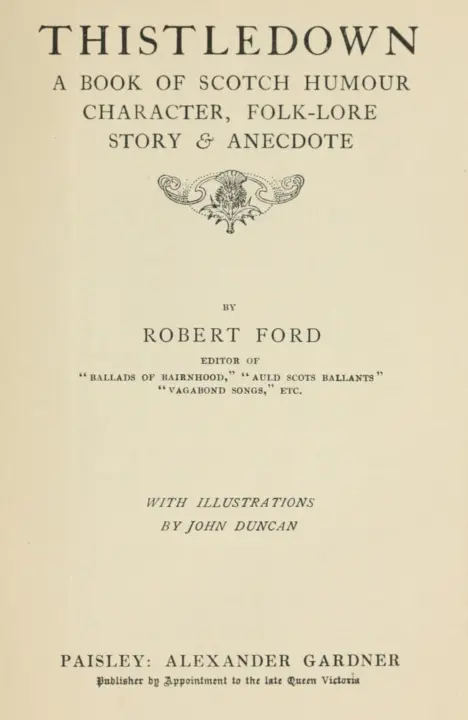
THE CLASSIC COLLECTION · 1921
"Thistledown: A Book of Scotch Humour, Character, Folk-lore, Story & Anecdote" by Robert Ford is a collection of humorous essays and anecdotes reflecting Scottish culture and character, likely written in the late 19th century. The work delves into various aspects of Scottish life, capturing the quirks and nuances of the Scottish tongue, and showcasing the unique blend of pathos and humor inherent to the people. Through a wide range of stories, it aims to provide not just laughter but also insight into the heart of Scottish identity. The opening of the book establishes the significance of the Scottish language, asserting that its richness and expressiveness are vital to understanding Scotland’s history and culture. Ford argues against the idea that the language is fading from the upper echelons of society, emphasizing that humor is ingrained in the Scottish character, appearing in the most unexpected places and situations. He introduces anecdotes that illustrate the intricacies of dialects across Scotland, highlighting both the charm and the humor found in its everyday use. As he lays the groundwork for the themes of the book, Ford positions Scotch humour not just as a source of entertainment but as a reflection of the nation’s spirit and resilience.
Introduction adapted from the source catalogue; source summaries may be automatically generated.
Free to read · English · 111,279 words · No account needed
MAKE TIME FOR A GOOD BOOK
On by default. Untick to stop anonymous reading totals. Each page counts after 10 seconds in view. How this works.
Anonymous counting is on unless you have switched it off.
“Here lie the bones
O’ Tonald Jones,
The wale o’ men
For eating scones.
Eating scones
And drinking yill,
Till his last moans
He took his fill.”
In the kirkyard of Horncliffe, on the Tweed, may be seen:—
“Here lies the Horner of Horncliffe,
Puir Tam Gordon, cauld and stiff,
Wha in this narrow hole was puttin
For his lawless love of wedder mutton.”
There is a neatly expressed compliment to the memory of a dead wife in these lines, said to be copied from a gravestone in Meigle:—
“She was—but words are wanting,
To say what.
Think what a wife should be—
She was that.”
The writer of William Mathieson’s epitaph, in the West Churchyard, Tranent, was not nearly so happy in his diction. It runs limpingly thus:—
“William Matthison here lies,
Whose age was forty-one;
February seventeenth he dies,
Went Is’bel Mitchell from.
Who was his married wife,
The fourth part of his life.
The soul it cannot die,
Tho’ th’ body be turn’d to clay;
Yet meet again must they
At the last day.
Trumpets shall sound, archangels cry,
Come forth Is’bel Mitchell and meet
William Matthison in the sky.”
Seldom has there been a better excuse for an epitaph than appears in the following, from the burial-place of Inchchapel, near Montrose:—
“Janet Milne, spouse to James Lurie, her Monument.
We do this for no other end
But that our Burial may be ken’d.”
These, though the choicest specimens of their kind, form not more than a tithe of the humorous and curious epitaphs which are readily accessible to the writer. But—though we have not laughed once irreverently—perhaps, my reader, we have laughed long enough over the “cauld clay biggin’s” of gloomy Death, where rests in awful solemnity much that is sainted and sacred to us both. No more, then.
A’ a’e oo, 16
Aberdeenshire woman’s affliction, 38
A dangerous case o’ typhus, 83
A day in the desk, 160
A fearfu’ sermon, 95
A fisher of men, 98
Ainslie, Hew, quoted, 27
Airlie, Earl of, 62, 238
Alexander, Dr. William Lindsay, 138
Also, but not likewise, 292
Anderson, Dr. William, 57, 80, 84
And the Lord said unto Moses, 60
Another glass and then, 62
An awfu’ fricht, 175
A pig in the bed, 213
Arbroath epitaph, 448
Are yer aits muckle bookit? 214
As it is in the original, 94
A week before the sun went doon, 209
A well-corrected mistake, 155
Auld, Dr., 378
Auld lang syne, 15
dune up in tartan, 245
Awfu’ wark; they’re just killin’ ane anither ower there, 35
Aytoun, Professor, 267, 269
Ballantyne, Mrs., 260
Balquhidder epitaph, 448
Balnamoon and the brock, 49
Banffshire epitaph, 444
Bannockburn, Story of the battle of, 201
Baptismal customs, 346
Baptisms, Stories about, 86, 107, 108
Barbour, Sheriff, 297
Bargaig, Lord, 295
Barebones’ first day in the desk, 158
Your reading position is saved on this browser. Take it to another device with a library code. Reading pages adapt to text, rather than matching a printed edition.
BEHIND THE BOOK
This eBook is for the use of anyone anywhere in the United States and most other parts of the world at no cost and with almost no restrictions whatsoever. You may copy it, give it away or re-use it under the terms of the Project Gutenberg License included with this eBook or online at www.gutenberg.org. If you are not located in the United States, you will have to check the laws of the country where you are located before using this eBook. Read the source licence.
The original source file, including credits and licence, is retained by this library. Request an original-format copy at no charge. Please include the book title and Project Gutenberg identifier #67576.
KEEP YOUR CURIOSITY GOING
David Patterson (Spirit) Hatch

David Patterson (Spirit) Hatch

David Patterson (Spirit) Hatch

Ralph Waldo Emerson

Maurice Baring

Oscar Wilde & James McNeill Whistler