
Last letters from the living dead man
David Patterson (Spirit) Hatch
THE CLASSIC COLLECTION · 1921
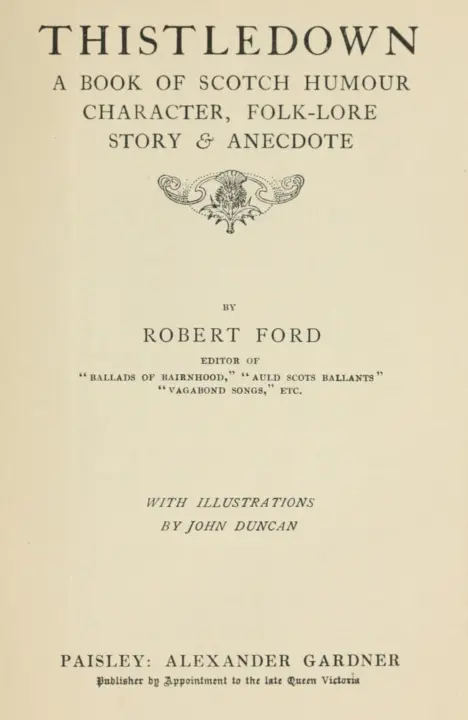
"Thistledown: A Book of Scotch Humour, Character, Folk-lore, Story & Anecdote" by Robert Ford is a collection of humorous essays and anecdotes reflecting Scottish culture and character, likely written in the late 19th century. The work delves into various aspects of Scottish life, capturing the quirks and nuances of the Scottish tongue, and showcasing the unique blend of pathos and humor inherent to the people. Through a wide range of stories, it aims to provide not just laughter but also insight into the heart of Scottish identity. The opening of the book establishes the significance of the Scottish language, asserting that its richness and expressiveness are vital to understanding Scotland’s history and culture. Ford argues against the idea that the language is fading from the upper echelons of society, emphasizing that humor is ingrained in the Scottish character, appearing in the most unexpected places and situations. He introduces anecdotes that illustrate the intricacies of dialects across Scotland, highlighting both the charm and the humor found in its everyday use. As he lays the groundwork for the themes of the book, Ford positions Scotch humour not just as a source of entertainment but as a reflection of the nation’s spirit and resilience.
Introduction adapted from the source catalogue; source summaries may be automatically generated.
Free to read · English · 111,279 words · No account needed
MAKE TIME FOR A GOOD BOOK
On by default. Untick to stop anonymous reading totals. Each page counts after 10 seconds in view. How this works.
Anonymous counting is on unless you have switched it off.
The following quaint inscription, copied from the Abbey of Melrose, consecrated in 1146, is of much historical value. From it, it would appear that one John Murdo superintended most of the ancient ecclesiastical edifices in Scotland:—
“John Murdo some tym callit was I,
And born in Parysse certainly,
And had in kepying all mason werk
Of Sanctandroys, the hye kyrk
Of Glasgu, Melros, and Paslay,
Of Nyddysdale, and of Galway,
Pray to God, and Mari baith,
And sweet St. John, keep this holy kyrk fra skaith.”
In Forfar cemetery we find:—
“’Tis here that Tibby Allan lies,
’Tis here, or here about,
But no one till the Resurrection day,
Shall the very spot dispute.”
Loch Ranza has this:—
“Here lies Donald and his wife,
Janet M’Fee;
Aged 40 hee,
Aged 30 shee.”
In the Necropolis of Glasgow, which is separated from the Cathedral and its olden cemetery by the Molendinar Burn, stands a plain stone with the grave warning:—
“Stranger, as you pass o’er the grass,
Think seriously, with no humdrumming,
Prepare for death, for judgment’s coming.”
In the same place may be seen:—
“Here lies Mess Andrew Gray,
Of whom ne muckle good can i say
He was ne Quaker, for he had ne spirit;
He was ne Papist, for he had ne merit;
He was ne Turk, for he drank muckle wine;
He was ne Jew, for he eat muckle swine;
Full forty years he preached and leed,
For which God doomed him when he deed.”
The subject of the next epitaph, owing to her bravery at the battle of Ancrum Moor, is celebrated in heroic verse still to be seen in a country churchyard in Roxburghshire:—
“Fair Maiden Lilliard lies under this stane, Little was her stature, but great was her fame; Upon the English louns she laid many thumps, And when her legs were cutted off she fought upon her stumps.”
In the churchyard of Hoddam is found:—
“Here lyes a man, who all his mortal life Past mending clocks, but could not mend his wyfe, The ’larum of his bell was ne’er sae shrill As was her tongue—aye clacking like a mill. But now he’s gane—oh! whither nane can tell— I hope beyond the sound o’ Mally’s bell.”
Over the last lair of a Glasgow magistrate there is written:—
“Here lyes—read it with your hats on—
The bones of Bailie William Watson,
Who was famous for his thinking,
And moderation in his drinking.”
The following has been deciphered from an inscription on a tombstone in
Skye:—
Your reading position is saved on this browser. Take it to another device with a library code. Reading pages adapt to text, rather than matching a printed edition.
BEHIND THE BOOK
This eBook is for the use of anyone anywhere in the United States and most other parts of the world at no cost and with almost no restrictions whatsoever. You may copy it, give it away or re-use it under the terms of the Project Gutenberg License included with this eBook or online at www.gutenberg.org. If you are not located in the United States, you will have to check the laws of the country where you are located before using this eBook. Read the source licence.
The original source file, including credits and licence, is retained by this library. Request an original-format copy at no charge. Please include the book title and Project Gutenberg identifier #67576.
KEEP YOUR CURIOSITY GOING
David Patterson (Spirit) Hatch

David Patterson (Spirit) Hatch

David Patterson (Spirit) Hatch

Ralph Waldo Emerson

Maurice Baring

Oscar Wilde & James McNeill Whistler