
Last letters from the living dead man
David Patterson (Spirit) Hatch
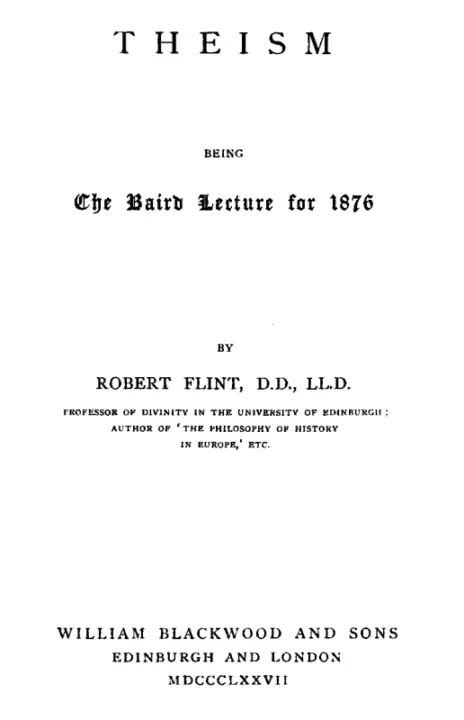
THE CLASSIC COLLECTION · 1877
"Theism; Being the Baird Lecture of 1876" by Robert Flint is a religious philosophical treatise written in the late 19th century. The work delves into the nature and validity of belief in God, exploring whether theism can be rationally justified over anti-theistic theories. Flint highlights the importance of understanding the nature of God as a self-existent, perfect being and the implications of belief in God on morality and society. The opening of this volume introduces significant questions regarding the rationality of religious belief. Flint posits that the inquiry should explore the existence of a divine being and whether such belief is justified. He emphasizes that religious belief must be rooted in knowledge, not mere feelings, and lays the groundwork for a thorough examination of theistic proofs by discussing the historical and philosophical context of theism. Flint argues that a worldview devoid of a divine entity ultimately deprives religious experiences of truth and meaning, leading to the idea that all human thought and morality is interconnected with the existence of God.
Introduction adapted from the source catalogue; source summaries may be automatically generated.
Free to read · English · 107,012 words · No account needed
MAKE TIME FOR A GOOD BOOK
On by default. Untick to stop anonymous reading totals. Each page counts after 10 seconds in view. How this works.
Anonymous counting is on unless you have switched it off.
The mere existence of originated minds necessarily implies the existence of an unoriginated mind. "What can be more absurd," asks Montesquieu, "than to imagine that a blind fatalistic force has produced intelligent beings?" The complicated and refined adjustments of the body to the mind, and of the mind to the body, are so numerous and interesting that their study has now become the task of a special class of scientific men. A very little disorder in the organisation of the brain--such as even microscopic post-mortem examination may fail to detect--suffices to cause hallucinations of the senses, to shake intellect from its throne, to paralyse the will, and to corrupt the sentiments and affections. How precise and skilful must the adjustment be between the sound brain and sane mind! Who sufficiently realises the mystery of wisdom which lies in the familiar fact that the mind, by merely willing to use the members of the body, sets in motion instantaneously and unconsciously, without effort and without failure, cords and pulleys and levers, joints and muscles, of which it only vaguely, if at all, surmises the existence? The laws of our various appetencies, affections, and emotions, and their relations to their special ends or objects, the nature of the several intellectual faculties and their subservience to mental culture, and still more the general constitution of the mind as a system consisting of a multitude of powers under the government of reason and conscience, present to us vast fields filled with the evidences of Divine Wisdom.[27]
[27] See Appendix XIX.
There are others no less extensive and inexhaustible in the principles which underlie and maintain human society, and those which preside over the progressive development of humanity. Political economy is the department of social science which has been cultivated with most success. What, then, is its most comprehensive and best established theorem? This--that although the great majority of men are moved mainly by self-interest, and few seek with much zeal or persistency the general good, the result of their being left in perfect freedom to pursue their own advantage, so long as they do not outwardly violate the rules of justice, is far better for the whole society than if they conformed their conduct to any plan which human wisdom, aiming directly at the general good, could devise; nature having provided in the principles of the human constitution and the circumstances of human life for the selfish plans and passions of individuals so neutralising one another, so counteracting and counterpoising one another, as to secure the social stability and welfare--as to leave general ideas and interests to rule with comparatively little resistance. It is surely a natural inference from this that a Supreme Reason grasps all human reasons, and uses them in order to realise a purpose grander and better than any which they themselves contemplate. History viewed as a whole teaches the same truth on a wider scale. An examination of it discloses a plan pervading human affairs from the origin of man until the present day--a progress which has proceeded without break or stoppage, in accordance with laws which are as yet very imperfectly apprehended. Of the countless generations which have come and gone like the leaves of the forest, for unknown thousands of years, few have had the slightest glimpse of the order which connected them with their fellows, and embraced their every action; fewer still have sought to conform to it; the immense majority have set before them only mean and narrow schemes for personal good; all passions have raged and all vices prevailed in their turn; there have been confusion and tumult and war; and yet the order, progress, plan I speak of have been slowly and silently but surely built up. In this evolution of order out of the chaos of millions on millions of conflicting human wills seeking merely their own pleasure, there is, perhaps, even a more impressive proof of the operation of Divine Wisdom than in the origination and preservation of order among the multitudinous stars of heaven. The philosophical historian who has most conclusively shown by the scrutiny of the chief events in the annals of humanity the existence of such a progressive plan, is amply justified in arguing that it cannot have originated with man, or matter, or chance, but must be the work of God. "We have passed in review," he says, "all the theories imagined by philosophers and historians to explain the mysterious fact that there is in the life of man unfolded in history a succession, a plan, a development, which cannot be referred to man himself. Some, despairing from the outset to find a solution, make of their ignorance a blind power which they call hazard. Evidently that is no solution. Hazard is a word, and nothing more. Other writers--the majority of writers--say that this mysterious power is nature, under the form of climate, or races, or the whole of the physical influences which act on the moral world. But what is nature? Whence has it this power, this foresight, this intelligence, which are so conspicuous in the course of our destinies? If nature is matter, and nothing but matter, that too is no answer. Who will believe that matter acts with wisdom--with intelligence? Where there is intelligent action there must be an intelligent being; therefore nature leads us to God. Finally, there are those who substitute for nature general laws. But do not laws suppose a legislator? and who can this legislator be, if not God?"[28]
Your reading position is saved on this browser. Take it to another device with a library code. Reading pages adapt to text, rather than matching a printed edition.
BEHIND THE BOOK
This eBook is for the use of anyone anywhere in the United States and most other parts of the world at no cost and with almost no restrictions whatsoever. You may copy it, give it away or re-use it under the terms of the Project Gutenberg License included with this eBook or online at www.gutenberg.org. If you are not located in the United States, you will have to check the laws of the country where you are located before using this eBook. Read the source licence.
The original source file, including credits and licence, is retained by this library. Request an original-format copy at no charge. Please include the book title and Project Gutenberg identifier #45850.
KEEP YOUR CURIOSITY GOING
David Patterson (Spirit) Hatch

David Patterson (Spirit) Hatch

David Patterson (Spirit) Hatch
Coulson Kernahan

Ralph Waldo Emerson
Frances Wright