
Last letters from the living dead man
David Patterson (Spirit) Hatch
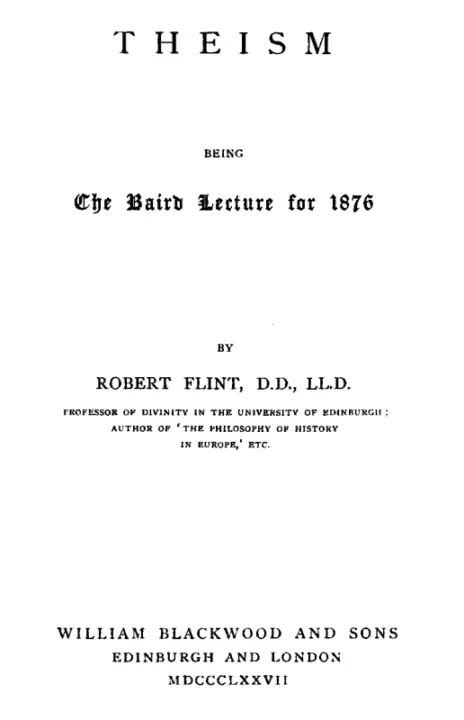
THE CLASSIC COLLECTION · 1877
"Theism; Being the Baird Lecture of 1876" by Robert Flint is a religious philosophical treatise written in the late 19th century. The work delves into the nature and validity of belief in God, exploring whether theism can be rationally justified over anti-theistic theories. Flint highlights the importance of understanding the nature of God as a self-existent, perfect being and the implications of belief in God on morality and society. The opening of this volume introduces significant questions regarding the rationality of religious belief. Flint posits that the inquiry should explore the existence of a divine being and whether such belief is justified. He emphasizes that religious belief must be rooted in knowledge, not mere feelings, and lays the groundwork for a thorough examination of theistic proofs by discussing the historical and philosophical context of theism. Flint argues that a worldview devoid of a divine entity ultimately deprives religious experiences of truth and meaning, leading to the idea that all human thought and morality is interconnected with the existence of God.
Introduction adapted from the source catalogue; source summaries may be automatically generated.
Free to read · English · 107,012 words · No account needed
MAKE TIME FOR A GOOD BOOK
On by default. Untick to stop anonymous reading totals. Each page counts after 10 seconds in view. How this works.
Anonymous counting is on unless you have switched it off.
[22] See Appendix XIV.
A much more recent science than astronomy, the science of chemistry, undertakes to instruct us as to the composition of the universe, and it is marvellous how much it can tell us even of the composition of the stars. What, then, is its most general and certain result? Just this, that order of the strictest kind, the most definite proportions, are wrought into the very structure of every world, and of every compound object in the world, air and water, earth and mineral, plant and animal. The vast variety of visible substances are reducible to rather more than sixty constituent elements, each of which has not only its own peculiar properties but its own definite and unvarying combining proportions with other elements, so that amidst the prodigious number of combinations all is strictly ordered, numerically exact. There is no chemical union possible except when the elements bear to each other a numerically constant ratio. Different compounds are always the products of the combination of the elements in different yet strictly definite proportions, there being no intermediate combinations, no transitional compounds. If each element did not admit of union with many others, the world would be dead and poor, its contents few and unvaried; if their unions were not always regulated by law, disorder would everywhere prevail. How comes it that they are so made in relation to one another that their manifold unions are ever regulated by law, and generate an endless variety of admirable products? Who made them thus? Did they make themselves? or, did any blind force make them? Reason answers that they must have been made by an intelligence which wanted them for its purposes. When the proportions of the elementary constituents are altered, the same elements produce the most diverse substances with the most dissimilar and even opposite properties, charcoal and diamond, a deadly poison or the breath of life, theine or strychnine. These powers all work together for good; but if they worked even a very little differently--if the circumstances in which they work, not to speak of the laws by which they work, were altered--they would spread destruction and death through the universe. The atmosphere is rather a mixture than a combination of chemical elements, but it is a mixture in which the constituents are proportioned to each other in the only way which fits it to sustain the lives of plants and animals, and to accomplish its many other important services; and wonderful in the extreme is the provision made for the constant restoration of the due proportions amidst perpetual oscillations. One of the chiefs of modern chemistry, Baron Liebig, points to what takes place when rain falls on the soil of a field adapted for vegetable growth as to something which "effectually strikes all human wisdom dumb." "During the filtration of rain-water," he says, "through the soil, the earth does not surrender one particle of all the nutritive matter which it contains available for vegetable growth (such as potash, silicic acid, ammonia, &c.); the most unintermittent rain is unable to abstract from it (except by the mechanical action of floods) any of the chief requisites for its fertility. The particles of mould not only firmly retain all matter nutritive to vegetable growth, but also immediately absorb such as are contained in the rain-water (ammonia, potash, &c.). But only such substances are completely absorbed from the water as are indispensable requisites for vegetable growth; others remain either entirely or for the most part in a state of solution." The laws and uses of light and heat, electricity and magnetism, and the adjustments which they presuppose, all point not less clearly to the ordinances of a supremely profound and accurate mind. In a word, out of a few elements endowed with definite powers, this world with its air and its seas, its hills and valleys, its vegetable forms and animal frames, and other worlds innumerable, have been built up by long-sustained and endlessly-varied processes of chemical synthesis mostly conducted under conditions so delicately adjusted to the requirements of each case, that the ablest chemists, with all their instruments and artifices, cannot even reproduce them on any scale however small. Can these elements be reasonably thought of as having been unfashioned and unprepared, or these processes as having been uninstituted and unpresided over by intelligence?[23]
Your reading position is saved on this browser. Take it to another device with a library code. Reading pages adapt to text, rather than matching a printed edition.
BEHIND THE BOOK
This eBook is for the use of anyone anywhere in the United States and most other parts of the world at no cost and with almost no restrictions whatsoever. You may copy it, give it away or re-use it under the terms of the Project Gutenberg License included with this eBook or online at www.gutenberg.org. If you are not located in the United States, you will have to check the laws of the country where you are located before using this eBook. Read the source licence.
The original source file, including credits and licence, is retained by this library. Request an original-format copy at no charge. Please include the book title and Project Gutenberg identifier #45850.
KEEP YOUR CURIOSITY GOING
David Patterson (Spirit) Hatch

David Patterson (Spirit) Hatch

David Patterson (Spirit) Hatch
Coulson Kernahan

Ralph Waldo Emerson
Frances Wright