
Last letters from the living dead man
David Patterson (Spirit) Hatch
THE CLASSIC COLLECTION · 1877
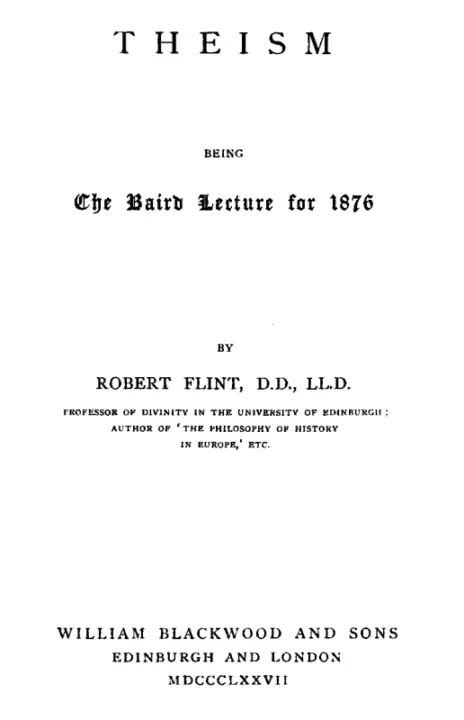
"Theism; Being the Baird Lecture of 1876" by Robert Flint is a religious philosophical treatise written in the late 19th century. The work delves into the nature and validity of belief in God, exploring whether theism can be rationally justified over anti-theistic theories. Flint highlights the importance of understanding the nature of God as a self-existent, perfect being and the implications of belief in God on morality and society. The opening of this volume introduces significant questions regarding the rationality of religious belief. Flint posits that the inquiry should explore the existence of a divine being and whether such belief is justified. He emphasizes that religious belief must be rooted in knowledge, not mere feelings, and lays the groundwork for a thorough examination of theistic proofs by discussing the historical and philosophical context of theism. Flint argues that a worldview devoid of a divine entity ultimately deprives religious experiences of truth and meaning, leading to the idea that all human thought and morality is interconnected with the existence of God.
Introduction adapted from the source catalogue; source summaries may be automatically generated.
Free to read · English · 107,012 words · No account needed
MAKE TIME FOR A GOOD BOOK
On by default. Untick to stop anonymous reading totals. Each page counts after 10 seconds in view. How this works.
Anonymous counting is on unless you have switched it off.
While we may readily admit the distinction to be so far valid, it is certainly not absolute. Regularity and adjustment are rather different aspects of order than different kinds of order, and, so far from excluding each other, they will be found implying each other. It is obvious that even the most specialised adjustments of organic structure and activity presuppose the most general and simple uniformities of purely physical nature. Such cases of adjustment comprehend in fact many cases of regularity. It is less obvious, but not less true, that wherever regularity can be traced adjustment will also be found, if the search be carried far enough. The regularity disclosed by astronomy depends on adjustment as regards magnitude, weight, distance, &c., in the celestial bodies, just as the adjustments brought to light by biology depend on the general regularity of the course of nature. There is no law of nature so simple as not to presuppose in every instance of its action at least two things related to one another in the manner which is meant when we speak of adjustment. It being thus impossible to separate regularity from adjustment as regards the phenomena of the universe, it seems unnecessary to attempt by abstraction to separate them in the theological argumentation, while giving a rapid general glance at the phenomena which display them.
The physical universe has, perhaps, no more general characteristic than this,--its laws are mathematical relations. The law of gravitation, which rules all masses of matter, great or small, heavy or light, at all distances, is a definite numerical law. The curves which the heavenly bodies describe under the influence of that law are the ellipse, circle, parabola, and hyperbola--or, in other words, they all belong to the class of curves called conic sections, the properties of which mathematicians had begun to investigate nearly twenty centuries before Newton established that whatever was true of them might be directly transferred to the heavens, since the planets revolve in ellipses, the satellites of Jupiter in circles, and the comets in elliptical, parabolic, and hyperbolic orbits. The law of chemical combination, through which the whole world of matter has been built up out of a few elements, always admits of precise numerical expression. So does the law of the correlation of heat and gravitation. Each colour in the rainbow is due to a certain number of vibrations in a given time; so is each note in the scale of harmony. Each crystal is a geometrical construction. The pistils of flowers, and the feathers in the wings and tails of birds, are all numbered. If nature had not thus been ruled by numerical laws, the mathematical sciences might have existed, but they would have had no other use than to exercise the intellect, whereas they have been the great instruments of physical investigation. They are the creations of a mental power which, while occupied in their origination and elaboration, requires to borrow little, if anything, from matter; and yet, it is only with their help that the constitution of the material universe has been displayed, and its laws have been discovered, with that high measure of success of which physicists are so proud. But they could not have been applied to the universe at all unless its order had been of the exact numerical and geometrical kind which has been indicated; unless masses had attracted each other, and elements combined with each other, in invariable proportions; unless "the waters had been measured as if in the hollow of a hand, the heaven meted out as with a span, the dust of the earth comprehended in a measure, and the mountains weighed in scales and the hills in a balance." Now it is possible to deny that things have been thus weighed, measured, and numbered by a Creative Intelligence, but not that they have been weighed, measured, and numbered. If we are to give any credit to science, there can be no doubt about the weights and measures and numbers. This question, then, is alone left,--Could anything else than intelligence thus weigh, measure, and number? Could mere matter know the abstrusest properties of space and time and number, so as to obey them in the wondrous way it does? Could what has taken so much mathematical knowledge and research to apprehend, have originated with what was wholly ignorant of all quantitative relations? Or must not the order of the universe be due to a mind whose thoughts as to these relations are high above even those of the profoundest mathematicians, as are the heavens above the earth? If the universe were created by an intelligence conversant with quantitative truth, it is easy to understand why it should be ruled by definitely quantitative laws; but that there should be such laws in a universe which did not originate in intelligence, is not only inexplicable but inconceivably improbable. There is not merely in that case no discoverable reason why there should be any numerically definite law in nature, but the probability of there being no law or numerical regularity of any kind is exceedingly great, and of there being no law-governed universe incalculably great. Apart from the supposition of a Supreme Intelligence, the chances in favour of disorder against order, of chaos against cosmos, of the numerically indefinite and inconstant against the definite and constant, must be pronounced all but infinite. The belief in a Divine Reason is alone capable of rendering rational the fact that mathematical truths are realised in the material world.[21]
Your reading position is saved on this browser. Take it to another device with a library code. Reading pages adapt to text, rather than matching a printed edition.
BEHIND THE BOOK
This eBook is for the use of anyone anywhere in the United States and most other parts of the world at no cost and with almost no restrictions whatsoever. You may copy it, give it away or re-use it under the terms of the Project Gutenberg License included with this eBook or online at www.gutenberg.org. If you are not located in the United States, you will have to check the laws of the country where you are located before using this eBook. Read the source licence.
The original source file, including credits and licence, is retained by this library. Request an original-format copy at no charge. Please include the book title and Project Gutenberg identifier #45850.
KEEP YOUR CURIOSITY GOING
David Patterson (Spirit) Hatch

David Patterson (Spirit) Hatch

David Patterson (Spirit) Hatch
Coulson Kernahan

Ralph Waldo Emerson
Frances Wright