
Last letters from the living dead man
David Patterson (Spirit) Hatch
THE CLASSIC COLLECTION · 1877
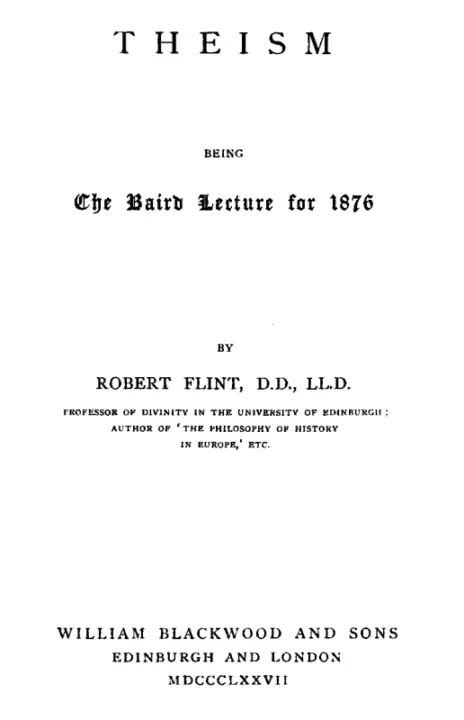
"Theism; Being the Baird Lecture of 1876" by Robert Flint is a religious philosophical treatise written in the late 19th century. The work delves into the nature and validity of belief in God, exploring whether theism can be rationally justified over anti-theistic theories. Flint highlights the importance of understanding the nature of God as a self-existent, perfect being and the implications of belief in God on morality and society. The opening of this volume introduces significant questions regarding the rationality of religious belief. Flint posits that the inquiry should explore the existence of a divine being and whether such belief is justified. He emphasizes that religious belief must be rooted in knowledge, not mere feelings, and lays the groundwork for a thorough examination of theistic proofs by discussing the historical and philosophical context of theism. Flint argues that a worldview devoid of a divine entity ultimately deprives religious experiences of truth and meaning, leading to the idea that all human thought and morality is interconnected with the existence of God.
Introduction adapted from the source catalogue; source summaries may be automatically generated.
Free to read · English · 107,012 words · No account needed
MAKE TIME FOR A GOOD BOOK
On by default. Untick to stop anonymous reading totals. Each page counts after 10 seconds in view. How this works.
Anonymous counting is on unless you have switched it off.
Then, in the third place, any plausible conceptions we can form of the ultimate nature of matter lead to the belief that even that is an event or effect, a something derivative and caused. It must be admitted that the most plausible of these conceptions are vague and conjectural. We have a practical and relative knowledge of matter which is both exact and trustworthy,--a knowledge of its properties from which we can mathematically deduce a multitude of remote consequences of an extremely precise character--but we are hardly entitled to characterise as knowledge at all any of the views which have been propounded as to what it is in itself. It is only the unreflecting who fancy that matter in itself is something very clear and obvious, which they may apprehend by merely opening their eyes and stretching out their hands. Those who have never reasoned on the subject are apt to imagine that the nature of matter is of all things the easiest to understand, and they unhesitatingly invest it with their own sensations and perceptions. That is the so-called commonsense view of matter; but the slightest inquiry proves it to be delusive and nonsensical. Colour, for example, is just what is seen, and sound just what is heard; they are not qualities inherent in objects independent of the eye and ear: the matter which is supposed to cause by its motions on our senses these and other perceptions of the material world, we cannot see, hear, or apprehend by any sense. Change our senses and the universe will be thereby changed, everything in it becoming something other than it was before, green perhaps red, the bitter sweet, the loudest noise a gentle whisper, the hardest substance soft. As soon, then, as we thoughtfully ask ourselves, What is matter? we begin to discover that it is in itself something utterly mysterious. The collection of phenomena which we call its properties are quite unlike the phenomena of mind in this most important respect, that whatever they may be they are not what they appear to be. A state of mind is what we feel it to be; a state of matter is certainly not what we seem to ourselves to perceive it to be. No one, of course, knew all this better than Mr Mill. He, as a philosopher, had asked himself what matter is; he had formed a theory in answer to the question. And what is his theory? Just this,--that we cannot find a permanent element in matter; that we have no right to suppose that there is a permanent real existence or actual substance in matter; that all that we are warranted to affirm about the ultimate nature of matter is that it is a permanent possibility,--the permanent possibility of sensations. That was the conclusion which he arrived at when he theorised on matter without any theological aim. But he appears to have forgotten it when he came to criticise the argument for a first cause. He could not otherwise have written as if it were quite certain that there was in matter "a permanent element," not an underlying possibility but an inherent real substance. Had he remembered what his own theory as to the nature of matter was, he would have avoided as utterly untrue and misleading every expression which could suggest the notion of there being a permanent element in matter, and would have admitted that very probably the permanent possibilities of sensation, the causes of all material phenomena, lay in the Divine will, since he had been unable to find anything else permanent in which they could be supposed to subsist. That is a view which many profound thinkers have adopted. They have been led to hold that matter is essentially force, and nothing but force; that the whole material world is ultimately resolvable into forces; and that all its forces are but manifestations or outgoings of will-force. If so, the whole material world is not only dependent on, but is, the will of God, and has no being of any kind apart from the will of God. If so, God's will is not only the cause and controlling power of nature, but its substance, its self. And this view, that what alone substantially underlies all the phenomena we designate material is an acting mind, an energising will, has not only been reached by mental philosophers and idealistic speculators, but by those physicists who, like Boscovitch and Faraday, have found themselves forced to conclude that what is constitutive of matter is not indivisible particles, even infinitesimally small, but mere centres of force, since force necessarily implies some sort of substance, and, therefore, spirit where not matter.
Your reading position is saved on this browser. Take it to another device with a library code. Reading pages adapt to text, rather than matching a printed edition.
BEHIND THE BOOK
This eBook is for the use of anyone anywhere in the United States and most other parts of the world at no cost and with almost no restrictions whatsoever. You may copy it, give it away or re-use it under the terms of the Project Gutenberg License included with this eBook or online at www.gutenberg.org. If you are not located in the United States, you will have to check the laws of the country where you are located before using this eBook. Read the source licence.
The original source file, including credits and licence, is retained by this library. Request an original-format copy at no charge. Please include the book title and Project Gutenberg identifier #45850.
KEEP YOUR CURIOSITY GOING
David Patterson (Spirit) Hatch

David Patterson (Spirit) Hatch

David Patterson (Spirit) Hatch
Coulson Kernahan

Ralph Waldo Emerson
Frances Wright