
Last letters from the living dead man
David Patterson (Spirit) Hatch
THE CLASSIC COLLECTION · 1877
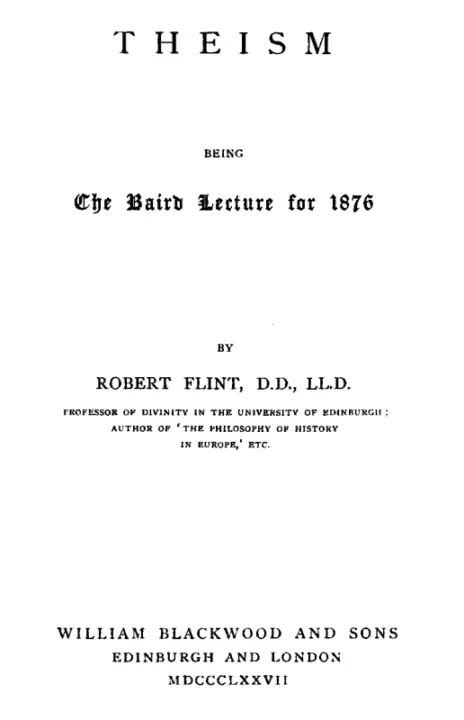
"Theism; Being the Baird Lecture of 1876" by Robert Flint is a religious philosophical treatise written in the late 19th century. The work delves into the nature and validity of belief in God, exploring whether theism can be rationally justified over anti-theistic theories. Flint highlights the importance of understanding the nature of God as a self-existent, perfect being and the implications of belief in God on morality and society. The opening of this volume introduces significant questions regarding the rationality of religious belief. Flint posits that the inquiry should explore the existence of a divine being and whether such belief is justified. He emphasizes that religious belief must be rooted in knowledge, not mere feelings, and lays the groundwork for a thorough examination of theistic proofs by discussing the historical and philosophical context of theism. Flint argues that a worldview devoid of a divine entity ultimately deprives religious experiences of truth and meaning, leading to the idea that all human thought and morality is interconnected with the existence of God.
Introduction adapted from the source catalogue; source summaries may be automatically generated.
Free to read · English · 107,012 words · No account needed
MAKE TIME FOR A GOOD BOOK
On by default. Untick to stop anonymous reading totals. Each page counts after 10 seconds in view. How this works.
Anonymous counting is on unless you have switched it off.
The philosophers and theologians who have supposed A PRIORI proof to be proof from a cause or antecedent existence, have, of course, denied that there can be any a priori proof of the Divine existence. Aristotle laid down as a rule that demonstration must proceed from things prior to and the causes of the things to be demonstrated, and those who assented to this rule necessarily denied the possibility of demonstrating the existence of God. The assertion of Clemens of Alexandria that "God cannot be apprehended by any demonstrative science" is indubitable, if the view of demonstration on which he rests it be correct; "for such science is from things prior and more knowable, whereas nothing can precede that which is uncreated." It is a manifest contradiction to imagine that an eternal being is subsequent to any other being, or a perfect being dependent on any other being. Even mathematical demonstration, however, is not from causes; nor is there any reason for supposing that the order of knowledge is necessarily and universally the same as the order of existence.
It is by confounding demonstration erroneously understood in the manner indicated with proof in general that not a few persons have arrived at the conclusion that the existence of God cannot be proved at all, and have deemed preposterous assertions like that of Jacobi, "A God who can be proved is no God, for the ground of proof is necessarily above the thing proved by it," both profound and pious.
NOTE XXXVIII., page 285.
I have treated of Clarke's argument in the 'Encyc. Brit.' art. "Samuel
Clarke."
The demonstration of Dr Fiddes is contained in his 'Theologia Speculativa, or a Body of Divinity,' 2 vols., 1718-20. It consists of six propositions: 1. Something does now exist; 2. Something has existed eternally; 3. Something has been eternally self-existent; 4. What is self-existent must have all the perfections that exist anywhere or in any subject; 5. What is self-existent must have all possible perfections, and every perfection, in an infinite measure; 6. What has all possible perfections in an infinite measure is God. He proves his fourth proposition thus: "Since nothing can arise out of nothing, and since there can be no perfection but what has some subject of inherence, every perfection must have been eternally somewhere or other, or in one subject or other, into which it must be ultimately resolved, or else it could never have been at all; without admitting, what of all things we are the best able to conceive, an infinite progression of efficient causes--that is, an infinite series of beings derived one from another, without a beginning or any original cause at the head of the series. So that whatever perfections we observe in any being must have been originally and eternally in the self-existent being." On behalf of his fifth proposition he advances two arguments: 1. "All properties essentially follow the nature and condition of the subject, and must be commensurate to it. For this reason we say that wisdom, power, and goodness being attributes of an infinite subject, or one which is the substratum of one infinite attribute, these and all the other perfections belonging to it must be infinite also. Otherwise the same subject, considered as a subject, would be infinite in one respect, and yet finite in another; which, if it be not a contradiction, seems to border so near upon one that we cannot comprehend the possibility of it." 2. "A self-existent being as the subject of any perfection cannot limit itself; because it must necessarily have existed from all eternity what it is, and have been the same in all properties essentially inherent in it, antecedently to any act or volition of its own. Nor can such a being be limited by anything external to it; for, besides that self-existence necessarily implies independence, properties which are essential to any subject can admit of no increase or diminution or the least imaginable change, without destroying the essence itself of the subject. Nor yet can it be said that there is any impossibility in the nature of the thing that the perfections inhering in an infinite subject should be in the highest or even in an infinite degree. Indeed it is scarce possible for us (for the reasons already assigned) to conceive how they should be otherwise. Neither can any such impossibility arise from the nature of the perfections themselves. If, then, the perfections of a self-existent being cannot be limited by itself, nor by anything external to it, nor from any invincible repugnancy in the nature of the perfections themselves, I conclude that the self-existent being must not only have all possible perfections, but every perfection in an infinite degree."
Your reading position is saved on this browser. Take it to another device with a library code. Reading pages adapt to text, rather than matching a printed edition.
BEHIND THE BOOK
This eBook is for the use of anyone anywhere in the United States and most other parts of the world at no cost and with almost no restrictions whatsoever. You may copy it, give it away or re-use it under the terms of the Project Gutenberg License included with this eBook or online at www.gutenberg.org. If you are not located in the United States, you will have to check the laws of the country where you are located before using this eBook. Read the source licence.
The original source file, including credits and licence, is retained by this library. Request an original-format copy at no charge. Please include the book title and Project Gutenberg identifier #45850.
KEEP YOUR CURIOSITY GOING
David Patterson (Spirit) Hatch

David Patterson (Spirit) Hatch

David Patterson (Spirit) Hatch
Coulson Kernahan

Ralph Waldo Emerson
Frances Wright