
Last letters from the living dead man
David Patterson (Spirit) Hatch
THE CLASSIC COLLECTION · 1877
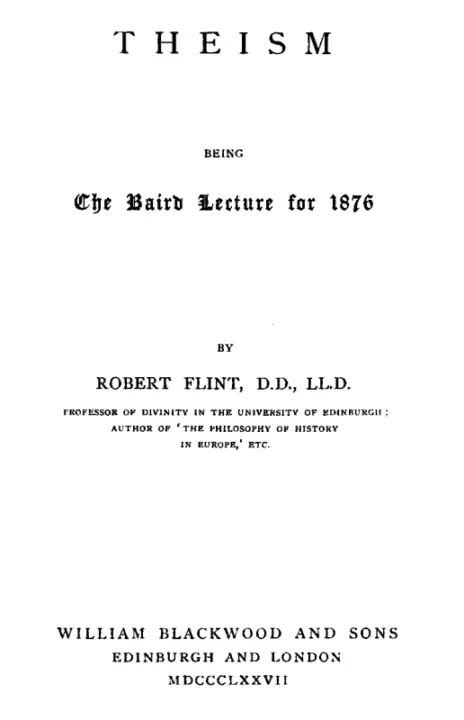
"Theism; Being the Baird Lecture of 1876" by Robert Flint is a religious philosophical treatise written in the late 19th century. The work delves into the nature and validity of belief in God, exploring whether theism can be rationally justified over anti-theistic theories. Flint highlights the importance of understanding the nature of God as a self-existent, perfect being and the implications of belief in God on morality and society. The opening of this volume introduces significant questions regarding the rationality of religious belief. Flint posits that the inquiry should explore the existence of a divine being and whether such belief is justified. He emphasizes that religious belief must be rooted in knowledge, not mere feelings, and lays the groundwork for a thorough examination of theistic proofs by discussing the historical and philosophical context of theism. Flint argues that a worldview devoid of a divine entity ultimately deprives religious experiences of truth and meaning, leading to the idea that all human thought and morality is interconnected with the existence of God.
Introduction adapted from the source catalogue; source summaries may be automatically generated.
Free to read · English · 107,012 words · No account needed
MAKE TIME FOR A GOOD BOOK
On by default. Untick to stop anonymous reading totals. Each page counts after 10 seconds in view. How this works.
Anonymous counting is on unless you have switched it off.
NOTE XXXI., page 235.
Lucretius (ii. 177-v. 196) has dwelt on the arrangements which render one zone of the earth torrid and others frigid--on the extent of barren heaths and rocks, of sands and seas--on the prevalence of unseasonable weather, storms, and tempests--and on the abundance of noxious herbs and destructive animals, &c.--as evidences that the earth was faulty and ill made, and could not be the work of a Divine Intelligence. Whether it was well or ill made appears to have been a favourite subject of dispute between the Epicureans and Stoics. Lactantius (De Ira Dei, c. xiii.) reports, and attempts to answer, the objections which the Epicureans and Academics were accustomed to urge against the constitution of the physical world. In Cudworth's 'Intellectual System,' vol. iii., pp. 464-8, Bentley's 'Folly of Atheism,' pt. i., Serm. 8; Derham's 'Astro-Theology,' book vii., c. 2, &c., such objections are discussed. In the remarks which I made on the subject in the lecture, I have had chiefly in view the opinions of Comte, J. S. Mill, and J. J. Murphy (Scientific Bases of Faith, c. xvi.)
Mr Mill's charges against nature are very vigorously and graphically expressed. "Next to the greatness of these cosmic forces, the quality which most forcibly strikes every one who does not avert his eyes from it, is their perfect and absolute recklessness. They go straight to their end, without regarding what or whom they crush on the road. Optimists, in their attempts to prove that 'whatever is, is right,' are obliged to maintain, not that Nature ever turns one step from her path to avoid trampling us into destruction, but that it would be very unreasonable in us to expect that she should. Pope's 'Shall gravitation cease when you go by?' may be a just rebuke to any one who should be so silly as to expect common human morality from Nature. But if the question were between two men, instead of between a man and a natural phenomenon, that triumphant apostrophe would be thought a rare piece of impudence. A man who should persist in hurling stones or firing cannon when another man 'goes by,' and, having killed him, should urge a similar plea in exculpation, would very deservedly be found guilty of murder. In sober truth, nearly all the things which men are hanged or imprisoned for doing to one another, are Nature's everyday performances. Killing, the most criminal act recognised by human laws, Nature does once to every being that lives, and in a large proportion of cases after protracted tortures, such as only the greatest monsters whom we read of ever purposely inflicted on their living fellow-creatures. If, by an arbitrary reservation, we refuse to account anything murder but what abridges to a certain term supposed to be allotted to human life, Nature also does this to all but a small percentage of lives, and does it in all the modes, violent or insidious, in which the worst human beings take the lives of one another. Nature impales men, breaks them as if on the wheel, casts them to be devoured by wild beasts, burns them to death, crushes them with stones like the first Christian martyr, starves them with hunger, freezes them with cold, poisons them by the quick or slow venom of her exhalations, and has hundreds of other hideous deaths in reserve, such as the ingenious cruelty of a Nabis or a Domitian never surpassed. All this Nature does with the most supercilious disregard both of mercy and of justice, emptying her shafts upon the best and noblest indifferently with the meanest and worst--upon those who are engaged in the highest and worthiest enterprises, and often as the direct consequence of the noblest acts,--and it might almost be imagined as a punishment for them. She mows down those on whose existence hangs the wellbeing of a whole people, perhaps the prospects of the human race for generations to come, with as little compunction as those whose death is a relief to themselves, or a blessing to those under their noxious influence. Such are Nature's dealings with life. Even when she does not intend to kill, she inflicts the same tortures in apparent wantonness. In the clumsy provision which she has made for that perpetual renewal of animal life, rendered necessary by the prompt termination she puts to it in every individual case, no human being ever comes into the world but another human being is literally stretched on the rack for hours or days, not unfrequently issuing in death. Next to taking life (equal to it, according to a high authority) is taking the means by which we live; and Nature does this, too, on the largest scale and with the most callous indifference. A single hurricane destroys the hopes of a season; a flight of locusts, or an inundation, desolates a district; a trifling chemical change in an edible root starves a million of people. The waves of the sea, like banditti, seize and appropriate the wealth of the rich and the little all of the poor with the same accompaniments of stripping, wounding, and killing, as their human antitypes. Everything, in short, which the worst men commit either against life or property, is perpetrated on a larger scale by natural agents. Nature has noyades more fatal than those of Carrier; her explosions of fire-damp are as destructive as human artillery; her plague and cholera far surpass the poison-cups of the Borgias. Even the love of 'order,' which is thought to be a following of the ways of Nature, is, in fact, a contradiction of them. All which people are accustomed to deprecate as 'disorder' and its consequences, is precisely a counterpart of Nature's ways. Anarchy and the Reign of Terror are overmatched in injustice, ruin, and death, by a hurricane and a pestilence."--Three Essays, pp. 28-31.
Your reading position is saved on this browser. Take it to another device with a library code. Reading pages adapt to text, rather than matching a printed edition.
BEHIND THE BOOK
This eBook is for the use of anyone anywhere in the United States and most other parts of the world at no cost and with almost no restrictions whatsoever. You may copy it, give it away or re-use it under the terms of the Project Gutenberg License included with this eBook or online at www.gutenberg.org. If you are not located in the United States, you will have to check the laws of the country where you are located before using this eBook. Read the source licence.
The original source file, including credits and licence, is retained by this library. Request an original-format copy at no charge. Please include the book title and Project Gutenberg identifier #45850.
KEEP YOUR CURIOSITY GOING
David Patterson (Spirit) Hatch

David Patterson (Spirit) Hatch

David Patterson (Spirit) Hatch
Coulson Kernahan

Ralph Waldo Emerson
Frances Wright