
Last letters from the living dead man
David Patterson (Spirit) Hatch
THE CLASSIC COLLECTION · 1877
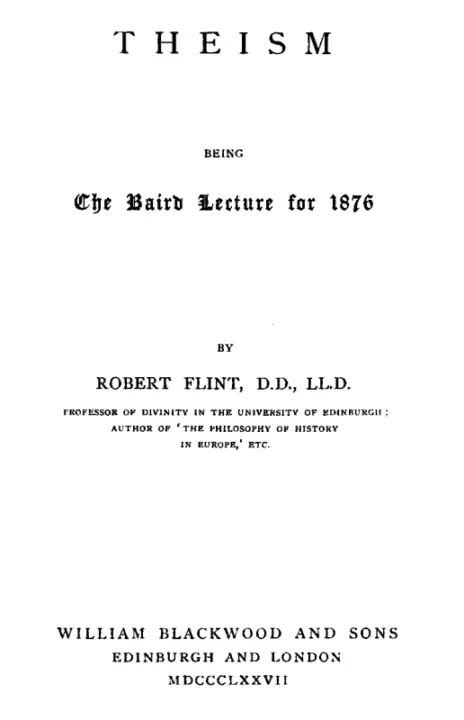
"Theism; Being the Baird Lecture of 1876" by Robert Flint is a religious philosophical treatise written in the late 19th century. The work delves into the nature and validity of belief in God, exploring whether theism can be rationally justified over anti-theistic theories. Flint highlights the importance of understanding the nature of God as a self-existent, perfect being and the implications of belief in God on morality and society. The opening of this volume introduces significant questions regarding the rationality of religious belief. Flint posits that the inquiry should explore the existence of a divine being and whether such belief is justified. He emphasizes that religious belief must be rooted in knowledge, not mere feelings, and lays the groundwork for a thorough examination of theistic proofs by discussing the historical and philosophical context of theism. Flint argues that a worldview devoid of a divine entity ultimately deprives religious experiences of truth and meaning, leading to the idea that all human thought and morality is interconnected with the existence of God.
Introduction adapted from the source catalogue; source summaries may be automatically generated.
Free to read · English · 107,012 words · No account needed
MAKE TIME FOR A GOOD BOOK
On by default. Untick to stop anonymous reading totals. Each page counts after 10 seconds in view. How this works.
Anonymous counting is on unless you have switched it off.
Kant's argument is thus summarised by the Archbishop of York: "The highest good of man consists of two parts, the greatest possible morality and happiness. The former is the demand of his spiritual, the latter of his animal nature. The former only, his morality, is within his own power; and while, by persevering virtue, he makes this his personal character, he is often compelled to sacrifice his happiness. But since the desire of happiness is neither irrational nor unnatural, he justly concludes either that there is a Supreme Being who will so guide the course of things (the natural world, not of itself subject to moral laws) as to render his holiness and happiness equal, or that the dictates of his conscience are unjust and irrational. But the latter supposition is morally impossible; and he is compelled, therefore, to receive the former as true."
Akin to this argument are those which are based on man's desire of good. Proclus, in his 'Theology of Plato,' argues to the following effect: All beings desire the good; but this good cannot be identical with the beings which desire it, for then these beings would be themselves the good, and would not desire what they already possessed. The good is antecedent, therefore, to all the beings who desire it. Since the time of Proclus to the present many have argued that there must be a God because the heart demands one to satisfy its desire of love, or holiness, or happiness; few, perhaps, have done so with more ingenuity of logic or fervour of belief than John Norris in "Contemplation and Love, or the Methodical Ascent of the Soul to God by steps of Meditation," and in "An Idea of Happiness" ('Collection of Miscellanies').
A contemporary theologian, Principal Pirie of Aberdeen, has laid great stress on an argument which we may assign to this class. "No argument," he says, "can be valid which founds on innate ideas, or which embraces considerations so entirely beyond the range of human apprehension that we cannot positively be assured whether they be true or false. Yet we have no hesitation in saying that there is an argument a priori for the existence and attributes of a God, which is involved in the very nature of our feelings, and which therefore tells upon the faith of the whole human race, even when they are altogether ignorant of it logically, as existing in the form of a proposition. It makes no appeal, however, to profound metaphysical speculations, and is consequently plain and intelligible to any one capable of exercising reason at all. It rests on the principle which both our feelings and our experience demonstrate to be true, that every primary and essential desire of the human mind has a co-relative--or, in other words, a something to gratify it--existing in the nature of things. The mode in which the development of this principle constitutes an argument a priori for the existence and attributes of a God we now proceed to explain. Every human being feels from the moment in which he comes into existence, and through his whole subsequent history, that he is in himself a weak, helpless creature. As we have said, this feeling begins from the very beginning of our conscious existence. The appeals of the infant for aid are made continually.... As we advance to childhood, youth, and manhood, our sense of power gradually increases. We are conscious that under certain circumstances we can do something for ourselves. Yet this capability, we are also conscious in its very exercise, does not depend on us for its continuance. We cannot preserve to ourselves fortune, health, or even life, for a single moment. Yet all these things we desire, and desire with the utmost earnestness, and desire as a primary tendency of our minds. We may not indeed always clothe such desire in words--we may not put it into the form of a proposition; but that it exists in every mind as a feeling, and practically operates upon every individual, is as certain as our existence itself, and is indeed manifest every moment in the efforts which we make to preserve these and all other forms of what we believe to involve happiness. In this desire, consequently, we have the voice of nature speaking, and commanding us to use such efforts. Of ourselves we know that they would be insufficient. The results depend upon causes over which we have no control. Our own efforts, we are conscious, are only means which nature has appointed us to employ, but their success depends on circumstances altogether beyond our power. It is, as has been said, the voice of nature telling us that each of our desires has a co-relative, through which it may be fully gratified by the use of the proper means. This co-relative, in the case of intense and permanent happiness, can only be found in the existence of a God, omnipotent, omniscient, true, just, benevolent, and eternal, in whom we repose entire confidence. No other assumption could by possibility satisfy our desire for the highest and permanent happiness now and for ever. For to realise thoroughly the argument, it is to be observed that our desire is for the highest and permanent happiness. It is not imperfect or temporary happiness merely which we desire, though we may be compelled to be content with this, if we cannot procure more. It is the highest happiness possible for our natures, and that without end. Now, if such happiness is to be attained at all, it can only be obtained through a God possessed of the attributes which we have enumerated."--Natural Theology, pp. 71-74.
Your reading position is saved on this browser. Take it to another device with a library code. Reading pages adapt to text, rather than matching a printed edition.
BEHIND THE BOOK
This eBook is for the use of anyone anywhere in the United States and most other parts of the world at no cost and with almost no restrictions whatsoever. You may copy it, give it away or re-use it under the terms of the Project Gutenberg License included with this eBook or online at www.gutenberg.org. If you are not located in the United States, you will have to check the laws of the country where you are located before using this eBook. Read the source licence.
The original source file, including credits and licence, is retained by this library. Request an original-format copy at no charge. Please include the book title and Project Gutenberg identifier #45850.
KEEP YOUR CURIOSITY GOING
David Patterson (Spirit) Hatch

David Patterson (Spirit) Hatch

David Patterson (Spirit) Hatch
Coulson Kernahan

Ralph Waldo Emerson
Frances Wright