
Last letters from the living dead man
David Patterson (Spirit) Hatch
THE CLASSIC COLLECTION · 1877
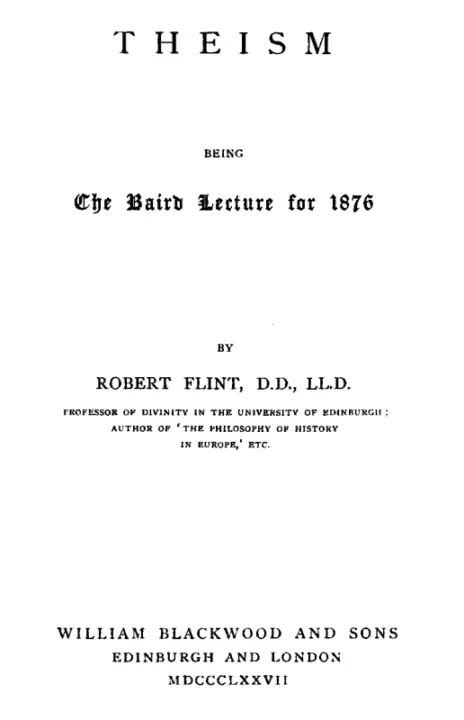
"Theism; Being the Baird Lecture of 1876" by Robert Flint is a religious philosophical treatise written in the late 19th century. The work delves into the nature and validity of belief in God, exploring whether theism can be rationally justified over anti-theistic theories. Flint highlights the importance of understanding the nature of God as a self-existent, perfect being and the implications of belief in God on morality and society. The opening of this volume introduces significant questions regarding the rationality of religious belief. Flint posits that the inquiry should explore the existence of a divine being and whether such belief is justified. He emphasizes that religious belief must be rooted in knowledge, not mere feelings, and lays the groundwork for a thorough examination of theistic proofs by discussing the historical and philosophical context of theism. Flint argues that a worldview devoid of a divine entity ultimately deprives religious experiences of truth and meaning, leading to the idea that all human thought and morality is interconnected with the existence of God.
Introduction adapted from the source catalogue; source summaries may be automatically generated.
Free to read · English · 107,012 words · No account needed
MAKE TIME FOR A GOOD BOOK
On by default. Untick to stop anonymous reading totals. Each page counts after 10 seconds in view. How this works.
Anonymous counting is on unless you have switched it off.
Mr Mill's own essay is rather strange. It begins with six pages of general observations, which are meant to show that it is a necessary and very laudable undertaking to attempt to prove that the belief in religion, considered as a mere persuasion apart from the question of its truth, may be advantageously dispensed with, any benefits which flow from the belief being local, temporary, and such as may be otherwise obtained, without the very large amount of alloy always contained in religion. Yet we are told that "an argument for the utility of religion is an appeal to unbelievers to induce them to practise a well-meant hypocrisy; or to semi-believers to make them avert their eyes from what might possibly shake their unstable belief; or, finally, to persons in general to abstain from expressing any doubts they may feel, since a fabric of immense importance to mankind is so insecure at its foundations, that men must hold their breath in its neighbourhood for fear of blowing it down." An argument for the utility of religion is "moral bribery." An argument for its uselessness is highly to be commended. Mr Mill further tells us that "little has been written, at least in the way of discussion or controversy, concerning the usefulness of religion;" and likewise, that "religious writers have not neglected to celebrate to the utmost the advantage both of religion in general and of their own religious faith in particular." The inference must be, that what religious writers urge for the utility of religion is not to be reckoned as reasoning; that only what writers like Mr Bentham and Mr Mill urge against its utility is to be thus regarded. The charity of this view is capped by the assertion that "the whole of the prevalent metaphysics of the present century is one tissue of suborned evidence in favour of religion;" an assertion which is made amusing by following a sentence in which Mr Mill speaks of "the intolerant zeal" of intuitionists. After his general considerations, he professes to inquire what religion does for society, but in reality never enters on the investigation. He devotes two pages to insisting on "the enormous influence of authority on the human mind;" three to emphasising "the tremendous power of education;" and ten to enlarging on "the power of public opinion." He might as relevantly have dwelt on the influence of reason, speech, the press, machinery, clothes, marriage, and thousands of other things which undoubtedly affect the intellectual and moral condition of society. It is as unreasonable to infer that religion is useless because authority, education, and public opinion are powerful, as it would be to infer that the fire in a steam-engine might be dispensed with because water is necessary. Any person who assumes, as Mr Mill assumed, that authority, education, or public opinion may be contrasted with religion--who does not see, as Mr Mill did not see, that all these powers are correlatives, which necessarily intermingle with, imply, and supplement one another--is, ipso facto, unable intelligently to discuss the question, What does religion do for society? In the second part of his essay, Mr Mill ought, in order to have kept his promise, to have considered what influence religion in the sense of belief in and love of God is naturally calculated to exert on the character and conduct of the individual; but instead of this he applies himself to the very different task of attempting to prove that "the idealisation of our earthly life, the cultivation of a high conception of what it may be made, is capable of supplying a poetry, and, in the best sense of the word, a religion, equally fitted to exalt the feelings, and (with the same aid from education) still better calculated to ennoble the conduct, than any belief respecting the unseen powers." He forgets to inquire whether there is any opposition between "the idealisation of our earthly life" and "belief respecting the unseen powers," or whether, on the contrary, religious belief is not the chief source of the idealisation of our earthly life. That this logical error is as serious as it is obvious, appears from the fact that ten years later Mr Mill himself confessed that "it cannot be questioned that the undoubting belief of the real existence of a Being who realises our own best ideas of perfection, and of our being in the hands of that Being as the ruler of the universe, gives an increase of force to our aspirations after goodness beyond what they can receive from reference to a merely ideal conception" (Theism, p. 252). His proof that the worship of God is inferior to the religion of humanity rests mainly on these three assertions: (1) That the former, "what now goes by the name of religion," "operates merely through the feeling of self-interest;" (2) That "it is impossible that any one who habitually thinks, and who is unable to blunt his inquiring intellect by sophistry, should be able without misgiving to go on ascribing absolute perfection to the author and ruler of so clumsily made and capriciously governed a creation as this planet and the life of its inhabitants;" and (3), That "mankind can perfectly well do without the belief in a heaven." "It seems to me not only possible, but probable, that in a higher, and, above all, a happier condition of human life, not annihilation but immortality may be the burdensome idea; and that human nature, though pleased with the present, and by no means impatient to quit it, would find comfort and not sadness in the thought that it is not chained through eternity to a conscious existence which it cannot be assured that it will always wish to preserve." On this last point more mature reflection brought him to a different and wiser conclusion (see Theism, pp. 249, 250).
Your reading position is saved on this browser. Take it to another device with a library code. Reading pages adapt to text, rather than matching a printed edition.
BEHIND THE BOOK
This eBook is for the use of anyone anywhere in the United States and most other parts of the world at no cost and with almost no restrictions whatsoever. You may copy it, give it away or re-use it under the terms of the Project Gutenberg License included with this eBook or online at www.gutenberg.org. If you are not located in the United States, you will have to check the laws of the country where you are located before using this eBook. Read the source licence.
The original source file, including credits and licence, is retained by this library. Request an original-format copy at no charge. Please include the book title and Project Gutenberg identifier #45850.
KEEP YOUR CURIOSITY GOING
David Patterson (Spirit) Hatch

David Patterson (Spirit) Hatch

David Patterson (Spirit) Hatch
Coulson Kernahan

Ralph Waldo Emerson
Frances Wright