
Last letters from the living dead man
David Patterson (Spirit) Hatch
THE CLASSIC COLLECTION · 1877
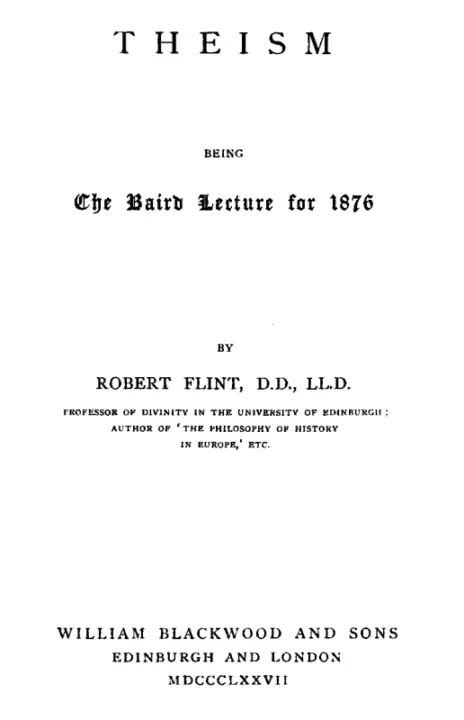
"Theism; Being the Baird Lecture of 1876" by Robert Flint is a religious philosophical treatise written in the late 19th century. The work delves into the nature and validity of belief in God, exploring whether theism can be rationally justified over anti-theistic theories. Flint highlights the importance of understanding the nature of God as a self-existent, perfect being and the implications of belief in God on morality and society. The opening of this volume introduces significant questions regarding the rationality of religious belief. Flint posits that the inquiry should explore the existence of a divine being and whether such belief is justified. He emphasizes that religious belief must be rooted in knowledge, not mere feelings, and lays the groundwork for a thorough examination of theistic proofs by discussing the historical and philosophical context of theism. Flint argues that a worldview devoid of a divine entity ultimately deprives religious experiences of truth and meaning, leading to the idea that all human thought and morality is interconnected with the existence of God.
Introduction adapted from the source catalogue; source summaries may be automatically generated.
Free to read · English · 107,012 words · No account needed
MAKE TIME FOR A GOOD BOOK
On by default. Untick to stop anonymous reading totals. Each page counts after 10 seconds in view. How this works.
Anonymous counting is on unless you have switched it off.
The Stoic philosopher Cleanthes, author of the famous Hymn to Zeus, argued that every comparison, in affirming or denying one thing to be better than another, implied and presupposed the existence of a superlative or an absolutely good and perfect Being. Centuries later, Boethius had recourse to nearly identical reasoning. It is only, he maintained, through the idea of perfection that we can judge anything to be imperfect; and the consciousness or perception of imperfection leads reason necessarily to believe that there is a perfect existence--one than whom a better cannot be conceived--God. Cleanthes and Boethius were thus the precursors of Anselm, who was, however, the first to endeavour to show that from the very idea of God as the highest Being His necessary reality may be strictly deduced. In consequence, Anselm was the founder of that kind of argumentation which, in the opinion of many, is alone entitled to be described as a priori or ontological. He reasoned thus: "The fool may say in his heart, There is no God; but he only proves thereby that he is a fool, for what he says is self-contradictory. Since he denies that there is a God, he has in his mind the idea of God, and that idea implies the existence of God, for it is the idea of a Being than which a higher cannot be conceived. That than which a higher cannot be conceived cannot exist merely as an idea, because what exists merely as an idea is inferior to what exists in reality as well as in idea. The idea of a highest Being which exists merely in thought, is the idea of a highest Being which is not the highest even in thought, but inferior to a highest Being which exists in fact as well as in thought." This reasoning found unfavourable critics even among the contemporaries of Anselm, and has commended itself completely to few. Yet it may fairly be doubted whether it has been conclusively refuted, and some of the objections most frequently urged against it are certainly inadmissible. It is no answer to it, for example, to deny that the idea of God is innate or universal. The argument merely assumes that he who denies that there is a God must have an idea of God. There is also no force, as Anselm showed, in the objection of Gaunilo, that the existence of God can no more be inferred from the idea of a perfect being, than the existence of a perfect island is to be inferred from the idea of such an island. There neither is nor can be an idea of an island which is greater and better than any other that can ever be conceived. Anselm could safely promise that he would make Gaunilo a present of such an island when he had really imagined it. Only one being--an infinite, independent, necessary being--can be perfect in the sense of being greater and better than every other conceivable being. The objection that the ideal can never logically yield the real--that the transition from thought to fact must be in every instance illegitimate--is merely an assertion that the argument is fallacious. It is an assertion which cannot fairly be made until the argument has been exposed and refuted. The argument is that a certain thought of God is found necessarily to imply His existence. The objection that existence is not a predicate, and that the idea of a God who exists is not more complete and perfect than the idea of a God who does not exist, is, perhaps, not incapable of being satisfactorily repelled. Mere existence is not a predicate, but specifications or determinations of existence are predicable. Now the argument nowhere implies that existence is a predicate; it implies only that reality, necessity, and independence of existence are predicates of existence; and it implies this on the ground that existence in re can be distinguished from existence in conceptu, necessary from contingent existence, self-existence from derived existence. Specific distinctions must surely admit of being predicated. That the exclusion of existence--which here means real and necessary existence--from the idea of God does not leave us with an incomplete idea of God, is not a position, I think, which can be maintained. Take away existence from among the elements in the idea of a perfect being, and the idea becomes either the idea of a nonentity or the idea of an idea, and not the idea of a perfect being at all. Thus, the argument of Anselm is unwarrantably represented as an argument of four terms instead of three. Those who urge the objection seem to me to prove only that if our thought of God be imperfect, a being who merely realised that thought would be an imperfect being; but there is a vast distance between this truism and the paradox that an unreal being may be an ideally perfect being.
Your reading position is saved on this browser. Take it to another device with a library code. Reading pages adapt to text, rather than matching a printed edition.
BEHIND THE BOOK
This eBook is for the use of anyone anywhere in the United States and most other parts of the world at no cost and with almost no restrictions whatsoever. You may copy it, give it away or re-use it under the terms of the Project Gutenberg License included with this eBook or online at www.gutenberg.org. If you are not located in the United States, you will have to check the laws of the country where you are located before using this eBook. Read the source licence.
The original source file, including credits and licence, is retained by this library. Request an original-format copy at no charge. Please include the book title and Project Gutenberg identifier #45850.
KEEP YOUR CURIOSITY GOING
David Patterson (Spirit) Hatch

David Patterson (Spirit) Hatch

David Patterson (Spirit) Hatch
Coulson Kernahan

Ralph Waldo Emerson
Frances Wright