
Last letters from the living dead man
David Patterson (Spirit) Hatch
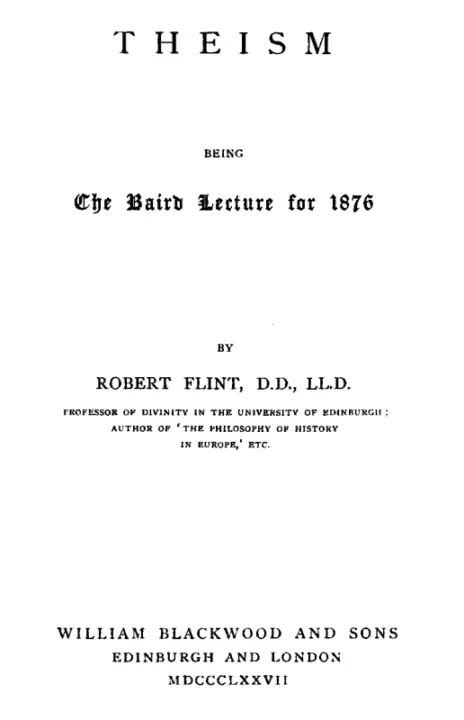
THE CLASSIC COLLECTION · 1877
"Theism; Being the Baird Lecture of 1876" by Robert Flint is a religious philosophical treatise written in the late 19th century. The work delves into the nature and validity of belief in God, exploring whether theism can be rationally justified over anti-theistic theories. Flint highlights the importance of understanding the nature of God as a self-existent, perfect being and the implications of belief in God on morality and society. The opening of this volume introduces significant questions regarding the rationality of religious belief. Flint posits that the inquiry should explore the existence of a divine being and whether such belief is justified. He emphasizes that religious belief must be rooted in knowledge, not mere feelings, and lays the groundwork for a thorough examination of theistic proofs by discussing the historical and philosophical context of theism. Flint argues that a worldview devoid of a divine entity ultimately deprives religious experiences of truth and meaning, leading to the idea that all human thought and morality is interconnected with the existence of God.
Introduction adapted from the source catalogue; source summaries may be automatically generated.
Free to read · English · 107,012 words · No account needed
MAKE TIME FOR A GOOD BOOK
On by default. Untick to stop anonymous reading totals. Each page counts after 10 seconds in view. How this works.
Anonymous counting is on unless you have switched it off.
"We have not wings, we cannot soar,
But we have feet to scale and climb
By slow degrees, by more and more,
The cloudy summits of our time."
It must be added that whoever acknowledges Christianity to be a revelation from God, must see in it reasons which go far to explain the permission of sin. There is, it is true, in the authoritative records of the Christian religion, the Hebrew and Greek Scriptures, no explanation of the origin of moral evil as a speculative problem. The account of the first parents of the human race introducing sin into the world by yielding to the seduction of a being who had himself sinned, is wholly of a historical character, and can neither be compared nor contrasted with the theories of philosophers as to the nature, possibility, and cause of sin. To measure the one by the others, or to set the one over against the others, is to do injustice both to Scripture and philosophy. But the whole scheme of Christianity must seem to those who accept it the strongest possible of practical grounds for the Divine permission of man's abuse of freewill. The existence of sin has, according to the Christian view, been the occasion and condition of a manifestation of the Divine character far more glorious than that which had been given by the creation of the heavens and the earth. It called forth a display of justice, love, and mercy before which all moral beings in the universe may well bow down in wonder and adoration, and man especially with unspeakable gratitude. If God has really manifested Himself in Christ for the reconciliation of the world to Himself, His permission of sin has certainly to all practical intents been amply justified.
But I must conclude. Let it be in leaving with you the lesson that belief in conscience and belief in God--belief in the moral order of the universe and belief in a moral Governor and Judge--are most intimately connected and mutually support each other. Many of you will remember how Robertson of Brighton,--when describing the crisis of the conflict between doubt and faith in the awful hour in which, as he says, life has lost its meaning, and the grave appears to be the end of all, and the sky above the universe is a dead expanse, black with the void from which God has disappeared,--tells us that he knows but of one way in which a man may come forth from this agony scatheless--namely, by holding fast to those things which are certain still, the grand, simple landmarks of morality. "In the darkest hour," are his words, "through which a human soul can pass, whatever else is doubtful, this at least is certain,--If there be no God, and no future state, even then, it is better to be generous than selfish, better to be chaste than licentious, better to be brave than to be a coward. Blessed, beyond all earthly blessedness, is the man who in the tempestuous darkness of the soul has dared to hold fast to these venerable landmarks. Thrice blessed is he who, when all is drear and cheerless within and without, when his teachers terrify him and his friends shrink from him, has obstinately clung to moral good. Thrice blessed, because his night shall pass into clear bright day." Now there is a great truth, a most sacred and solemn truth, in these words. But it is only a half truth, and it should not be mistaken for the whole truth. It is not less true, and it is true, perhaps, of a far greater number of human souls, that there are dark and dreadful hours when they are tempted to believe that virtue is but a name, that generosity is not better than selfishness, truth not better than falsehood, and the courage which defends a post of dangerous duty not better than the cowardice which abandons it; and in these hours I know not how the soul is to regain its trust in human goodness, except by holding fast its faith in Divine goodness; or how it can be strengthened to cling to what is right, except by cleaving to God. It is as possible to doubt of the authority of conscience as to doubt of the existence of God. There are few souls which have not their Philippi, when they are tempted to cry like Brutus, "O virtue, thou art but an empty name!" Blessed in such an hour is he who, feeling himself to be sinking in gloomy waters, cries to that God who is able to rescue him from the abyss, and clings to that justice in heaven which is the pledge that justice will be done on earth below. Thrice blessed, because he will be guided through the darkness of a sea of doubts even thus terrible to a haven of light and safety. Faith in duty helps us to faith in God: faith in God helps us to faith in duty. Duty and God, God and duty, that is the full truth.[46]
Your reading position is saved on this browser. Take it to another device with a library code. Reading pages adapt to text, rather than matching a printed edition.
BEHIND THE BOOK
This eBook is for the use of anyone anywhere in the United States and most other parts of the world at no cost and with almost no restrictions whatsoever. You may copy it, give it away or re-use it under the terms of the Project Gutenberg License included with this eBook or online at www.gutenberg.org. If you are not located in the United States, you will have to check the laws of the country where you are located before using this eBook. Read the source licence.
The original source file, including credits and licence, is retained by this library. Request an original-format copy at no charge. Please include the book title and Project Gutenberg identifier #45850.
KEEP YOUR CURIOSITY GOING
David Patterson (Spirit) Hatch

David Patterson (Spirit) Hatch

David Patterson (Spirit) Hatch
Coulson Kernahan

Ralph Waldo Emerson
Frances Wright