
Last letters from the living dead man
David Patterson (Spirit) Hatch
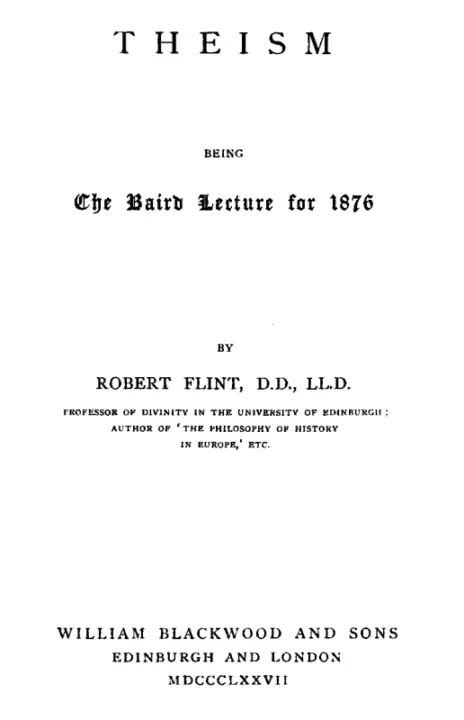
THE CLASSIC COLLECTION · 1877
"Theism; Being the Baird Lecture of 1876" by Robert Flint is a religious philosophical treatise written in the late 19th century. The work delves into the nature and validity of belief in God, exploring whether theism can be rationally justified over anti-theistic theories. Flint highlights the importance of understanding the nature of God as a self-existent, perfect being and the implications of belief in God on morality and society. The opening of this volume introduces significant questions regarding the rationality of religious belief. Flint posits that the inquiry should explore the existence of a divine being and whether such belief is justified. He emphasizes that religious belief must be rooted in knowledge, not mere feelings, and lays the groundwork for a thorough examination of theistic proofs by discussing the historical and philosophical context of theism. Flint argues that a worldview devoid of a divine entity ultimately deprives religious experiences of truth and meaning, leading to the idea that all human thought and morality is interconnected with the existence of God.
Introduction adapted from the source catalogue; source summaries may be automatically generated.
Free to read · English · 107,012 words · No account needed
MAKE TIME FOR A GOOD BOOK
On by default. Untick to stop anonymous reading totals. Each page counts after 10 seconds in view. How this works.
Anonymous counting is on unless you have switched it off.
I may add, that when a man argues, as Comte does, that we can know nothing of final causes, nothing of the purposes which things are meant to accomplish, and yet that they might have realised their final causes, fulfilled their purposes, better than they do, he obviously takes up a very untenable and self-contradictory position. If we can have no notion of the purpose of a thing, we cannot judge whether it is fulfilling its purpose or not, whether it is fulfilling it well or ill. The denial of the possibility of knowing the ends of things is inconsistent with the assertion that things might have been constituted and arranged in a happier and more advantageous manner.
Organic nature has been still more severely criticised than the inorganic world. There have been pointed out a few fully developed organs, as, for example, the spleen, of which the uses are unknown, and a multitude of organs so imperfectly developed as to be incapable of performing any serviceable functions. Even the most elaborate organisms have been maintained to have essential defects; thus the eye has been argued by Helmholtz to be not a perfect optical instrument, and on the strength of the proof one writer at least has declared that if a human optician were to blunder as badly as the supposed author of eyes must have done, he would be hissed out of his trade. Stress has been laid on the fact that abortions and monsters are not rare. Many seemingly intelligent contrivances, we are reminded, serve mainly to inflict pain and destruction. And the inference has been drawn that the first cause of organic existences was not Divine Wisdom but mere matter and blind force.
The considerations which have already been brought forward should enable us to answer all reasonings of this kind. An organ is not to be pronounced useless because its uses have not yet been discovered. To the extent that evolutionism is true, rudimentary and obsolete organs are accounted for, and the wisdom displayed in them amply vindicated; and if evolutionism be not true, they can still be explained on the theory of types. They are stages in the realisation of the Divine conception; indications of an order which comprehends and conditions the law of use and contrivance for use; keys to the understanding of the Divine plan. Theism cannot have much to fear from the fact that all human eyes are limited in their range and finite in their perfections, or even from the fact that a great many persons have very bad eyesight. Whatever may be its imperfections, the eye, if viewed with a comprehensive regard to its manifold uses and possibilities, must be admitted by every unprejudiced judge to be incomparably superior to every other optical instrument: indeed it is the only real optical instrument; all so-called optical instruments are merely aids and supplements to it. If the eye had been absolutely perfect, its modification or evolution could only have been deterioration, artificial optical instruments would not have been needed, and all man's relations to creation must have been essentially different from what they are. Who can rationally assure us that this was to be desired? Abortions and monsters are at least exceptions. If mind were not what is ultimate in the universe--if nature worked blindly--if there were any truth in what Lange and Huxley have said of her procedure, that it is "like shooting a million or more loaded guns in a field to kill one hare,"--this could not be the case; the bullets which miss would then be incalculably more numerous than those which hit, and the evidence of her failures ought to be strewn far more thickly around us than the remains of her successes; there would be, as it were, no course of nature because of the multitude of deviations, no rule in nature because of the multitude of exceptions. But what are the facts? These: the lowest organisms are as perfectly adapted to their circumstances as the highest, the earliest as the latest; there is a vast amount of death and a vast amount of life in the world, but, whatever some men may thoughtlessly assert, no man can show that there is too much of either, any real waste, if the wants of creation as a whole are to be provided for; abortions and monsters, which are the only things in nature which can be plausibly characterised as "failures," as "bullets which have fallen wide of the mark," are comparatively few and far between; and the monsters, even, are not really exceptions to law and order, are not strictly monsters. The labours of teratologists have scientifically established the grand general result that there are no monsters in nature in the sense which Empedocles imagined; none except in the sense in which a man who gets his leg broken is a monster. A monster is simply a being to whom an accident not fatal has happened in the womb. Why should an accident not occur there as well as elsewhere? Why should God not act by general laws there as well as elsewhere? Who is entitled to say that any result of His general laws is a failure; that any so-called accident was not included in His plan; that a world in which a child could not be born deformed nor a grown man have a leg broken, would be, were all things taken into account, as good as the world in which we actually live? Huxley, Lange, and those whom they represent, have failed to show us any of nature's "bullets which have missed the mark," and have not sufficiently, I think, realised how imperfect might be their own perception of nature's target. The contrivances for the infliction of pain and death displayed in the structure of animals of prey are none the less evidences of intelligence because they are not also, at least immediately or directly, evidences of beneficence. Intelligence is one thing, benevolence is another, and what conclusively disproved benevolence might conclusively prove intelligence.[44]
Your reading position is saved on this browser. Take it to another device with a library code. Reading pages adapt to text, rather than matching a printed edition.
BEHIND THE BOOK
This eBook is for the use of anyone anywhere in the United States and most other parts of the world at no cost and with almost no restrictions whatsoever. You may copy it, give it away or re-use it under the terms of the Project Gutenberg License included with this eBook or online at www.gutenberg.org. If you are not located in the United States, you will have to check the laws of the country where you are located before using this eBook. Read the source licence.
The original source file, including credits and licence, is retained by this library. Request an original-format copy at no charge. Please include the book title and Project Gutenberg identifier #45850.
KEEP YOUR CURIOSITY GOING
David Patterson (Spirit) Hatch

David Patterson (Spirit) Hatch

David Patterson (Spirit) Hatch
Coulson Kernahan

Ralph Waldo Emerson
Frances Wright