
Last letters from the living dead man
David Patterson (Spirit) Hatch
THE CLASSIC COLLECTION · 1877
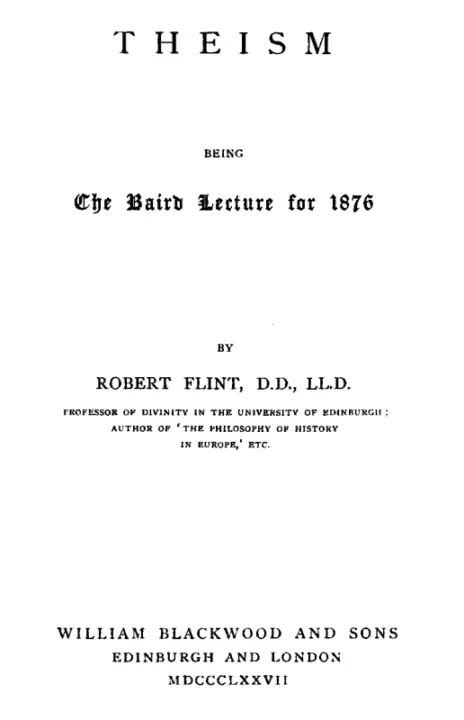
"Theism; Being the Baird Lecture of 1876" by Robert Flint is a religious philosophical treatise written in the late 19th century. The work delves into the nature and validity of belief in God, exploring whether theism can be rationally justified over anti-theistic theories. Flint highlights the importance of understanding the nature of God as a self-existent, perfect being and the implications of belief in God on morality and society. The opening of this volume introduces significant questions regarding the rationality of religious belief. Flint posits that the inquiry should explore the existence of a divine being and whether such belief is justified. He emphasizes that religious belief must be rooted in knowledge, not mere feelings, and lays the groundwork for a thorough examination of theistic proofs by discussing the historical and philosophical context of theism. Flint argues that a worldview devoid of a divine entity ultimately deprives religious experiences of truth and meaning, leading to the idea that all human thought and morality is interconnected with the existence of God.
Introduction adapted from the source catalogue; source summaries may be automatically generated.
Free to read · English · 107,012 words · No account needed
MAKE TIME FOR A GOOD BOOK
On by default. Untick to stop anonymous reading totals. Each page counts after 10 seconds in view. How this works.
Anonymous counting is on unless you have switched it off.
"He that has light within his own clear breast,
May sit in the centre, and enjoy bright day;
But he that hides a dark soul and foul thoughts,
Benighted walks under the mid-day sun--
Himself is his own dungeon."[40]
[40] See Appendix XXIX.
When we look from individuals to societies, we perceive the same truth confirmed on a more comprehensive and conspicuous scale. It is true that in the social world there are bad triumphs and impious successes--that the victory of good over evil is often reached only after a long series of defeats. But it is equally true that the welfare of society is dependent on a practical recognition of moral principles--that the laws of morality are conditions of the progress, and even of the existence, of society. A cynical moralist of the eighteenth century maintained that private vices were public benefits; but, of course, his sophisms were easily exposed: he failed to convince any one of the correctness of his paradox. No inductive truth can be easier to establish, or better established, than that righteousness exalteth a nation, while sin lowers and destroys it. The vicious affections which torment and debase isolated men, equally disturb and degrade a tribe or nation. The virtuous affections which diffuse peace and happiness in a single heart, equally spread harmony and prosperity through the largest community. Thus the general conditions of social life testify that God loves virtue and hates vice. Then, if we examine history as a whole, we cannot but recognise that it has been in the main a process of moral progress, of moral growth. The children of the present day may be born with no better dispositions than those of five thousand years ago, and men may be now as guilty, as wilful sinners against what they know to be right, as ever they were; in that sense there may be no moral progress; but of this there can be, I think, no reasonable doubt in the mind of any impartial student of history, that the thoughts of men have been surely, if slowly, widened as to liberty, chastity, justice, benevolence, piety--and that their feelings have been correspondingly modified, their manners refined, and their laws and institutions improved. There may be no such thing as the inheritance or transmission of virtue, and every step of moral advance may have to be gained by the free exertion of each individual, people, and generation in succession; but, as a matter of fact, our race does on the whole advance, and not recede, in the path towards good. Just as reason, although it may be feebler than the passions in a short struggle, can always conquer them if it get time to collect its energies--so virtue gains and vice loses advantages with the lapse of years; for, while the prejudices which opposed the former subside and its excellences become ever increasingly apparent, as history flows onward, those who leagued themselves in support of the latter quarrel among themselves, its fascinations decay, and its deformities become more manifest and repulsive. Age is linked to age, and in the struggle of good and evil which pervades all the ages, victory is seen slowly but steadily declaring itself for the good. The vices die--the virtues never die. Some great evils which once afflicted our race have passed away. What great good has ever been lost? Justice carries it over injustice in the end. Now, whatever be the means by which moral progress is brought about, the testimony which it involves as to the moral character of God is none the less certain. The successful application of Darwinian principles, for example, to the explanation of human progress, would be no disproof of design in social evolution. If a natural selection, based on force, were shown to have prepared the way for a natural selection based on craft, which in its turn gave place to justice, and that again to love, God must none the less be credited with having contemplated the final result, and that result must none the less be held to be an indication of His character. When what is called the struggle for existence has been proved to lead, not to the deterioration but to the improvement of life--to the greatest abundance of the highest kinds of life possible in the circumstances--it will have been vindicated and shown to have been a means to secure such ends as a wise and benevolent Being would entertain. When it has been proved to have constrained men gradually to recognise that the virtues are the conditions of the most desirable existence, and that the vices are so many obstacles to the attainment of such an existence, it will have been still further vindicated by having been thus shown to be the mode in which righteousness is realised in the world. It matters little, so far as the religious inference is concerned, after what natural process and by what natural laws moral progress has been brought about; for whatever the process and laws may be discovered to be, they will be those which God has chosen, and will be fitted to show forth the glory of His wisdom, love, and justice.[41]
Your reading position is saved on this browser. Take it to another device with a library code. Reading pages adapt to text, rather than matching a printed edition.
BEHIND THE BOOK
This eBook is for the use of anyone anywhere in the United States and most other parts of the world at no cost and with almost no restrictions whatsoever. You may copy it, give it away or re-use it under the terms of the Project Gutenberg License included with this eBook or online at www.gutenberg.org. If you are not located in the United States, you will have to check the laws of the country where you are located before using this eBook. Read the source licence.
The original source file, including credits and licence, is retained by this library. Request an original-format copy at no charge. Please include the book title and Project Gutenberg identifier #45850.
KEEP YOUR CURIOSITY GOING
David Patterson (Spirit) Hatch

David Patterson (Spirit) Hatch

David Patterson (Spirit) Hatch
Coulson Kernahan

Ralph Waldo Emerson
Frances Wright