THE CLASSIC COLLECTION✦In quest of the perfect bookCLASSIC FREE BOOKS
In quest of the perfect book
William Dana Orcutt
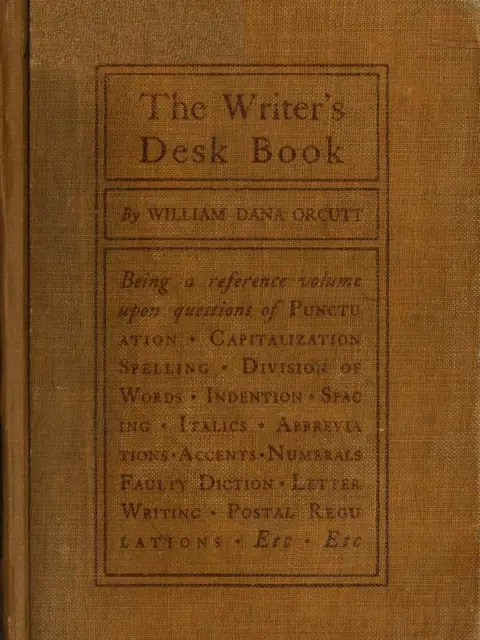
THE CLASSIC COLLECTION · 1912
"The Writer's Desk Book" by William Dana Orcutt is a reference guide on writing mechanics and conventions, likely written in the early 20th century. The book addresses various aspects of writing, including punctuation, capitalization, spelling, and letter writing. It aims to provide clarity and guidance for writers by outlining the rules and principles that enhance effective communication. The opening of the book introduces its nature as a practical reference, listing contents that cover a wide array of topics essential for proper writing. Topics include punctuation marks, rules for capitalization, spelling considerations, as well as guidelines for letter writing and postal regulations. The text emphasizes the importance of correct punctuation and provides detailed rules and examples to ensure clarity and consistency in written communication. This foundational approach suggests that the volume serves as a beneficial tool for both aspiring and seasoned writers seeking to refine their craft.
Introduction adapted from the source catalogue; source summaries may be automatically generated.
Free to read · English · 35,564 words · No account needed
MAKE TIME FOR A GOOD BOOK
On by default. Untick to stop anonymous reading totals. Each page counts after 10 seconds in view. How this works.
Anonymous counting is on unless you have switched it off.
5. In monosyllables and words not accented on the last syllable, an added termination does not double the final consonant when it is preceded by a diphthong or by two vowels: e.g., profit, profited; cancel, canceled; benefit, benefited; equal, equality, novel, novelist, and all the derivatives of parallel.
6. Words which end in any double letters retain the double with a termination not beginning with the same letter. This rule also holds for derivatives formed by means of prefixes: e.g., agreeing, calling, recall. Exceptions: instalment, enrolment, skilful, wilful, enthralment, pontific, withal, until, and similar derivatives.
7. Words ending in -our, the u being unsounded, are spelled -or, with the exception of Saviour and glamour. The English custom is to retain the -our in most words having this ending.
8. Words derived from words ending in silent e after a consonant retain the e when the added termination begins with a consonant: e.g., state, statement, stately; pale, paleness; move, movement. Exceptions: abridgment, {35} acknowledgment, judgment, lodgment, nursling, wholly, wisdom.
When another vowel (except e or i) immediately precedes the final e, the final e is usually dropped before a consonant: e.g., argue, argument; awe, awful; true, truly, etc. There are, however, many exceptions to this rule: e.g., eye, eyesight, etc.
When the termination begins with a vowel, the final e is omitted: e.g., sale, salable; bride, bridal; force, forcible. Exceptions: mileage, etc.
9. When words end in ce or ge the final e is retained before added terminations beginning with a or o: e.g., change, changeable; courage, courageous.
10. In participles the final e is sometimes retained for the purpose of distinguishing them from other words pronounced the same but having a different meaning: e.g., singe, singeing, to distinguish from singing; dye, dyeing, to distinguish from dying, etc. The e is also retained in hoeing, toeing, and shoeing.[3]
[3] See list on page 37.
11. Words ending in ie change their termination to y upon adding ing: e.g., die, dying; vie, vying.
12. Words ending in y preceded by a consonant change the y to i before any added termination not beginning with i: e.g., {36} merry, merriment; happy, happiness. Exceptions: adjectives of one syllable: e.g., dry, dryly; sly, slyness. Also except derivatives formed by adding ship and hood: e.g., suretyship, babyhood; but hardihood.
When the final y is preceded by a vowel, the y is usually changed to i: e.g., gay, gaiety; day, daily; pay, paid; lay, laid, etc.
13. The French ending -re in theater, center, meager, sepulcher, etc., is not now generally considered good usage.
Your reading position is saved on this browser. Take it to another device with a library code. Reading pages adapt to text, rather than matching a printed edition.
William Dana Orcutt
William Dana Orcutt
William Dana Orcutt
William Dana Orcutt
BEHIND THE BOOK
This eBook is for the use of anyone anywhere in the United States and most other parts of the world at no cost and with almost no restrictions whatsoever. You may copy it, give it away or re-use it under the terms of the Project Gutenberg License included with this eBook or online at www.gutenberg.org. If you are not located in the United States, you will have to check the laws of the country where you are located before using this eBook. Read the source licence.
The original source file, including credits and licence, is retained by this library. Request an original-format copy at no charge. Please include the book title and Project Gutenberg identifier #54025.
KEEP YOUR CURIOSITY GOING

Charles G. (Charles Griffith) Ross
Hannah Webster Foster

Emily Lawless
Edwin Hamlin Carr

Charles De Lano Hine
Andrew Ure