THE CLASSIC COLLECTION✦In quest of the perfect bookCLASSIC FREE BOOKS
In quest of the perfect book
William Dana Orcutt
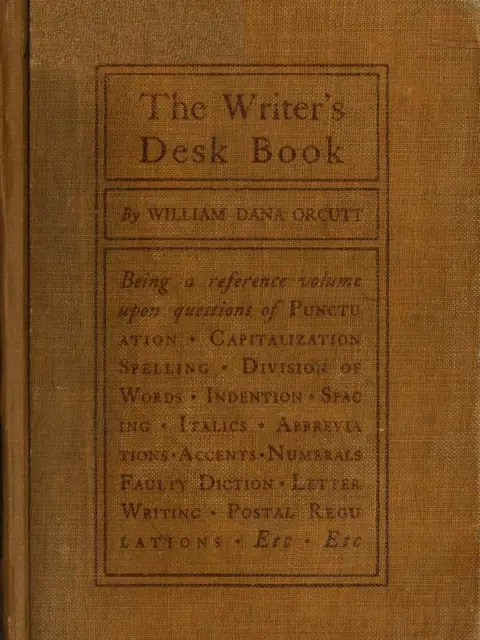
THE CLASSIC COLLECTION · 1912
"The Writer's Desk Book" by William Dana Orcutt is a reference guide on writing mechanics and conventions, likely written in the early 20th century. The book addresses various aspects of writing, including punctuation, capitalization, spelling, and letter writing. It aims to provide clarity and guidance for writers by outlining the rules and principles that enhance effective communication. The opening of the book introduces its nature as a practical reference, listing contents that cover a wide array of topics essential for proper writing. Topics include punctuation marks, rules for capitalization, spelling considerations, as well as guidelines for letter writing and postal regulations. The text emphasizes the importance of correct punctuation and provides detailed rules and examples to ensure clarity and consistency in written communication. This foundational approach suggests that the volume serves as a beneficial tool for both aspiring and seasoned writers seeking to refine their craft.
Introduction adapted from the source catalogue; source summaries may be automatically generated.
Free to read · English · 35,564 words · No account needed
MAKE TIME FOR A GOOD BOOK
On by default. Untick to stop anonymous reading totals. Each page counts after 10 seconds in view. How this works.
Anonymous counting is on unless you have switched it off.
11. In titles of books or essays all words except unimportant adjectives, prepositions, and conjunctions: e.g., The Fall of the House of Usher.
Do not capitalize:
1. Adjectives compounded with an inseparable prefix with proper names; e.g., transatlantic, unamerican.
2. The words apostle, pope, bishop, canon, rector, chaplain, minister, etc., when separated from names or used descriptively: e.g., the apostle Paul; but in direct address they should be capitalized: e.g., “O Apostle Paul.”
Capitalize:
1. Thanksgiving Day, Lord’s Day, New Year’s Day, the Fourth (referring to the {27} Fourth of July), Children’s Day, Easter, Founder’s Day, etc.
2. The word College or University only when part of the title: e.g., Amherst College, Harvard University.
3. Political alliances and terms which have acquired similar significance: e.g., the Dreibund, the Insurgents.
4. Titles of treaties, laws, and acts: e.g., the Treaty of Portsmouth, the Declaration of Independence, the Edict of Nantes.
5. Names of political parties: e.g., Republican, Democrat, etc.; but use lower case for republican form of government, a true democrat, etc., where reference is not made to members of political parties.
6. Names and epithets of races, tribes, and peoples: e.g., Hottentots, Celestials, etc.; but use lower case for negro, colored people, the blacks, the whites, poor whites, etc.
7. Generic parts of names of political divisions (a) when the term is an organic part of the name, directly following the proper name: e.g., the Russian Empire, Norfolk County, etc.; (b) when it is used with the preposition of as an integral part of the name indicating administrative subdivisions of the United States: e.g., Commonwealth of Massachusetts; (c) when it is used singly as designation for a specific division: e.g., the Dominion (of Canada), the Union; (d) when it is used as part of an appellation as though {28} a real geographical name: e.g., the Pine Tree State, the Promised Land; but use lower case for such terms when standing alone or preceding the specific name: e.g., the empire of Germany, the county of Norfolk.
8. Numbered political divisions: e.g., Ward Eleven, Fifth Precinct, Eleventh Congressional District, etc.
Do not capitalize:
1. The words legislature, circuit court, district court, city council, supreme court, senate, and house of representatives except when specifically applied: e.g., the legislature of the State, the circuit court, etc.; but Congress, the Circuit Court of Suffolk County, the House of Representatives of the United States.
2. The words high school, grammar school, except as part of title: e.g., the Dorchester High School; but the high school of Dorchester.
Capitalize:
Your reading position is saved on this browser. Take it to another device with a library code. Reading pages adapt to text, rather than matching a printed edition.
William Dana Orcutt
William Dana Orcutt
William Dana Orcutt
William Dana Orcutt
BEHIND THE BOOK
This eBook is for the use of anyone anywhere in the United States and most other parts of the world at no cost and with almost no restrictions whatsoever. You may copy it, give it away or re-use it under the terms of the Project Gutenberg License included with this eBook or online at www.gutenberg.org. If you are not located in the United States, you will have to check the laws of the country where you are located before using this eBook. Read the source licence.
The original source file, including credits and licence, is retained by this library. Request an original-format copy at no charge. Please include the book title and Project Gutenberg identifier #54025.
KEEP YOUR CURIOSITY GOING

Charles G. (Charles Griffith) Ross
Hannah Webster Foster

Emily Lawless
Edwin Hamlin Carr

Charles De Lano Hine
Andrew Ure