THE CLASSIC COLLECTION✦In quest of the perfect bookCLASSIC FREE BOOKS
In quest of the perfect book
William Dana Orcutt
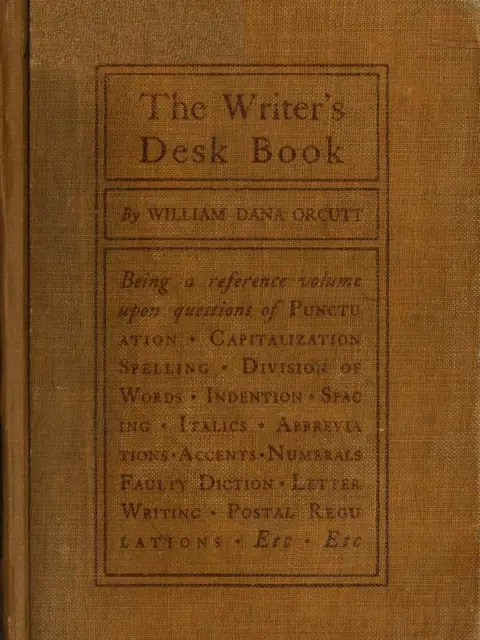
THE CLASSIC COLLECTION · 1912
"The Writer's Desk Book" by William Dana Orcutt is a reference guide on writing mechanics and conventions, likely written in the early 20th century. The book addresses various aspects of writing, including punctuation, capitalization, spelling, and letter writing. It aims to provide clarity and guidance for writers by outlining the rules and principles that enhance effective communication. The opening of the book introduces its nature as a practical reference, listing contents that cover a wide array of topics essential for proper writing. Topics include punctuation marks, rules for capitalization, spelling considerations, as well as guidelines for letter writing and postal regulations. The text emphasizes the importance of correct punctuation and provides detailed rules and examples to ensure clarity and consistency in written communication. This foundational approach suggests that the volume serves as a beneficial tool for both aspiring and seasoned writers seeking to refine their craft.
Introduction adapted from the source catalogue; source summaries may be automatically generated.
Free to read · English · 35,564 words · No account needed
MAKE TIME FOR A GOOD BOOK
On by default. Untick to stop anonymous reading totals. Each page counts after 10 seconds in view. How this works.
Anonymous counting is on unless you have switched it off.
Title-pages, capitalization of certain words, 30.
Titles:
capitalization of, 24–26;
of poems, series, and works of art, to be quoted, 17;
of parables (biblical), capitalization of, 20;
of psalms, capitalization of, 20;
use of colon in literary references, 10–11;
capitalization of compounded, 22;
use of comma separating, from names, 6;
of honor, nobility, and respect, capitalization of, 25;
civil and military, capitalization of, 25;
foreign, capitalization of, 25–26;
of books or essays, capitalization of, 26;
of treaties, laws, and acts, capitalization of, 27;
definite article not treated as part of, in newspapers or
magazines, 30;
“ex,” “vice,” “general,” “elect,” etc., use of hyphen in
connecting, 47;
italicizing of books, newspapers, and periodicals, 62;
abbreviations of, with lists, 68–75;
capitalize when used alone 68–69;
of sovereigns, 69.
“To,” compounds with, 50.
“Too,” correct use of, 112.
“Treat,” followed by of, 112.
Treaties, capitalization of names of, 27.
“Tree,” compounds with, 49.
“Tri-,” compounds with, 50.
Tribes, capitalization of names of, 27.
Troy ounce, uses of the, 154–155.
Troy weight, table of, 150.
“Try,” followed by to, 112.
Two-letter syllables, avoid division of, 53.
“Ugly,” correct use of, 112.
Ult., not used, 65.
“Ultra,” compounds with, 48.
“Un-” (negative prefix), compounds with, 50.
“Under,” compounds with, 50.
“United States,” when abbreviated, 66.
Units of measure, not capitalized, 29–30.
Unity of paragraphs, 57.
“University,” capitalization of, 27.
Unknown quantities: algebraic, geometric, etc., italicized, 64.
Your reading position is saved on this browser. Take it to another device with a library code. Reading pages adapt to text, rather than matching a printed edition.
William Dana Orcutt
William Dana Orcutt
William Dana Orcutt
William Dana Orcutt
BEHIND THE BOOK
This eBook is for the use of anyone anywhere in the United States and most other parts of the world at no cost and with almost no restrictions whatsoever. You may copy it, give it away or re-use it under the terms of the Project Gutenberg License included with this eBook or online at www.gutenberg.org. If you are not located in the United States, you will have to check the laws of the country where you are located before using this eBook. Read the source licence.
The original source file, including credits and licence, is retained by this library. Request an original-format copy at no charge. Please include the book title and Project Gutenberg identifier #54025.
KEEP YOUR CURIOSITY GOING

Charles G. (Charles Griffith) Ross
Hannah Webster Foster

Emily Lawless
Edwin Hamlin Carr

Charles De Lano Hine
Andrew Ure