THE CLASSIC COLLECTION✦In quest of the perfect bookCLASSIC FREE BOOKS
In quest of the perfect book
William Dana Orcutt
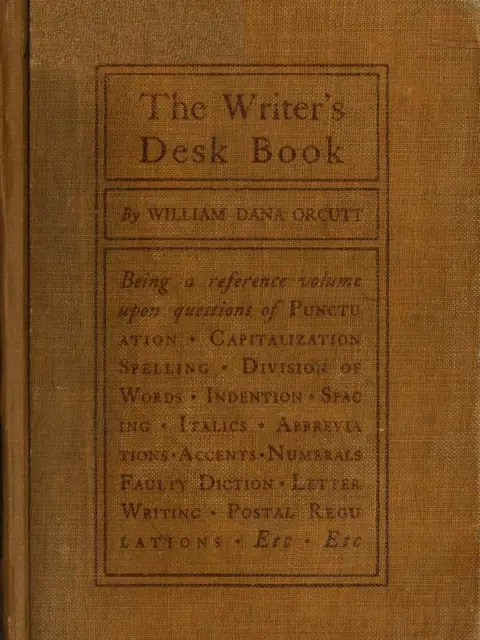
THE CLASSIC COLLECTION · 1912
"The Writer's Desk Book" by William Dana Orcutt is a reference guide on writing mechanics and conventions, likely written in the early 20th century. The book addresses various aspects of writing, including punctuation, capitalization, spelling, and letter writing. It aims to provide clarity and guidance for writers by outlining the rules and principles that enhance effective communication. The opening of the book introduces its nature as a practical reference, listing contents that cover a wide array of topics essential for proper writing. Topics include punctuation marks, rules for capitalization, spelling considerations, as well as guidelines for letter writing and postal regulations. The text emphasizes the importance of correct punctuation and provides detailed rules and examples to ensure clarity and consistency in written communication. This foundational approach suggests that the volume serves as a beneficial tool for both aspiring and seasoned writers seeking to refine their craft.
Introduction adapted from the source catalogue; source summaries may be automatically generated.
Free to read · English · 35,564 words · No account needed
MAKE TIME FOR A GOOD BOOK
On by default. Untick to stop anonymous reading totals. Each page counts after 10 seconds in view. How this works.
Anonymous counting is on unless you have switched it off.
Contraction of word, use of apostrophe, 19.
Conventions, capitalization of names of, 25.
Co-ordinate clauses. See Clauses.
Corporations, capitalization of names, of abbreviations, and of
“Co.,” 23.
Corrections, indicated by use of brackets, 18.
Correctness, a requisite of discourse, 99.
Credits, italicizing of, 62.
Criticisms, indicated by use of brackets, 18.
Cuba, postal rates to, 135.
Cubic measure, table of, 152.
Cut-in side notes, omission of period after, 12.
Dashes:
use of, with changed construction, dates, abrupt terminations,
rhetorical emphasis, verse and page references, short, snappy
sentences, omitted letters, concluding clauses, 13;
for separating subject-matter from its authority, 13;
to precede addition to completed sentence, 14;
substitution of, for commas or parenthesis, 14;
with colon, to mark long quotation, 14;
substitution of, for quotation-marks, 14;
misuse of, 12;
rules for, 13–14;
use in France, 14;
use of hair-space with, 59;
examples of, 60;
use of in salutatory phrases of letters, 117.
“Data,” plural of datum, 109.
Date-lines, omission of period after, 12.
Dates:
use of dash to connect, 13;
abbreviation of, 65–66;
st, d, rd, and th, to be omitted, 65;
of letters, where placed, when capitalized and italicized, 30;
ult., inst., and prox., not used, 65;
the Dewey, 66;
of letters, 115.
“Daughter,” compounds with, 47.
Days of week:
capitalization of, 23;
abbreviation of, 65–66.
“Deadly,” correct use of, 103.
Decades, specific references to, spelled out, 32.
“Decided,” correct use of, 104.
“Definite,” correct use of, 104.
Degrees:
capitalization and abbreviations of, 25;
use of comma separating, from name of person, 6.
“Demean,” correct use of, 104.
“Demi,” compounds with, 50.
Dependent clauses, use of comma, 6.
Derivation, influence of, in division, 52, 53.
“Deutero,” compounds with, 51.
Devil. See Evil One.
Dewey abbreviations of dates, the, 66.
Diction,
correct and faulty, 99–113;
Dr. Campbell’s canons, 99;
use of standard authors, 100;
list of words and phrases, 101–113.
Dictionary, the function of, 100.
“Different,” correct use of, 104.
Diphthongs, general rules for, 33.
Directions, use of brackets in indicating, 18.
“Directly,” use of, 104.
Disbelief, in statement, indicated by use of exclamation-point, 15.
“Discover,” correct use of, 104.
Display composition, use of period after, 12.
Division of words:
rules for, 52–54;
avoid unnecessary, 52;
on two letters to be avoided, 53.
Divisional mark, avoid separating from matter it pertains to, 54.
Dollars ($),
no space between symbol and following figures, 60;
table of monetary signs, 90–91.
Domestic postal rates, 134.
“Donne,” plural of donna, 109.
“Don’t,” correct use of, 104.
Drop-folios, enclosed by brackets, 18.
Dry measure, table of, 150.
Dynasties:
capitalization of names, 29;
numbers of, to be spelled out, 32.
“Each other,” correct use of, 104.
Ecclesiastical appellations, capitalization of, 26.
“Effect,” correct use of, 104.
e.g., set in roman, 64.
“Egoists,” correct use of, 104.
“Either,” correct use of, 104.
“Elect,” compounds with, 47.
Electrical measures, 155–156.
“Electro,” compounds with, 51.
Ellipses:
comma indicating, 7;
period indicating, 12;
to be treated as part of quotation, 17.
Emphasis, rhetorical:
use of dash to secure, 13;
of exclamation-point, 15;
of paragraph, 57–58;
of italics, 62.
En échelon indention:
described, 56;
use of in addressing letters, 116;
“Enormity,” correct use of, 104.
“Enthuse,” (verb) correct use of, 104.
Your reading position is saved on this browser. Take it to another device with a library code. Reading pages adapt to text, rather than matching a printed edition.
William Dana Orcutt
William Dana Orcutt
William Dana Orcutt
William Dana Orcutt
BEHIND THE BOOK
This eBook is for the use of anyone anywhere in the United States and most other parts of the world at no cost and with almost no restrictions whatsoever. You may copy it, give it away or re-use it under the terms of the Project Gutenberg License included with this eBook or online at www.gutenberg.org. If you are not located in the United States, you will have to check the laws of the country where you are located before using this eBook. Read the source licence.
The original source file, including credits and licence, is retained by this library. Request an original-format copy at no charge. Please include the book title and Project Gutenberg identifier #54025.
KEEP YOUR CURIOSITY GOING

Charles G. (Charles Griffith) Ross
Hannah Webster Foster

Emily Lawless
Edwin Hamlin Carr

Charles De Lano Hine
Andrew Ure