
Last letters from the living dead man
David Patterson (Spirit) Hatch
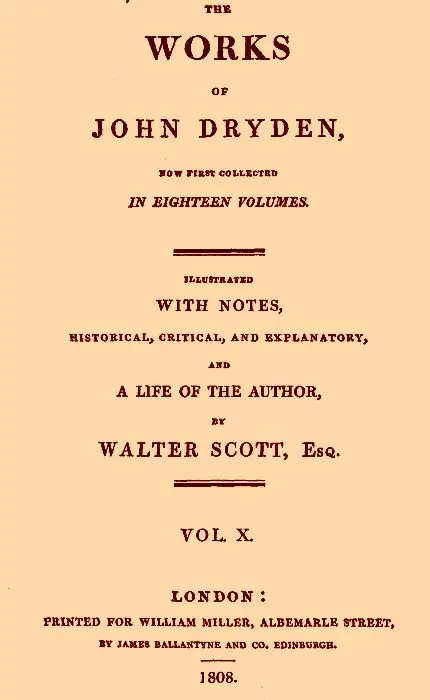
THE CLASSIC COLLECTION · 1633
"The Works of John Dryden, now first collected in eighteen volumes. Volume 10" is a collection of literary works, specifically poetry and essays, compiled from the writings of John Dryden and published during the early 19th century. This volume includes Dryden's poem "Religio Laici," which discusses theological matters and presents his perspectives on faith and religion amidst the complexities of his time. The works likely engage with themes of Christianity, sectarianism, and personal belief. The opening of this volume presents "Religio Laici," an epistolary poem where Dryden articulates his beliefs as a layman amidst a tumultuous religious landscape. He navigates the contentious debates between various religious factions, aiming for a rational exposition of faith that reconciles differing viewpoints. Dryden addresses objections to revealed religion versus rational inquiry, emphasizing the importance of individual reason tempered with faith. His arguments suggest a yearning for a balanced perspective, advocating for personal conviction while also acknowledging the authority of the Church of England despite recognizing the shortcomings within traditions.
Introduction adapted from the source catalogue; source summaries may be automatically generated.
Free to read · English · 135,998 words · No account needed
MAKE TIME FOR A GOOD BOOK
On by default. Untick to stop anonymous reading totals. Each page counts after 10 seconds in view. How this works.
Anonymous counting is on unless you have switched it off.
[Footnote 95: The Roman Catholic church.]
[Footnote 96: Note I.]
[Footnote 97: The Roman Catholic priests executed in England, at different times since the Reformation, and regarded as martyrs and saints by those of their communion.]
[Footnote 98: The Independents. See Note II.]
[Footnote 99: The Quakers. See Note III.]
[Footnote 100: Free-thinkers. See Note IV.]
[Footnote 101: Anabaptists. See Note V.]
[Footnote 102: Unitarians. See Note VI.]
[Footnote 103: See Introductory remarks.]
[Footnote 104: Note VII.]
[Footnote 105: Quasi By-land-er, an old word for a boat, used in
coast navigation.]
[Footnote 106: Note VIII.]
[Footnote 107: Alluding to the classical ordination, which the Presbyterian church has adopted, instead of that by Bishops.]
[Footnote 108: Geneva, the cradle of Calvinism. The territories of the little republic, dum Troja fuit, were bounded by its ramparts and lake.]
[Footnote 109: Alluding to the recall of the Edict of Nantz, and persecution of the Huguenots. See Note IX.]
[Footnote 110: Which is usually distinguished by an act of grace, or
general pardon.]
[Footnote 111: Nimrod.]
[Footnote 112: Jesus Christ.]
[Footnote 113: King James II.]
[Footnote 114: Note X.]
[Footnote 115: Our author recollected his own Philidel in "King Arthur:"
An airy shape, the tenderest of my kind,
The last seduced and least deformed of hell;
Half-white, and shuffled in the crowd I fell,
Desirous to repent and loath to sin,
Awkward in mischief, piteous of mankind;
My name is Philidel, my lot in air,
Where, next beneath the moon, and nearest heaven,
I soar, I have a glimpse to be received.
Vol. VIII. p. 135.
]
[Footnote 116: Henry the Eighth's passion for Anna Bullen led the way
to the Reformation.]
[Footnote 117: The marriage of the clergy, licensed by the Reformation.]
[Footnote 118: Worn out, or become hagard.]
[Footnote 119: A Popish advocate, in the controversy with Tennison, tells us exultingly, "That Martin Luther himself, Dr T's excellent instrument, after he had eat a feasting supper, and drank lutheranice, as the German proverb has it, was called into another world at two o'clock in the night, February 18, 1546." This was one of the reasons why his adversaries alleged, that Martin Luther set sail for hell in the manner described by Sterne, in his tale from Slawkenbergius.]
[Footnote 120: The king being owned the head of the church of England, contrary to the doctrine of the other reformed churches.]
[Footnote 121: Phylacteries are little scrolls of parchment worn by the Jews on their foreheads and wrists, inscribed with sentences from the law. They are supposed, as is expressed by the phrase in the original, to have the virtue of preserving the wearer from danger and evil.]
Your reading position is saved on this browser. Take it to another device with a library code. Reading pages adapt to text, rather than matching a printed edition.
BEHIND THE BOOK
This eBook is for the use of anyone anywhere in the United States and most other parts of the world at no cost and with almost no restrictions whatsoever. You may copy it, give it away or re-use it under the terms of the Project Gutenberg License included with this eBook or online at www.gutenberg.org. If you are not located in the United States, you will have to check the laws of the country where you are located before using this eBook. Read the source licence.
The original source file, including credits and licence, is retained by this library. Request an original-format copy at no charge. Please include the book title and Project Gutenberg identifier #51652.
KEEP YOUR CURIOSITY GOING
David Patterson (Spirit) Hatch

David Patterson (Spirit) Hatch

David Patterson (Spirit) Hatch

Ralph Waldo Emerson

Maurice Baring

Oscar Wilde & James McNeill Whistler