
Last letters from the living dead man
David Patterson (Spirit) Hatch
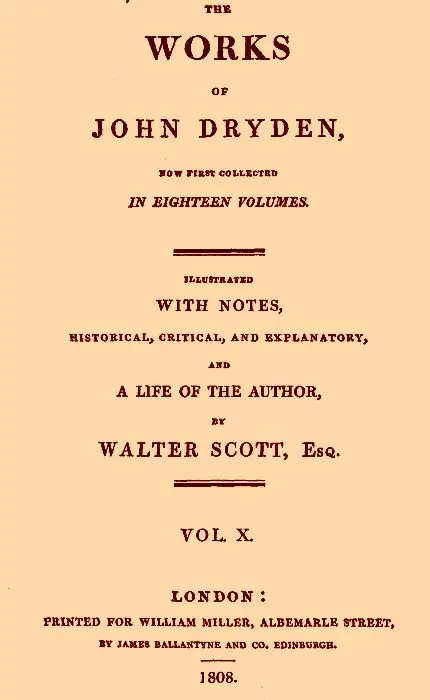
THE CLASSIC COLLECTION · 1633
"The Works of John Dryden, now first collected in eighteen volumes. Volume 10" is a collection of literary works, specifically poetry and essays, compiled from the writings of John Dryden and published during the early 19th century. This volume includes Dryden's poem "Religio Laici," which discusses theological matters and presents his perspectives on faith and religion amidst the complexities of his time. The works likely engage with themes of Christianity, sectarianism, and personal belief. The opening of this volume presents "Religio Laici," an epistolary poem where Dryden articulates his beliefs as a layman amidst a tumultuous religious landscape. He navigates the contentious debates between various religious factions, aiming for a rational exposition of faith that reconciles differing viewpoints. Dryden addresses objections to revealed religion versus rational inquiry, emphasizing the importance of individual reason tempered with faith. His arguments suggest a yearning for a balanced perspective, advocating for personal conviction while also acknowledging the authority of the Church of England despite recognizing the shortcomings within traditions.
Introduction adapted from the source catalogue; source summaries may be automatically generated.
Free to read · English · 135,998 words · No account needed
MAKE TIME FOR A GOOD BOOK
On by default. Untick to stop anonymous reading totals. Each page counts after 10 seconds in view. How this works.
Anonymous counting is on unless you have switched it off.
A milk-white Hind,[95] immortal and unchanged, Fed on the lawns, and in the forest ranged; Without unspotted, innocent within, She feared no danger, for she knew no sin. Yet had she oft been chased with horns and hounds, And Scythian shafts; and many winged wounds Aimed at her heart; was often forced to fly, And doomed to death, though fated not to die.[96] Not so her young; for their unequal line Was hero's make, half human, half divine. Their earthly mould obnoxious was to fate, The immortal part assumed immortal state. Of these a slaughtered army lay in blood,[97] Extended o'er the Caledonian wood, Their native walk; whose vocal blood arose, And cried for pardon on their perjured foes. Their fate was fruitful, and the sanguine seed, Endued with souls, increased the sacred breed. So captive Israel multiplied in chains, A numerous exile, and enjoyed her pains. With grief and gladness mixed, the mother viewed Her martyr'd offspring, and their race renewed; Their corps to perish, but their kind to last, So much the deathless plant the dying fruit surpassed. Panting and pensive now she ranged alone, And wandered in the kingdoms, once her own. The common hunt, though from their rage restrained By sovereign power, her company disdained, Grinned as they passed, and with a glaring eye Gave gloomy signs of secret enmity 'Tis true, she bounded by, and trip'd so light, They had not time to take a steady sight; For truth has such a face and such a mien, As to be loved needs only to be seen. The bloody Bear, an independent beast, Unlicked to form, in groans her hate exprest.[98] Among the timorous kind, the quaking Hare Professed neutrality, but would not swear.[99] Next her the buffoon Ape, as atheists use, Mimicked all sects, and had his own to chuse; Still when the Lion looked, his knees he bent, And paid at church a courtier's compliment.[100] The bristled baptist Boar, impure as he,[101] But whitened with the foam of sanctity, With fat pollutions filled the sacred place,} And mountains levelled in his furious race; } So first rebellion founded was in grace. } But since the mighty ravage, which he made In German forests, had his guilt betrayed, With broken tusks, and with a borrowed name, He shunned the vengeance, and concealed the shame; So lurked in sects unseen. With greater guile False Reynard fed on consecrated spoil;[102] The graceless beast by Athanasius first Was chased from Nice, then by Socinus nursed; His impious race their blasphemy renewed, And nature's king through nature's optics viewed. Reversed, they viewed him lessened to their eye, Nor in an infant could a God descry; New swarming sects to this obliquely tend, Hence they began, and here they all will end. What weight of antient witness can prevail, If private reason hold the public scale? But, gracious God, how well dost thou provide For erring judgments an unerring guide! Thy throne is darkness in the abyss of light, A blaze of glory that forbids the sight. O teach me to believe thee, thus concealed, And search no farther than thyself revealed; But her alone for my director take, Whom thou hast promised never to forsake! My thoughtless youth was winged with vain desires; My manhood, long misled by wandering fires, Followed false lights; and, when their glimpse was gone, My pride struck out new sparkles of her own. Such was I, such by nature still I am; Be thine the glory, and be mine the shame! Good life be now my task; my doubts are done;[103] What more could fright my faith, than three in one? Can I believe eternal God could lie } Disguised in mortal mould, and infancy? } That the great Maker of the world could die?} And after that trust my imperfect sense, Which calls in question his omnipotence? Can I my reason to my faith compel, And shall my sight, and touch, and taste rebel? Superior faculties are set aside; Shall their subservient organs be my guide? Then let the moon usurp the rule of day, And winking tapers shew the sun his way; For what my senses can themselves perceive, I need no revelation to believe. Can they, who say the host should be descried By sense, define a body glorified? Impassable, and penetrating parts? Let them declare by what mysterious arts He shot that body through the opposing might, } Of bolts and bars impervious to the light, } And stood before his train confessed in open sight.[104]} For since thus wondrously he passed, 'tis plain, One single place two bodies did contain; And sure the same Omnipotence as well Can make one body in more places dwell. Let reason then at her own quarry fly, But how can finite grasp infinity? 'Tis urged again, that faith did first commence By miracles, which are appeals to sense, And thence concluded, that our sense must be The motive still of credibility; For latter ages must on former wait, And what began belief, must propagate. But winnow well this thought, and you shall find 'Tis light as chaff that flies before the wind. Were all those wonders wrought by power divine, As means or ends of some more deep design? Most sure as means, whose end was this alone, To prove the Godhead of the Eternal Son. God thus asserted, man is to believe Beyond what sense and reason can conceive, And, for mysterious things of faith, rely On the proponent, heaven's authority. If, then, our faith we for our guide admit, Vain is the farther search of human wit; As when the building gains a surer stay, We take the unuseful scaffolding away. Reason by sense no more can understand; The game is played into another hand. Why chuse we then like bilanders[105] to creep} Along the coast, and land in view to keep, } When safely we may launch into the deep? } In the same vessel, which our Saviour bore, } Himself the pilot, let us leave the shore, } And with a better guide a better world explore.} Could he his Godhead veil with flesh and blood, And not veil these again to be our food? His grace in both is equal in extent, The first affords us life, the second nourishment. And if he can, why all this frantic pain, } To construe what his clearest words contain,} And make a riddle what he made so plain? } To take up half on trust, and half to try, Name it not faith, but bungling bigotry; Both knave and fool the merchant we may call, } To pay great sums, and to compound the small; } For who would break with heaven, and would not break for all?} Rest then, my soul, from endless anguish freed; Nor sciences thy guide, nor sense thy creed. Faith is the best ensurer of thy bliss; The bank above must fail, before the venture miss. But heaven and heaven-born faith are far from thee, Thou first apostate to divinity. Unkennelled range in thy Polonian plains; A fiercer foe the insatiate Wolf remains. Too boastful Britain, please thyself no more, That beasts of prey are banished from thy shore; The bear, the boar, and every savage name, Wild in effect, though in appearance tame, Lay waste thy woods, destroy thy blissful bower, And, muzzled though they seem, the mutes devour. More haughty than the rest, the wolfish race} Appears with belly gaunt, and famished face;} Never was so deformed a beast of grace. } His ragged tail betwixt his legs he wears, } Close clap'd for shame; but his rough crest he rears,} And pricks up his predestinating ears.[106] } His wild disordered walk, his hagard eyes, Did all the bestial citizens surprise. Though feared and hated, yet he ruled a while, As captain or companion of the spoil. Full many a year his hateful head had been For tribute paid, nor since in Cambria seen; The last of all the litter 'scaped by chance, And from Geneva first infested France. Some authors thus his pedigree will trace, But others write him of an upstart race; Because of Wickliffe's brood no mark he brings, But his innate antipathy to kings. These last deduce him from the Helvetian kind, Who near the Leman-lake his consort lined; That fiery Zuinglius first the affection bred, And meagre Calvin blest the nuptial bed. In Israel some believe him whelped long since, When the proud sanhedrim oppressed the prince; Or, since he will be Jew, derive him higher, When Corah with his brethren did conspire From Moses' hand the sovereign sway to wrest, And Aaron of his ephod to divest; 'Till opening earth made way for all to pass, And could not bear the burden of a class.[107] The Fox and he came shuffled in the dark, If ever they were stowed in Noah's ark; Perhaps not made; for all their barking train The dog (a common species) will contain; And some wild curs, who from their masters ran,} Abhorring the supremacy of man, } In woods and caves the rebel-race began. } O happy pair, how well have you increased! What ills in church and state have you redressed! With teeth untried, and rudiments of claws, Your first essay was on your native laws; Those having torn with ease, and trampled down,} Your fangs you fastened on the mitred crown, } And freed from God and monarchy your town. } What though your native kennel still be small, Bounded betwixt a puddle and a wall;[108] Yet your victorious colonies are sent Where the north ocean girds the continent. Quickened with fire below, your monsters breed In fenny Holland, and in fruitful Tweed; And, like the first, the last affects to be Drawn to the dregs of a democracy. As, where in fields the fairy rounds are seen, A rank sour herbage rises on the green; So, springing where those midnight elves advance, Rebellion prints the footsteps of the dance. Such are their doctrines, such contempt they show} To heaven above, and to their prince below, } As none but traitors and blasphemers know. } God like the tyrant of the skies is placed, And kings, like slaves, beneath the crowd debased. So fulsome is their food, that flocks refuse To bite, and only dogs for physic use. As, where the lightning runs along the ground, No husbandry can heal the blasting wound; Nor bladed grass, nor bearded corn succeeds, But scales of scurf and putrefaction breeds; Such wars, such waste, such fiery tracks of dearth Their zeal has left, and such a teemless earth. But, as the poisons of the deadliest kind Are to their own unhappy coasts confined; As only Indian shades of sight deprive, And magic plants will but in Colchos thrive; So presbytery and pestilential zeal Can only flourish in a commonweal. From Celtic woods is chased the wolfish crew;[109] But ah! some pity e'en to brutes is due; Their native walks, methinks, they might enjoy, Curbed of their native malice to destroy. Of all the tyrannies on human-kind, The worst is that which persecutes the mind. Let us but weigh at what offence we strike; 'Tis but because we cannot think alike. In punishing of this, we overthrow The laws of nations and of nature too. Beasts are the subjects of tyrannic sway, Where still the stronger on the weaker prey; Man only of a softer mould is made, Not for his fellows' ruin, but their aid; Created kind, beneficent and free, The noble image of the Deity. One portion of informing fire was given To brutes, the inferior family of heaven. The smith divine, as with a careless beat, Struck out the mute creation at a heat; But, when arrived at last to human race, The Godhead took a deep considering space; And, to distinguish man from all the rest, Unlocked the sacred treasures of his breast; And mercy mixt with reason did impart, One to his head, the other to his heart; Reason to rule, but mercy to forgive; The first is law, the last prerogative. And like his mind his outward form appeared, } When, issuing naked to the wondering herd, } He charmed their eyes; and, for they loved, they feared } Not armed with horns of arbitrary might, } Or claws to seize their furry spoils in fight, } Or with increase of feet to o'ertake them in their flight; } Of easy shape, and pliant every way, } Confessing still the softness of his clay, } And kind as kings upon their coronation day;[110]} With open hands, and with extended space Of arms, to satisfy a large embrace. Thus kneaded up with milk, the new-made man His kingdom o'er his kindred world began; Till knowledge misapplied, misunderstood, And pride of empire, soured his balmy blood. Then, first rebelling, his own stamp he coins; The murderer Cain was latent in his loins; And blood began its first and loudest cry, For differing worship of the Deity. Thus persecution rose, and farther space Produced the mighty hunter[111] of his race. Not so the blessed Pan[112] his flock increased, Content to fold them from the famished beast: Mild were his laws; the sheep and harmless hind Were never of the persecuting kind. Such pity now the pious pastor shows, } Such mercy from the British Lion flows,[113] } That both provide protection from their foes. } Oh happy regions, Italy and Spain, Which never did those monsters entertain! The Wolf, the Bear, the Boar, can there advance No native claim of just inheritance; And self-preserving laws, severe in show, May guard their fences from the invading foe. Where birth has placed them, let them safely share The common benefit of vital air; Themselves unharmful, let them live unharmed, Their jaws disabled, and their claws disarmed; Here, only in nocturnal howlings bold, They dare not seize the Hind, nor leap the fold. More powerful, and as vigilant as they, The Lion awfully forbids the prey. Their rage repressed, though pinched with famine sore, } They stand aloof, and tremble at his roar; } Much is their hunger, but their fear is more. } These are the chief; to number o'er the rest, And stand, like Adam, naming every beast, Were weary work; nor will the muse describe A slimy-born and sun-begotten tribe; Who, far from steeples and their sacred sound, In fields their sullen conventicles found.[114] These gross, half-animated, lumps I leave; Nor can I think what thoughts they can conceive. But if they think at all, 'tis sure no higher Than matter, put in motion, may aspire; Souls that can scarce ferment their mass of clay; } So drossy, so divisible are they, } As would but serve pure bodies for allay; } Such souls as shards produce, such beetle things As only buz to heaven with evening wings; Strike in the dark, offending but by chance, Such are the blindfold blows of ignorance. They know not beings, and but hate a name; To them the Hind and Panther are the same. The Panther, sure the noblest, next the Hind, And fairest creature of the spotted kind; Oh, could her in-born stains be washed away, She were too good to be a beast of prey! How can I praise, or blame, and not offend, Or how divide the frailty from the friend? Her faults and virtues lie so mixed, that she Nor wholly stands condemned, nor wholly free. Then, like her injured Lion, let me speak; He cannot bend her, and he would not break. Unkind already, and estranged in part, The Wolf begins to share her wandering heart. Though unpolluted yet with actual ill, She half commits who sins but in her will. If, as our dreaming platonists report, There could be spirits of a middle sort, Too black for heaven, and yet too white for hell, Who just dropt half-way down, nor lower fell;[115] So poised, so gently she descends from high, It seems a soft dismission from the sky. Her house not ancient, whatsoe'er pretence Her clergy-heralds make in her defence; A second century not half-way run, Since the new honours of her blood begun. A lion, old, obscene, and furious made By lust, compressed her mother in a shade; Then, by a left-hand marriage, weds the dame, Covering adultery with a specious name;[116] So schism begot; and sacrilege and she, A well matched pair, got graceless heresy. God's and kings' rebels have the same good cause, To trample down divine and human laws; Both would be called reformers, and their hate Alike destructive both to church and state. The fruit proclaims the plant; a lawless prince } By luxury reformed incontinence; } By ruins, charity; by riots, abstinence. } Confessions, fasts, and penance set aside, } Oh with what ease we follow such a guide, } Where souls are starved, and senses gratified! } Where marriage-pleasures midnight prayer supply, } And mattin bells, a melancholy cry, } Are tuned to merrier notes, Increase and multiply.[117] } Religion shews a rosy-coloured face; } Not hattered[118] out with drudging works of grace; } A down-hill reformation rolls apace. } What flesh and blood would crowd the narrow gate, } Or, till they waste their pampered paunches, wait? } All would be happy at the cheapest rate. } Though our lean faith these rigid laws has given, The full-fed Musselman goes fat to heaven; For his Arabian prophet with delights Of sense allured his eastern proselytes. The jolly Luther, reading him, began To interpret scriptures by his alcoran; To grub the thorns beneath our tender feet, And make the paths of paradise more sweet, Bethought him of a wife, ere half way gone, For 'twas uneasy travelling alone; And, in this masquerade of mirth and love, Mistook the bliss of heaven for Bacchanals above. Sure he presumed of praise, who came to stock The etherial pastures with so fair a flock, Burnished, and battening on their food, to show Their diligence of careful herds below.[119] Our Panther, though like these she changed her head, Yet, as the mistress of a monarch's bed,[120] Her front erect with majesty she bore, The crosier wielded, and the mitre wore. Her upper part of decent discipline Shewed affectation of an ancient line; And fathers, councils, church and churches head, Were on her reverend phylacteries[121] read. But what disgraced and disavowed the rest, Was Calvin's brand, that stigmatized the beast. Thus, like a creature of a double kind, In her own labyrinth she lives confined; To foreign lands no sound of her is come, Humbly content to be despised at home. Such is her faith, where good cannot be had, At least she leaves the refuse of the bad: Nice in her choice of ill, though not of best, And least deformed, because reformed the least. In doubtful points betwixt her differing friends, Where one for substance, one for sign contends, Their contradicting terms she strives to join;[122] Sign shall be substance, substance shall be sign. A real presence all her sons allow, } And yet 'tis flat idolatry to bow, } Because the god-head's there they know not how.} Her novices are taught, that bread and wine} Are but the visible and outward sign, } Received by those who in communion join; } But the inward grace, or the thing signified, His blood and body, who to save us died,[123] The faithful this thing signified receive: What is't those faithful then partake or leave? For, what is signified and understood, Is, by her own confession, flesh and blood. Then, by the same acknowledgment, we know They take the sign, and take the substance too. The literal sense is hard to flesh and blood, But nonsense never can be understood. Her wild belief on every wave is tost; But sure no church can better morals boast. True to her king her principles are found; Oh that her practice were but half so sound![124] Stedfast in various turns of state she stood, And sealed her vowed affection with her blood:[125] Nor will I meanly tax her constancy, } That interest or obligement made the tye,} Bound to the fate of murdered monarchy. } Before the sounding axe so falls the vine, Whose tender branches round the poplar twine. She chose her ruin, and resigned her life, In death undaunted as an Indian wife: A rare example! but some souls we see Grow hard, and stiffen with adversity: Yet these by fortune's favours are undone; } Resolved,[126] into a baser form they run, } And bore the wind, but cannot bear the sun.} Let this be nature's frailty, or her fate, Or Isgrim's counsel, her new-chosen mate,[127] Still she's the fairest of the fallen crew; No mother more indulgent, but the true. Fierce to her foes, yet fears her force to try, Because she wants innate authority; For how can she constrain them to obey, Who has herself cast off the lawful sway? Rebellion equals all, and those, who toil In common theft, will share the common spoil. Let her produce the title and the right, Against her old superiors first to fight; If she reform by text, even that's as plain For her own rebels to reform again. As long as words a different sense will bear, And each may be his own interpreter, Our airy faith will no foundation find, The word's a weathercock for every wind: The bear, the fox, the wolf, by turns prevail; The most in power supplies the present gale. The wretched Panther cries aloud for aid To church and councils, whom she first betrayed; No help from fathers or tradition's train: Those ancient guides she taught us to disdain, And by that scripture, which she once abused To reformation, stands herself accused.[128] What bills for breach of laws can she prefer, Expounding which she owns herself may err? And, after all her winding ways are tried, } If doubts arise, she slips herself aside, } And leaves the private conscience for the guide.} If, then, that conscience set the offender free, It bars her claim to church authority. How can she censure, or what crime pretend, But scripture may be construed to defend? Even those, whom for rebellion she transmits To civil power, her doctrine first acquits; Because no disobedience can ensue, Where no submission to a judge is due; Each judging for himself by her consent, Whom, thus absolved, she sends to punishment. Suppose the magistrate revenge her cause, 'Tis only for transgressing human laws. How answering to its end a church is made, Whose power is but to counsel and persuade? O solid rock, on which secure she stands! Eternal house, not built with mortal hands! O sure defence against the infernal gate, A patent during pleasure of the state! Thus is the Panther neither loved nor feared, A mere mock queen of a divided herd; Whom soon by lawful power she might controul, Herself a part submitted to the whole. Then, as the moon who first receives the light By which she makes our nether regions bright, So might she shine, reflecting from afar The rays she borrowed from a better star; Big with the beams which from her mother flow, And reigning o'er the rising tides below:[129] Now, mixing with a savage crowd, she goes, And meanly flatters her inveterate foes; Ruled while she rules, and losing every hour Her wretched remnants of precarious power. One evening, while the cooler shade she sought, Revolving many a melancholy thought, Alone she walked, and looked around in vain, With rueful visage, for her vanished train: None of her sylvan subjects made their court; Levées and couchées passed without resort. So hardly can usurpers manage well Those, whom they first instructed to rebel: More liberty begets desire of more; The hunger still increases with the store. Without respect, they brushed along the wood, } Each in his clan, and, filled with loathsome food,} Asked no permission to the neighbouring flood. } The Panther, full of inward discontent, Since they would go, before them wisely went; Supplying want of power by drinking first, As if she gave them leave to quench their thirst. Among the rest, the Hind, with fearful face, Beheld from far the common watering place, Nor durst approach; till with an awful roar The sovereign Lion bade her fear no more.[130] Encouraged thus, she brought her younglings nigh, Watching the motions of her patron's eye, And drank a sober draught; the rest, amazed, Stood mutely still, and on the stranger gazed; Surveyed her part by part, and sought to find} The ten-horned monster in the harmless Hind, } Such as the Wolf and Panther had designed.[131]} They thought at first they dreamed; for 'twas offence With them, to question certitude of sense, Their guide in faith: but nearer when they drew,} And had the faultless object full in view, } Lord, how they all admired her heavenly hue! } Some, who, before, her fellowship disdained, } Scarce, and but scarce, from in-born rage restrained,} Now frisked about her, and old kindred feigned. } Whether for love or interest, every sect Of all the savage nation shewed respect. The viceroy Panther could not awe the herd; The more the company, the less they feared. The surly Wolf with secret envy burst, } Yet could not howl; (the Hind had seen him first;)[132]} But what he durst not speak, the Panther durst. } For when the herd, sufficed, did late repair To ferny heaths, and to their forest lair, She made a mannerly excuse to stay, Proffering the Hind to wait her half the way; That, since the sky was clear, an hour of talk Might help her to beguile the tedious walk. With much good-will the motion was embraced, To chat a while on their adventures passed; Nor had the grateful Hind so soon forgot Her friend and fellow-sufferer in the plot.[133] Yet wondering how of late she grew estranged, Her forehead cloudy, and her countenance changed, She thought this hour the occasion would present, To learn her secret cause of discontent; Which well she hoped, might be with ease redressed,} Considering her a well-bred civil beast, } And more a gentlewoman than the rest. } After some common talk what rumours ran, The lady of the spotted muff began.
Your reading position is saved on this browser. Take it to another device with a library code. Reading pages adapt to text, rather than matching a printed edition.
BEHIND THE BOOK
This eBook is for the use of anyone anywhere in the United States and most other parts of the world at no cost and with almost no restrictions whatsoever. You may copy it, give it away or re-use it under the terms of the Project Gutenberg License included with this eBook or online at www.gutenberg.org. If you are not located in the United States, you will have to check the laws of the country where you are located before using this eBook. Read the source licence.
The original source file, including credits and licence, is retained by this library. Request an original-format copy at no charge. Please include the book title and Project Gutenberg identifier #51652.
KEEP YOUR CURIOSITY GOING
David Patterson (Spirit) Hatch

David Patterson (Spirit) Hatch

David Patterson (Spirit) Hatch

Ralph Waldo Emerson

Maurice Baring

Oscar Wilde & James McNeill Whistler