
Last letters from the living dead man
David Patterson (Spirit) Hatch
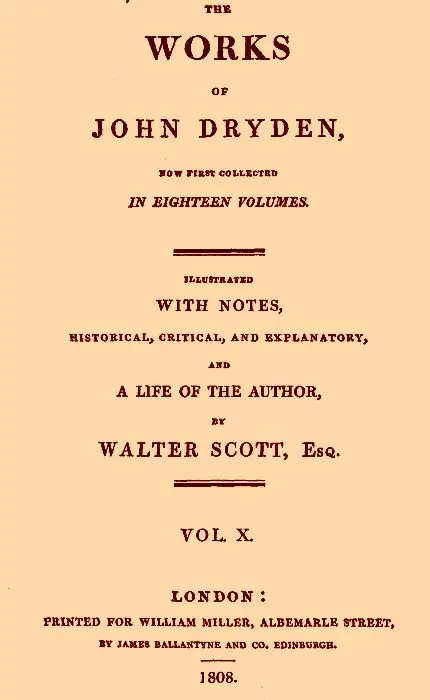
THE CLASSIC COLLECTION · 1633
"The Works of John Dryden, now first collected in eighteen volumes. Volume 10" is a collection of literary works, specifically poetry and essays, compiled from the writings of John Dryden and published during the early 19th century. This volume includes Dryden's poem "Religio Laici," which discusses theological matters and presents his perspectives on faith and religion amidst the complexities of his time. The works likely engage with themes of Christianity, sectarianism, and personal belief. The opening of this volume presents "Religio Laici," an epistolary poem where Dryden articulates his beliefs as a layman amidst a tumultuous religious landscape. He navigates the contentious debates between various religious factions, aiming for a rational exposition of faith that reconciles differing viewpoints. Dryden addresses objections to revealed religion versus rational inquiry, emphasizing the importance of individual reason tempered with faith. His arguments suggest a yearning for a balanced perspective, advocating for personal conviction while also acknowledging the authority of the Church of England despite recognizing the shortcomings within traditions.
Introduction adapted from the source catalogue; source summaries may be automatically generated.
Free to read · English · 135,998 words · No account needed
MAKE TIME FOR A GOOD BOOK
On by default. Untick to stop anonymous reading totals. Each page counts after 10 seconds in view. How this works.
Anonymous counting is on unless you have switched it off.
[Footnote 77: i.e. Dryden himself.]
[Footnote 78: I know not, however, but a critic might here also point out an example of that discrepancy, which is censured by Johnson, and ridiculed by Prior. The cause of dissatisfaction in the pigeon-house is, that the proprietor chuses rather to feed upon the flesh of his domestic poultry, than upon theirs; no very rational cause of mutiny on the part of the doves.]
[Footnote 79: Butler, however, assigns the Bear-Garden as a type of my Mother Kirk; and the resemblance is thus proved by Ralpho:
Synods are mystical bear-gardens,
Where elders, deputies, church-wardens,
And other members of the court,
Manage the Babylonish sport;
For prolocutor, scribe, and bear-ward,
Do differ only in a mere word;
Both are but several synagogues
Of carnal men, and bears, and dogs;
Both antichristian assemblies,
To mischief bent as far's in them lies;
Both slave and toil with fierce contests,
The one with men, the other beasts:
The difference is, the one fights with
The tongue, the other with the teeth;
And that they bait but bears in this,
In t'other souls and consciences.
Hudibras denies the resemblance, and answers by an appeal to the senses:
For bears and dogs on four legs go
As beasts, but synod-men have two;
'Tis true, they all have teeth and nails,
But prove that synod-men have tails;
Or that a rugged shaggy fur
Grows o'er the hide of presbyter;
Or that his snout and spacious ears
Do hold proportion with a bear's.
A bear's a savage beast, of all
Most ugly and unnatural;
Whelped without form, until the dam
Has licked it into shape and frame;
But all thy light can ne'er evict,
That ever synod-man was lickt,
Or brought to any other fashion,
Than his own will and inclination.
Hudibras, Part 1. Canto 3.
]
[Footnote 80: "In short, the whole poem, if it may deserve that name, is a piece of deformed, arrogant nonsense, and self-contradiction, drest up in fine language, like an ugly brazen-faced whore, peeping through the costly trappings of a point de Venise cornet. I call it nonsense, because unseasonable; and arrogant, because impertinent: For could Mr Bayes have so little wit, to think himself a sufficient champion to decide the high mysteries of faith and transubstantiation, and the nice disputes concerning traditions and infallibility, in a discourse between "The Hind and the Panther," which, undetermined hitherto, have exercised all the learning in the world? Or, could he think the grand arcana of divinity a subject fit to be handled in flourishing rhyme, by the author of "The Duke of Guise," or "The Conquest of Peru," or "The Spanish Friar:" Doubts which Mr Bayes is no more able to unfold, than Saffold to resolve a question in astrology. And all this only as a tale to usher in his beloved character, and to shew the excellency of his wit in abusing honest men. If these were his thoughts, as we cannot rationally otherwise believe, seeing that no man of understanding will undertake an enterprise, wherein he does not think himself to have some advantage of his predecessors; then does this romance, I say, of The Panther and the Hind, fall under the most fatal censure of unseasonable folly and saucy impertinence. Nor can I think, that the more solid, prudent, and learned persons of the Roman Church, con him any thanks for laying the prophane fingers of a turn-coat upon the altar of their sacred debates."--The Revolter, a tragi-comedy, acted between The Hind and Panther and Religio Laici, &c. 1687.]
Your reading position is saved on this browser. Take it to another device with a library code. Reading pages adapt to text, rather than matching a printed edition.
BEHIND THE BOOK
This eBook is for the use of anyone anywhere in the United States and most other parts of the world at no cost and with almost no restrictions whatsoever. You may copy it, give it away or re-use it under the terms of the Project Gutenberg License included with this eBook or online at www.gutenberg.org. If you are not located in the United States, you will have to check the laws of the country where you are located before using this eBook. Read the source licence.
The original source file, including credits and licence, is retained by this library. Request an original-format copy at no charge. Please include the book title and Project Gutenberg identifier #51652.
KEEP YOUR CURIOSITY GOING
David Patterson (Spirit) Hatch

David Patterson (Spirit) Hatch

David Patterson (Spirit) Hatch

Ralph Waldo Emerson

Maurice Baring

Oscar Wilde & James McNeill Whistler