
Last letters from the living dead man
David Patterson (Spirit) Hatch
THE CLASSIC COLLECTION · 1633
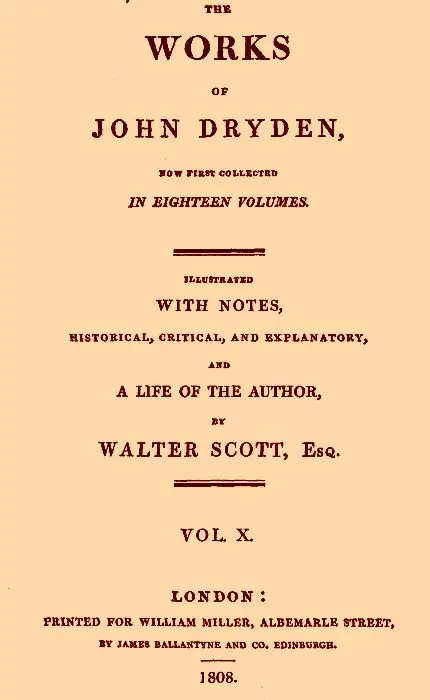
"The Works of John Dryden, now first collected in eighteen volumes. Volume 10" is a collection of literary works, specifically poetry and essays, compiled from the writings of John Dryden and published during the early 19th century. This volume includes Dryden's poem "Religio Laici," which discusses theological matters and presents his perspectives on faith and religion amidst the complexities of his time. The works likely engage with themes of Christianity, sectarianism, and personal belief. The opening of this volume presents "Religio Laici," an epistolary poem where Dryden articulates his beliefs as a layman amidst a tumultuous religious landscape. He navigates the contentious debates between various religious factions, aiming for a rational exposition of faith that reconciles differing viewpoints. Dryden addresses objections to revealed religion versus rational inquiry, emphasizing the importance of individual reason tempered with faith. His arguments suggest a yearning for a balanced perspective, advocating for personal conviction while also acknowledging the authority of the Church of England despite recognizing the shortcomings within traditions.
Introduction adapted from the source catalogue; source summaries may be automatically generated.
Free to read · English · 135,998 words · No account needed
MAKE TIME FOR A GOOD BOOK
On by default. Untick to stop anonymous reading totals. Each page counts after 10 seconds in view. How this works.
Anonymous counting is on unless you have switched it off.
Come leave your cracking tricks; and, as they say,} Use not that barber that trims time, delay;-- } Which, egad, is new, and my own.-- } I've eyes as well as you to find the way."-- } Then on they jogged; and, since an hour of talk Might cut a banter on the tedious walk, "As I remember," said the sober Mouse, "I've heard much talk of the Wit's Coffee-house." "Thither," says Brindle, "thou shalt go, and see Priests sipping coffee, sparks and poets tea, Here, rugged frieze; there, quality well drest; These, baffling the Grand Seigneur; those, the Test; And here shrewd guesses made, and reasons given, That human laws were never made in heaven. But, above all, what shall oblige thy sight, And fill thy eye-balls with a vast delight, Is the poetic Judge of sacred wit,[77] Who does i'the darkness of glory sit. And as the moon, who first receives the light With which she makes these nether regions bright, So does he shine, reflecting from afar The rays he borrowed from a better star; For rules, which from Corneille and Rapin flow, Admired by all the scribbling herd below, From French tradition while he does dispense, } Unerring truths, 'tis schism,--a damned offence,--} To question his, or trust your private sense. }
"Ha! is not that right, Mr Johnson?--Gad forgive me, he is fast asleep! Oh the damned stupidity of this age! Asleep!--Well, sir, since you're so drowsy, your humble servant.
John. Nay, pray, Mr Bayes! Faith, I heard you all the while.--The
white mouse----
Bayes. The white mouse! Ay, ay, I thought how you heard me. Your
servant, sir, your servant.
John. Nay, dear Bayes: Faith, I beg thy pardon, I was up late last night. Prithee, lend me a little snuff, and go on.
Bayes. Go on! Pox, I don't know where I was.--Well, I'll begin. Here, mind, now they are both come to town. [Reads.]
But now at Piccadilly they arrive, And, taking coach, t'wards Temple-Bar they drive; But, at St Clement's church, eat out the back, And, slipping through the palsgrave, bilked poor hack.
"There's the utile which ought to be in all poetry. Many a young Templar will save his shilling by this stratagem of my mice.
Smith. Why, will any young Templar eat out the back of a coach?
Bayes. No, egad! But you'll grant, it is mighty natural for a mouse."--Hind and Panther Transversed.
Such was the wit, which, bolstered up by the applause of party, was deemed an unanswerable ridicule of Dryden's favourite poem.]
[Footnote 76: Preface to the Second Part of "The Reasons of Mr Bayes
changing his Religion."]
Your reading position is saved on this browser. Take it to another device with a library code. Reading pages adapt to text, rather than matching a printed edition.
BEHIND THE BOOK
This eBook is for the use of anyone anywhere in the United States and most other parts of the world at no cost and with almost no restrictions whatsoever. You may copy it, give it away or re-use it under the terms of the Project Gutenberg License included with this eBook or online at www.gutenberg.org. If you are not located in the United States, you will have to check the laws of the country where you are located before using this eBook. Read the source licence.
The original source file, including credits and licence, is retained by this library. Request an original-format copy at no charge. Please include the book title and Project Gutenberg identifier #51652.
KEEP YOUR CURIOSITY GOING
David Patterson (Spirit) Hatch

David Patterson (Spirit) Hatch

David Patterson (Spirit) Hatch

Ralph Waldo Emerson

Maurice Baring

Oscar Wilde & James McNeill Whistler