
Last letters from the living dead man
David Patterson (Spirit) Hatch
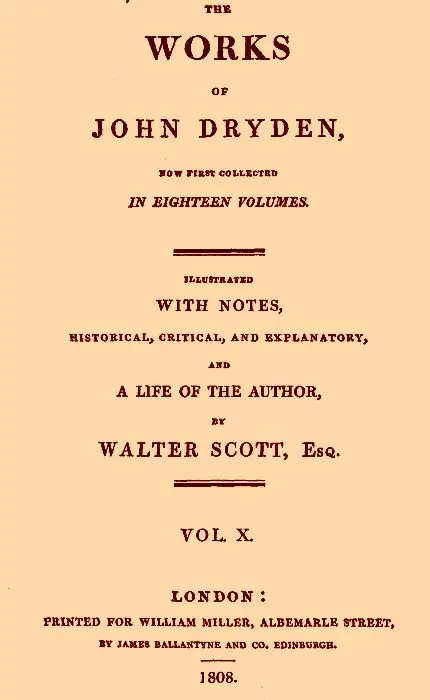
THE CLASSIC COLLECTION · 1633
"The Works of John Dryden, now first collected in eighteen volumes. Volume 10" is a collection of literary works, specifically poetry and essays, compiled from the writings of John Dryden and published during the early 19th century. This volume includes Dryden's poem "Religio Laici," which discusses theological matters and presents his perspectives on faith and religion amidst the complexities of his time. The works likely engage with themes of Christianity, sectarianism, and personal belief. The opening of this volume presents "Religio Laici," an epistolary poem where Dryden articulates his beliefs as a layman amidst a tumultuous religious landscape. He navigates the contentious debates between various religious factions, aiming for a rational exposition of faith that reconciles differing viewpoints. Dryden addresses objections to revealed religion versus rational inquiry, emphasizing the importance of individual reason tempered with faith. His arguments suggest a yearning for a balanced perspective, advocating for personal conviction while also acknowledging the authority of the Church of England despite recognizing the shortcomings within traditions.
Introduction adapted from the source catalogue; source summaries may be automatically generated.
Free to read · English · 135,998 words · No account needed
MAKE TIME FOR A GOOD BOOK
On by default. Untick to stop anonymous reading totals. Each page counts after 10 seconds in view. How this works.
Anonymous counting is on unless you have switched it off.
An article was published in the Gazette, on the third day of the king's illness, importing, "That his physicians now conceived him to be in a state of safety, and that in a few days he would be freed from his indisposition."[61] North tells us, however, on the authority of his brother, the Lord Keeper, that the only hope which the physicians afforded to the council, was an assurance, (joyfully communicated,) that the king was ill of a violent fever. The council seeing little consolation in these tidings, one of the medical gentlemen explained, by saying, that they now knew what they had to do, which was to administer the cortex. This was done while life lasted,[62] although some of the physicians seem to have deemed the prescription improper; in which case, Charles, after escaping the poniards and pistols of the Jesuits, may be said to have fallen a victim to their bark.
Note IV.
And he who most performed, and promised less, Even Short himself, forsook the unequal strife.--P. 67.
Dr Thomas Short, an eminent physician, who came into the court practice when Dr Richard Lower, who formerly enjoyed it, embraced the political principles of the Whig party. Short, a Roman Catholic, and himself a Tory, was particularly acceptable to the Tories. To this circumstance he probably owes the compliment paid him by our author, and another from Lord Mulgrave to the same purpose. Otway reckons, among his selected friends,
Short, beyond what numbers can commend.[63]
Duke has also inscribed to him his translation of the eleventh Idyllium of Theocritus; beginning,
O Short! no herb nor salve was ever found,
To ease a lover's heat, or heal his wound.
Dr Short, as one of the king's physicians, attended the death-bed of Charles, and subscribed the attestation, that he died of an apoplexy. Yet there has been ascribed to him an expression of dubious import, which caused much disquisition at the time; namely, that "the king had not fair play for his life." Burnet says plainly, that "Short suspected poison, and talked more freely of it than any Protestant durst venture to do at the time." He, adds, that "Short himself was taken suddenly ill, upon taking a large draught of wormwood wine, in the house of a Popish patient near the Tower; and while on his death-bed, he told Lower, and Millington, and other physicians, that he believed he himself was poisoned, for having spoken too freely of the king's death."[64] Mulgrave states the same report in these words, which, coming from a professed Tory, are entitled to the greater credit: "I am obliged to observe, that the most knowing and most deserving of all his physicians did not only believe him poisoned, but thought himself so too, not long after, for having declared his opinion a little too boldly."[65] North, in confutation of this report, has interpreted Short's expression, as meaning nothing more than that the king's malady was mistaken by his physicians, who, by their improper prescriptions, deprived nature of fair play;[66] and he appeals to all the eminent physicians who attended Dr Short in his last illness, whether he did not fall a victim to his own bold method, in using the cortex. Upon the whole, whatever opinion this individual physician may have adopted through mistake, or affectation of singularity, and whatever credit faction, or indeed popular prejudice in general, may have given to such rumours at the time, there appears no solid reason to believe that Charles died of poison. Both Burnet and Mulgrave say, that they never heard a hint that his brother was accessary to such a crime; and it is very unlikely that any zealous Catholic should have had either opportunity, or inclination, to hasten the reign of a prince of that religion, by the unsolicited service of poisoning his brother. The other physicians, several of whom, Lower, for example, were Whigs, as well as Protestants, gave no countenance to this rumour, which was circulated by a Catholic. And, as the symptoms of the king's disorder are decidedly apoplectic, the report may be added to those with which history abounds, and which are raised and believed only because an extraordinary end is thought most fit for the eminent and powerful.
Your reading position is saved on this browser. Take it to another device with a library code. Reading pages adapt to text, rather than matching a printed edition.
BEHIND THE BOOK
This eBook is for the use of anyone anywhere in the United States and most other parts of the world at no cost and with almost no restrictions whatsoever. You may copy it, give it away or re-use it under the terms of the Project Gutenberg License included with this eBook or online at www.gutenberg.org. If you are not located in the United States, you will have to check the laws of the country where you are located before using this eBook. Read the source licence.
The original source file, including credits and licence, is retained by this library. Request an original-format copy at no charge. Please include the book title and Project Gutenberg identifier #51652.
KEEP YOUR CURIOSITY GOING
David Patterson (Spirit) Hatch

David Patterson (Spirit) Hatch

David Patterson (Spirit) Hatch

Ralph Waldo Emerson

Maurice Baring

Oscar Wilde & James McNeill Whistler