
Last letters from the living dead man
David Patterson (Spirit) Hatch
THE CLASSIC COLLECTION · 1633
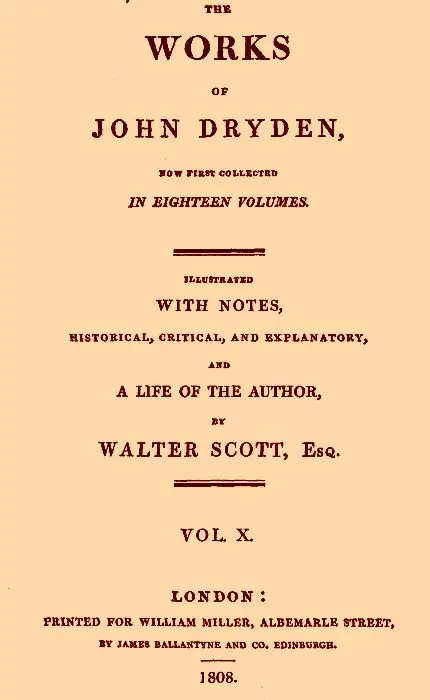
"The Works of John Dryden, now first collected in eighteen volumes. Volume 10" is a collection of literary works, specifically poetry and essays, compiled from the writings of John Dryden and published during the early 19th century. This volume includes Dryden's poem "Religio Laici," which discusses theological matters and presents his perspectives on faith and religion amidst the complexities of his time. The works likely engage with themes of Christianity, sectarianism, and personal belief. The opening of this volume presents "Religio Laici," an epistolary poem where Dryden articulates his beliefs as a layman amidst a tumultuous religious landscape. He navigates the contentious debates between various religious factions, aiming for a rational exposition of faith that reconciles differing viewpoints. Dryden addresses objections to revealed religion versus rational inquiry, emphasizing the importance of individual reason tempered with faith. His arguments suggest a yearning for a balanced perspective, advocating for personal conviction while also acknowledging the authority of the Church of England despite recognizing the shortcomings within traditions.
Introduction adapted from the source catalogue; source summaries may be automatically generated.
Free to read · English · 135,998 words · No account needed
MAKE TIME FOR A GOOD BOOK
On by default. Untick to stop anonymous reading totals. Each page counts after 10 seconds in view. How this works.
Anonymous counting is on unless you have switched it off.
[Footnote 54: The testament of king David, by which he bequeathed to his son the charge of executing vengeance on those enemies whom he had spared during his life, has been much canvassed by divines. I indulge myself in a tribute to a most venerable character, when I state, that the most ingenious discourses I ever heard from the pulpit, were upon this and other parts of David's conduct, in a series of lectures by the late Reverend Dr John Erskine, one of the ministers of the Old Greyfriars church in Edinburgh.]
[Footnote 55: King Charles' first parliament, from passing the Act of Indemnity, and taking other measures to drown all angry recollection of the civil wars, was called the Healing Parliament.]
[Footnote 56: A similar line occurs in the Annus Mirabilis, St. 160:
Beyond the year, and out of heaven's high-way.
The expression is originally Virgil's:
Extra anni, solisque vias.
]
[Footnote 57: See the Astræa Redux. Note VI.]
[Footnote 58: Reckoning from the death of his father, Charles had reigned thirty-six years and eight days; and, counting from his restoration, twenty-four years, eight months, and nine days.]
[Footnote 59: Ancus Martius, who succeeded the peaceful Numa Pompilius
as king of Rome.]
[Footnote 60: Note VII.]
Note I.
An unexpected burst of woes.--P. 62.
Charles II. enjoyed excellent health, and was particularly careful to preserve it by constant exercise. His danger, therefore, fell like a thunder-bolt on his people, whose hearts were gained by his easy manners and good humour, and who considered, that the worst apprehensions they had ever entertained during his reign, arose from the religion and disposition of his successor. The mingled passions of affection and fear produced a wonderful sensation on the nation. The people were so passionately concerned, that North says, and appeals to all who recollected the time for the truth of his averment, that it was rare to see a person walking the street with dry eyes. Examen. p. 647.
Note II.
The second causes took the swift command,
The medicinal head, the ready hand,
All eager to perform their part.--P. 64.
If there is safety in the multitude of counsellors, Charles did not find it in the multitude of physicians. Nine were in attendance, all men of eminence; the presence of the least of whom, Le Sage would have said, was fully adequate to account for the subsequent catastrophe. They were Sir Thomas Millington, Sir Thomas Witherby, Sir Charles Scarborough, Sir Edmund King, Doctors Berwick, Charlton, Lower, Short, and Le Fevre. They signed a declaration, that the king had died of an apoplexy.
Note III.
The joyful short-lived news soon spread around.--P. 65.
Your reading position is saved on this browser. Take it to another device with a library code. Reading pages adapt to text, rather than matching a printed edition.
BEHIND THE BOOK
This eBook is for the use of anyone anywhere in the United States and most other parts of the world at no cost and with almost no restrictions whatsoever. You may copy it, give it away or re-use it under the terms of the Project Gutenberg License included with this eBook or online at www.gutenberg.org. If you are not located in the United States, you will have to check the laws of the country where you are located before using this eBook. Read the source licence.
The original source file, including credits and licence, is retained by this library. Request an original-format copy at no charge. Please include the book title and Project Gutenberg identifier #51652.
KEEP YOUR CURIOSITY GOING
David Patterson (Spirit) Hatch

David Patterson (Spirit) Hatch

David Patterson (Spirit) Hatch

Ralph Waldo Emerson

Maurice Baring

Oscar Wilde & James McNeill Whistler