
Last letters from the living dead man
David Patterson (Spirit) Hatch
THE CLASSIC COLLECTION · 1633
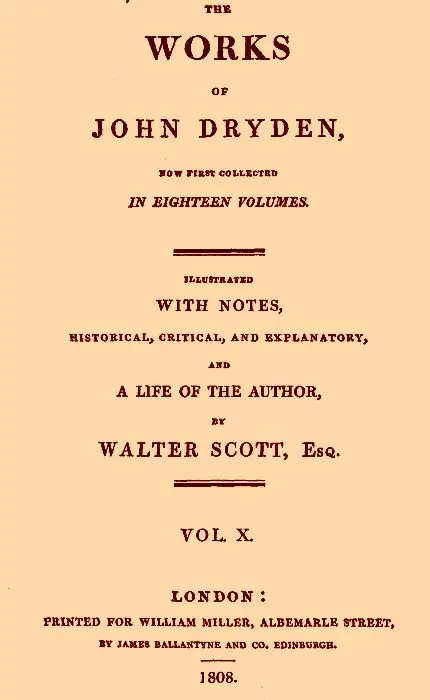
"The Works of John Dryden, now first collected in eighteen volumes. Volume 10" is a collection of literary works, specifically poetry and essays, compiled from the writings of John Dryden and published during the early 19th century. This volume includes Dryden's poem "Religio Laici," which discusses theological matters and presents his perspectives on faith and religion amidst the complexities of his time. The works likely engage with themes of Christianity, sectarianism, and personal belief. The opening of this volume presents "Religio Laici," an epistolary poem where Dryden articulates his beliefs as a layman amidst a tumultuous religious landscape. He navigates the contentious debates between various religious factions, aiming for a rational exposition of faith that reconciles differing viewpoints. Dryden addresses objections to revealed religion versus rational inquiry, emphasizing the importance of individual reason tempered with faith. His arguments suggest a yearning for a balanced perspective, advocating for personal conviction while also acknowledging the authority of the Church of England despite recognizing the shortcomings within traditions.
Introduction adapted from the source catalogue; source summaries may be automatically generated.
Free to read · English · 135,998 words · No account needed
MAKE TIME FOR A GOOD BOOK
On by default. Untick to stop anonymous reading totals. Each page counts after 10 seconds in view. How this works.
Anonymous counting is on unless you have switched it off.
[Footnote 417: Note I.]
[Footnote 418: Note II.]
[Footnote 419: Note III.]
[Footnote 420: Note IV.]
[Footnote 421: Note V.]
[Footnote 422: Note VI.]
[Footnote 423: Note VII.]
[Footnote 424: An eminent dancing-master of the period.]
[Footnote 425: Note VIII.]
[Footnote 426: Note IX.]
[Footnote 427: Alluding to the political apprehensions of the period,
so universal in the city.]
[Footnote 428: These lines are a parody on a passage in Cowley's
Davideis, Book I.:
Beneath the dens where unfledged tempests lie,
And infant winds their tender voices cry;
Where their vast court the mother waters keep;
And, undisturbed by moons, in silence sleep.
]
[Footnote 429: The character of a cobler in an interlude.]
[Footnote 430: A celebrated punster, according to Derrick.]
[Footnote 431: Note X.]
[Footnote 432: Note XI.]
[Footnote 433: Henry Herringman, bookseller, published almost all the poems, plays, and lighter pieces of the day. He was Dryden's original publisher.]
[Footnote 434: A play of Flecknoe's so called. See Note XII.]
[Footnote 435: Perhaps in allusion to Shadwell's frequent use of opium, as well as to his dulness.]
[Footnote 436: Note XIII.]
[Footnote 437: Note XIV.]
[Footnote 438: Note XV.]
[Footnote 439: Note XVI.]
[Footnote 440: Note XVII.]
[Footnote 441: This elegant phrase is the current catch-word of Sir Samuel Hearty in the "Virtuoso," described in the dramatis personæ as "a brisk, amorous, adventurous, unfortunate coxcomb; one that, by the help of humorous, nonsensical bye-words, takes himself to be a great wit."]
[Footnote 442: Alluding, probably, to the following vaunt of Shadwell, in the Dedication to the "Virtuoso:" "Four of the humours are entirely new; and, without vanity, I may say, I ne'er produced a comedy that had not some natural humour in it not represented before, and I hope I never shall."]
[Footnote 443: Note XVIII.]
[Footnote 444: Bruce and Longvil are fine gentlemen in Shadwell's comedy of the "Virtuoso;" who, during a florid speech of Sir Formal Trifle, contrive to get rid of the orator, by letting go a trap-door, upon which he had placed himself during his declamation.]
Note I.
This Flecknoe found.--P. 433.
Richard Flecknoe, the unfortunate bard whom our author has damned to everlasting fame, was by birth an Irishman, and by profession a Roman Catholic priest. Marvel, who seems to have known him at Rome, describes his person as meagre in the extreme, and his itch for scribbling as incessant. The poem, in which Marvel depicts him, is in the old taste of extravagant burlesque, and the lines are as rugged as Flecknoe could himself have produced. It contains, however, some witty and some humorous description, and the reader may be pleased to see a specimen:
Flecknoe, an English Priest at Rome.
Your reading position is saved on this browser. Take it to another device with a library code. Reading pages adapt to text, rather than matching a printed edition.
BEHIND THE BOOK
This eBook is for the use of anyone anywhere in the United States and most other parts of the world at no cost and with almost no restrictions whatsoever. You may copy it, give it away or re-use it under the terms of the Project Gutenberg License included with this eBook or online at www.gutenberg.org. If you are not located in the United States, you will have to check the laws of the country where you are located before using this eBook. Read the source licence.
The original source file, including credits and licence, is retained by this library. Request an original-format copy at no charge. Please include the book title and Project Gutenberg identifier #51652.
KEEP YOUR CURIOSITY GOING
David Patterson (Spirit) Hatch

David Patterson (Spirit) Hatch

David Patterson (Spirit) Hatch

Ralph Waldo Emerson

Maurice Baring

Oscar Wilde & James McNeill Whistler