
Last letters from the living dead man
David Patterson (Spirit) Hatch
THE CLASSIC COLLECTION · 1633
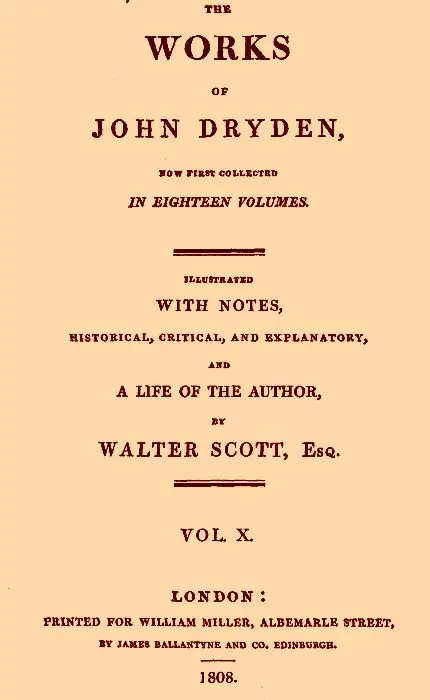
"The Works of John Dryden, now first collected in eighteen volumes. Volume 10" is a collection of literary works, specifically poetry and essays, compiled from the writings of John Dryden and published during the early 19th century. This volume includes Dryden's poem "Religio Laici," which discusses theological matters and presents his perspectives on faith and religion amidst the complexities of his time. The works likely engage with themes of Christianity, sectarianism, and personal belief. The opening of this volume presents "Religio Laici," an epistolary poem where Dryden articulates his beliefs as a layman amidst a tumultuous religious landscape. He navigates the contentious debates between various religious factions, aiming for a rational exposition of faith that reconciles differing viewpoints. Dryden addresses objections to revealed religion versus rational inquiry, emphasizing the importance of individual reason tempered with faith. His arguments suggest a yearning for a balanced perspective, advocating for personal conviction while also acknowledging the authority of the Church of England despite recognizing the shortcomings within traditions.
Introduction adapted from the source catalogue; source summaries may be automatically generated.
Free to read · English · 135,998 words · No account needed
MAKE TIME FOR A GOOD BOOK
On by default. Untick to stop anonymous reading totals. Each page counts after 10 seconds in view. How this works.
Anonymous counting is on unless you have switched it off.
But of those ladies he despairs to-day, Who love a dull romantic whining play; Where poor frail woman's made a deity, } With senseless amorous idolatry, } And snivelling heroes sigh, and pine, and cry.} Though singly they beat armies, and huff kings, Rant at the gods, and do impossible things; Though they can laugh at danger, blood, and wounds, Yet if the dame once chides, the milk-sop hero swoons. These doughty things nor manners have nor wit; We ne'er saw hero fit to drink with yet.
The passage in the Dedication, in which he insinuates that the provision of a pension was all he wanted, to place him on a level with the proudest of his rivals, is as follows: "That there are a great many faults in the conduct of this play, I am not ignorant; but I (having no pension but from the theatre, which is either unwilling, or unable, to reward a man sufficiently for so much pains as correct comedies require) cannot allot my whole time to the writing of plays, but am forced to mind some other business of advantage. Had I as much money, and as much time for it, I might perhaps write as correct a comedy as any of my contemporaries."]
[Footnote 414: See Essay on Satire, Vol. XIII. p. 65.]
[Footnote 415: This epithet preceded the nickname of Whig. See Vol. IX.
p. 211.]
[Footnote 416: "I make bold to use his own expression in "Mac-Flecnoe," if it is his, I say, for Mr Shadwell, in the preface before his Translation of the Tenth Satire of Juvenal, has been lately pleased to acquaint the world, that he publicly disowned the writing it with as solemn imprecations as his friend the Spanish Friar did the Cavalier Lorenzo."--Reasons, &c.]
All human things are subject to decay, And, when fate summons, monarchs must obey. This Flecknoe found,[417] who, like Augustus, young Was called to empire, and had governed long; In prose and verse was owned, without dispute, Through all the realms of Nonsense, absolute. This aged prince, now flourishing in peace, And blest with issue of a large increase, Worn out with business, did at length debate To settle the succession of the state; And, pondering which of all his sons was fit To reign, and wage immortal war with wit, Cried,--'Tis resolved! for nature pleads, that he Should only rule, who most resembles me. Shadwell alone my perfect image bears, Mature in dulness from his tender years;[418] Shadwell alone, of all my sons, is he, Who stands confirmed in full stupidity. The rest to some faint meaning make pretence, But Shadwell never deviates into sense; Some beams of wit on other souls may fall, Strike through, and make a lucid interval; But Shadwell's genuine night admits no ray, His rising fogs prevail upon the day. Besides, his goodly fabric fills the eye, And seems designed for thoughtless majesty; Thoughtless as monarch oaks, that shade the plain, And, spread in solemn state, supinely reign. Heywood and Shirley[419] were but types of thee, Thou last great prophet of tautology! Even I, a dunce of more renown than they, Was sent before but to prepare thy way; And, coarsely clad in Norwich drugget,[420] came To teach the nations in thy greater name. My warbling lute,--the lute I whilom strung, When to king John of Portugal I sung,-- Was but the prelude to that glorious day, When thou on silver Thames didst cut thy way, With well-timed oars, before the royal barge,[421] Swelled with the pride of thy celestial charge; And big with hymn, commander of an host,-- The like was ne'er in Epsom blankets tost.[422] Methinks I see the new Arion sail, The lute still trembling underneath thy nail.[423] At thy well-sharpened thumb, from shore to shore, The trebles squeak for fear, the basses roar; Echoes, from Pissing-Alley, Shadwell call, And Shadwell they resound from Aston-Hall. About thy boat the little fishes throng, As at the morning toast that floats along. Sometimes, as prince of thy harmonious band, Thou weild'st thy papers in thy threshing hand; St André's[424] feet ne'er kept more equal time, Not even the feet of thy own Psyche's rhyme, Though they in number as in sense excel;[425] So just, so like tautology, they fell, That, pale with envy, Singleton[426] forswore } The lute and sword, which he in triumph bore, } And vowed he ne'er would act Villerius more.--} Here stopt the good old sire, and wept for joy, In silent raptures of the hopeful boy. All arguments, but most his plays, persuade, That for anointed dulness he was made. Close to the walls which fair Augusta bind, (The fair Augusta much to fears inclined,[427]) An ancient fabric raised to inform the sight, There stood of yore, and Barbican it hight; A watch-tower once, but now, so fate ordains, Of all the pile an empty name remains; From its old ruins brothel-houses rise, Scenes of lewd loves, and of polluted joys; Where their vast courts the mother-strumpets keep, And, undisturbed by watch, in silence sleep.[428] Near these a nursery erects its head, Where queens are formed, and future heroes bred; Where unfledged actors learn to laugh and cry;} Where infant punks their tender voices try, } And little Maximins the gods defy. } Great Fletcher never treads in buskins here, Nor greater Jonson dares in socks appear; But gentle Simkin[429] just reception finds Amidst this monument of vanished minds; Pure clinches the suburbian muse affords, And Panton[430] waging harmless war with words. Here Flecknoe, as a place to fame well known, Ambitiously designed his Shadwell's throne. For ancient Decker[431] prophesied long since, } That in this pile should reign a mighty prince,} Born for a scourge of wit, and flail of sense; } To whom true dulness should some Psyches owe, But worlds of Misers from his pen should flow; Humorists, and Hypocrites, it should produce, Whole Raymond families, and tribes of Bruce.[432] Now empress Fame had published the renown Of Shadwell's coronation through the town. Roused by report of fame, the nations meet, From near Bunhill, and distant Watling-street. No Persian carpets spread the imperial way, But scattered limbs of mangled poets lay; From dusty shops neglected authors come, Martyrs of pies, and relics of the bum; Much Heywood, Shirley, Ogleby there lay, But loads of Shadwell almost choked the way; Bilked stationers for yeomen stood prepared, And Herringman[433] was captain of the guard. The hoary prince in majesty appeared, High on a throne of his own labours reared. At his right hand our young Ascanius sate, Rome's other hope, and pillar of the state; His brows thick fogs, instead of glories, grace, And lambent dulness played around his face. As Hannibal did to the altars come, Swore by his sire, a mortal foe to Rome, So Shadwell swore, nor should his vow be vain, That he till death true dulness would maintain; And, in his father's right, and realm's defence, Ne'er to have peace with wit, nor truce with sense. The king himself the sacred unction made, As king by office, and as priest by trade. In his sinister hand, instead of ball, He placed a mighty mug of potent ale; "Love's kingdom"[434] to his right he did convey, At once his sceptre, and his rule of sway; Whose righteous lore the prince had practised young, And from whose loins recorded Psyche sprung. His temples, last, with poppies were o'erspread,[435] That nodding seemed to consecrate his head. Just at the point of time, if fame not lie, On his left hand twelve reverend owls did fly;-- So Romulus, 'tis sung, by Tyber's brook, Presage of sway from twice six vultures took. The admiring throng loud acclamations make, And omens of his future empire take. The sire then shook the honours of his head, And from his brows damps of oblivion shed Full on the filial dulness: long he stood, } Repelling from his breast the raging god; } At length burst out in this prophetic mood:--} Heavens bless my son! from Ireland let him reign, To far Barbadoes on the western main; Of his dominion may no end be known, And greater than his father's be his throne; Beyond love's kingdom let him stretch his pen!-- He paused, and all the people cried, Amen.-- Then thus continued he: My son, advance Still in new impudence, new ignorance. Success let others teach, learn thou from me Pangs without birth, and fruitless industry. Let Virtuosos in five years be writ, Yet not one thought accuse thy toil of wit.[436] Let gentle George in triumph tread the stage, Make Dorimant betray, and Loveit rage; Let Cully, Cockwood, Fopling, charm the pit,[437] And in their folly show the writer's wit; Yet still thy fools shall stand in thy defence, And justify their author's want of sense. Let them be all by thy own model made Of dulness, and desire no foreign aid; That they to future ages may be known, Not copies drawn, but issue of thy own: Nay, let thy men of wit too be the same, All full of thee, and differing but in name; But let no alien Sedley interpose, To lard with wit thy hungry Epsom prose.[438] And when false flowers of rhetoric thou would'st cull, Trust nature; do not labour to be dull, But write thy best, and top; and, in each line, Sir Formal's oratory will be thine: Sir Formal, though unsought, attends thy quill, And does thy northern dedications fill.[439] Nor let false friends seduce thy mind to fame, By arrogating Jonson's hostile name;[440] Let father Flecknoe fire thy mind with praise, And uncle Ogleby thy envy raise. Thou art my blood, where Jonson has no part: What share have we in nature, or in art? Where did his wit on learning fix a brand, And rail at arts he did not understand? Where made he love in Prince Nicander's vein, Or swept the dust in Psyche's humble strain? Where sold he bargains, "whip-stitch, kiss my arse,"[441] Promised a play, and dwindled to a farce? When did his muse from Fletcher scenes purloin, As thou whole Etheridge dost transfuse to thine? But so transfused, as oil and waters flow, His always floats above, thine sinks below. This is thy province, this thy wonderous way, New humours to invent for each new play:[442] This is that boasted bias of thy mind, By which one way to dulness 'tis inclined; Which makes thy writings lean on one side still, And, in all changes, that way bends thy will. Nor let thy mountain-belly make pretence Of likeness; thine's a tympany of sense. A tun of man in thy large bulk is writ, But sure thou'rt but a kilderkin of wit. Like mine, thy gentle numbers feebly creep; Thy tragic muse gives smiles, thy comic sleep. With whate'er gall thou sett'st thyself to write, Thy inoffensive satires never bite; In thy felonious heart though venom lies, It does but touch thy Irish pen, and dies. Thy genius call thee not to purchase fame In keen iambics, but mild anagram. Leave writing plays, and choose for thy command, Some peaceful province in Acrostic land. There thou may'st wings display, and altars raise,[443] And torture one poor word ten thousand ways; Or, if thou would'st thy different talents suit, Set thy own songs, and sing them to thy lute.-- He said:--but his last words were scarcely heard;} For Bruce and Longvil had a trap prepared, } And down they sent the yet declaiming bard.[444] } Sinking he left his drugget robe behind, Borne upwards by a subterranean wind. The mantle fell to the young prophet's part, With double portion of his father's art.
Your reading position is saved on this browser. Take it to another device with a library code. Reading pages adapt to text, rather than matching a printed edition.
BEHIND THE BOOK
This eBook is for the use of anyone anywhere in the United States and most other parts of the world at no cost and with almost no restrictions whatsoever. You may copy it, give it away or re-use it under the terms of the Project Gutenberg License included with this eBook or online at www.gutenberg.org. If you are not located in the United States, you will have to check the laws of the country where you are located before using this eBook. Read the source licence.
The original source file, including credits and licence, is retained by this library. Request an original-format copy at no charge. Please include the book title and Project Gutenberg identifier #51652.
KEEP YOUR CURIOSITY GOING
David Patterson (Spirit) Hatch

David Patterson (Spirit) Hatch

David Patterson (Spirit) Hatch

Ralph Waldo Emerson

Maurice Baring

Oscar Wilde & James McNeill Whistler