
Last letters from the living dead man
David Patterson (Spirit) Hatch
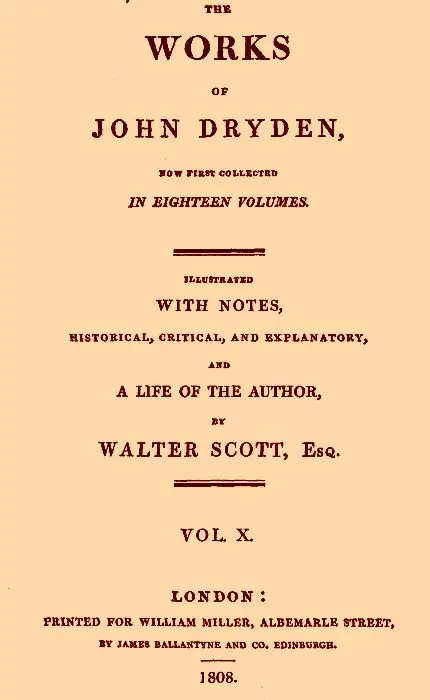
THE CLASSIC COLLECTION · 1633
"The Works of John Dryden, now first collected in eighteen volumes. Volume 10" is a collection of literary works, specifically poetry and essays, compiled from the writings of John Dryden and published during the early 19th century. This volume includes Dryden's poem "Religio Laici," which discusses theological matters and presents his perspectives on faith and religion amidst the complexities of his time. The works likely engage with themes of Christianity, sectarianism, and personal belief. The opening of this volume presents "Religio Laici," an epistolary poem where Dryden articulates his beliefs as a layman amidst a tumultuous religious landscape. He navigates the contentious debates between various religious factions, aiming for a rational exposition of faith that reconciles differing viewpoints. Dryden addresses objections to revealed religion versus rational inquiry, emphasizing the importance of individual reason tempered with faith. His arguments suggest a yearning for a balanced perspective, advocating for personal conviction while also acknowledging the authority of the Church of England despite recognizing the shortcomings within traditions.
Introduction adapted from the source catalogue; source summaries may be automatically generated.
Free to read · English · 135,998 words · No account needed
MAKE TIME FOR A GOOD BOOK
On by default. Untick to stop anonymous reading totals. Each page counts after 10 seconds in view. How this works.
Anonymous counting is on unless you have switched it off.
[Footnote 29: The author applies the same simile to the use of rhyme in
tragedy;
Passion's too fierce to be in fetters bound,
And nature flies him like enchanted ground.
Prologue to Aureng-Zebe.
]
[Footnote 30: All the editions read Sons, which seems to make a double genitive, unless we construe the line to mean, "the name of his Eternal Son's salvation." I own I should have been glad to have found an authority for reading Son.]
[Footnote 31: Simon's Critical History of the Old Testament, translated by the young gentleman to whom the poem is addressed.--See Preface.]
[Footnote 32: Calvinistic divines, who made translations of the
Scripture, with commentaries, on which Pere Simon makes learned
criticisms.]
[Footnote 33: The Socinians, or followers of Lelius Socinius, denied the doctrine of the Trinity and of Redemption. The modern Unitarians have embraced some of the principles of this sect.]
[Footnote 34: The founders of two noted heresies, who, nevertheless, as the poet observes, ventured to appeal to the traditions of the church in support of their doctrines.]
[Footnote 35: Perhaps this idea is borrowed from "Hudibras:"
The learned write, an insect breeze
Is but a mongrel prince of bees,
That falls before a storm on cows,
And stings the founders of his house,
From whose corrupted flesh, that breed
Of vermin did at first proceed.
So, ere the storm of war broke out,
Religion spawned a various rout
Of petulant capricious sects,
The maggots of corrupted texts,
That first run all religion down,
And after every swarm its own.
Hudibras, Part III. canto 2.
]
[Footnote 36: The famous Tom Brown is pleased to droll on this association of persons; being a part of the punishment which he says the laureat inflicted on Shadwell for presuming to dispute his theatrical infallibility. "But, gentlemen, when I had thus, in the plenitude of my power, issued out the above-mentioned decretal epistles, you cannot imagine what abundance of adversaries I created myself: some were for appealing to a free unbiassed synod of impartial authors; others were for suing out a quo warranto, to examine the validity of my charter. Not to mention those of higher quality, I was immediatly set upon by the fierce Elkanah, the Empress of Morocco's agent, who at that time commanded a party of Moorish horse, in order to raise the siege of Grenada; and a fat old gouty gentleman, commonly called the King of Basan, who had almost devoured the stage with free quarter for his men of wit and humourists. But I countermined all their designs against my crown and person in a moment; for I presently got the one to be dressed up in a sanbenit, under the unsanctified name of Doeg; the other I coupled myself with his namesake Tom Sternhold. Being thus degraded from their poetical functions, and become incapable of crowning princes, raising ghosts, and offering any more incense of flattery to the living and the dead, I delivered them over to the secular arm, to be chastised by the furious dapper-wits of the Inns of Court, and the young critics of the university. Furthermore, to prevent all infection of their errors, I directed my monitory letters to the Sieur Batterton, advising him to keep no correspondence, either directly or indirectly, with those aforesaid apostates from sense and reason; adding, that in case of neglect, I would certainly put the theatre under an interdict, send a troop of dragoons from Drury-Lane to demolish his garrison in Salisbury-court, and absolve all his subjects, even to the sub-deacons and acolythes of the stage, his trusty door-keepers and candle-lighters, from their oaths of fealty and allegiance." Reasons for Mr Bayes' changing his Religion.]
Your reading position is saved on this browser. Take it to another device with a library code. Reading pages adapt to text, rather than matching a printed edition.
BEHIND THE BOOK
This eBook is for the use of anyone anywhere in the United States and most other parts of the world at no cost and with almost no restrictions whatsoever. You may copy it, give it away or re-use it under the terms of the Project Gutenberg License included with this eBook or online at www.gutenberg.org. If you are not located in the United States, you will have to check the laws of the country where you are located before using this eBook. Read the source licence.
The original source file, including credits and licence, is retained by this library. Request an original-format copy at no charge. Please include the book title and Project Gutenberg identifier #51652.
KEEP YOUR CURIOSITY GOING
David Patterson (Spirit) Hatch

David Patterson (Spirit) Hatch

David Patterson (Spirit) Hatch

Ralph Waldo Emerson

Maurice Baring

Oscar Wilde & James McNeill Whistler