
Last letters from the living dead man
David Patterson (Spirit) Hatch
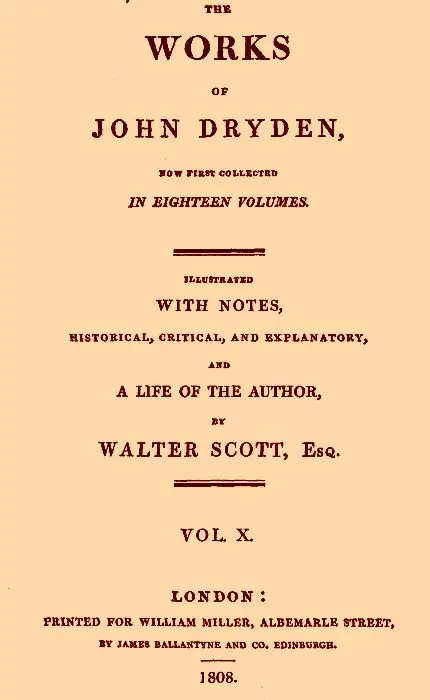
THE CLASSIC COLLECTION · 1633
"The Works of John Dryden, now first collected in eighteen volumes. Volume 10" is a collection of literary works, specifically poetry and essays, compiled from the writings of John Dryden and published during the early 19th century. This volume includes Dryden's poem "Religio Laici," which discusses theological matters and presents his perspectives on faith and religion amidst the complexities of his time. The works likely engage with themes of Christianity, sectarianism, and personal belief. The opening of this volume presents "Religio Laici," an epistolary poem where Dryden articulates his beliefs as a layman amidst a tumultuous religious landscape. He navigates the contentious debates between various religious factions, aiming for a rational exposition of faith that reconciles differing viewpoints. Dryden addresses objections to revealed religion versus rational inquiry, emphasizing the importance of individual reason tempered with faith. His arguments suggest a yearning for a balanced perspective, advocating for personal conviction while also acknowledging the authority of the Church of England despite recognizing the shortcomings within traditions.
Introduction adapted from the source catalogue; source summaries may be automatically generated.
Free to read · English · 135,998 words · No account needed
MAKE TIME FOR A GOOD BOOK
On by default. Untick to stop anonymous reading totals. Each page counts after 10 seconds in view. How this works.
Anonymous counting is on unless you have switched it off.
'Tis nobly done, a layman's creed profest, When all our faith of late hung on a priest; His doubtful words, like oracles received, And, when we could not understand, believed. Triumphant faith now takes a nobler course, Tis gentle, but resists intruding force. Weak reason may pretend an awful sway, And consistories charge her to obey; (Strange nonsense, to confine the sacred Dove,} And narrow rules prescribe how he shall love, } And how upon the barren waters move.) } But she rejects and scorns their proud pretence, And, whilst those grovling things depend on sense, She mounts on certain wings, and flies on high,} And looks upon a dazzling mystery, } With fixed, and steady, and an eagle's eye. } Great king of verse, that dost instruct and please, As Orpheus softened the rude savages; And gently freest us from a double care, The bold Socinian, and the papal chair: Thy judgment is correct, thy fancy young, Thy numbers, as thy generous faith, are strong: Whilst through dark prejudice they force their way, Our souls shake off the night, and view the day. We live secure from mad enthusiasts' rage, And fond tradition, now grown blind with age. Let factious and ambitious souls repine, } Thy reason's strong, and generous thy design;} And always to do well is only thine. }
Dim as the borrowed beams of moon and stars
To lonely, weary, wandering travellers,
Is reason to the soul: and as, on high,
Those rolling fires discover but the sky,
Not light us here; so reason's glimmering ray}
Was lent, not to assure our doubtful way, }
But guide us upward to a better day. }
And as those nightly tapers disappear,
When day's bright lord ascends our hemisphere;
So pale grows reason at religion's sight,
So dies, and so dissolves in supernatural light.
Some few, whose lamp shone brighter, have been led
From cause to cause, to nature's sacred head,
And found that one First Principle must be:
But what, or who, that universal He;
Whether some soul encompassing this ball,
Unmade, unmoved; yet making, moving all;
Or various atoms' interfering dance
Leaped into form, the noble work of chance;
Or this great All was from eternity,-- }
Not even the Stagyrite himself could see,}
And Epicurus guessed as well as he. }
As blindly groped they for a future state,
As rashly judged of providence and fate;
But least of all could their endeavours find
What most concerned the good of human kind;
For happiness was never to be found,
But vanished from them like enchanted ground.[29]
One thought content the good to be enjoyed;
This every little accident destroyed:
The wiser madmen did for virtue toil,
A thorny, or, at best, a barren soil:
In pleasure some their glutton souls would steep; }
But found their line too short, the well too deep,}
And leaky vessels which no bliss could keep. }
Thus anxious thoughts in endless circles roll,
Without a centre where to fix the soul:
In this wild maze their vain endeavours end:--
How can the less the greater comprehend?
Or finite reason reach infinity?
For what could fathom God were more than he.
The Deist thinks he stands on firmer ground;
Cries [Greek: eureka]! the mighty secret's found:
God is that spring of good, supreme and best,
We made to serve, and in that service blest;
If so, some rules of worship must be given,
Distributed alike to all by heaven;
Else God were partial, and to some denied
The means his justice should for all provide.
This general worship is to praise and pray;
One part to borrow blessings, one to pay;
And when frail nature slides into offence,
The sacrifice for crimes is penitence.
Yet since the effects of providence, we find,
Are variously dispensed to human kind;
That vice triumphs, and virtue suffers here,
A brand that sovereign justice cannot bear;
Our reason prompts us to a future state,
The last appeal from fortune and from fate,
Where God's all righteous ways will be declared;
The bad meet punishment, the good reward.
Thus man by his own strength to heaven would soar,
And would not be obliged to God for more.
Vain wretched creature, how art thou misled,
To think thy wit these god-like notions bred!
These truths are not the product of thy mind,
But dropt from heaven, and of a nobler kind.
Revealed religion first informed thy sight,
And reason saw not till faith sprung the light.
Hence all thy natural worship takes the source;
'Tis revelation what thou think'st discourse.
Else how com'st thou to see these truths so clear,
Which so obscure to heathens did appear?
Not Plato these, nor Aristotle found,
Nor he whose wisdom oracles renowned.
Hast thou a wit so deep, or so sublime,
Or canst thou lower dive, or higher climb?
Canst thou by reason more of godhead know
Than Plutarch, Seneca, or Cicero?
Those giant wits, in happier ages born,
When arms and arts did Greece and Rome adorn,
Knew no such system; no such piles could raise
Of natural worship, built on prayer and praise
To one sole God;
Nor did remorse to expiate sin prescribe,
But slew their fellow-creatures for a bribe:
The guiltless victim groaned for their offence,
And cruelty and blood was penitence.
If sheep and oxen could atone for men,
Ah! at how cheap a rate the rich might sin!
And great oppressors might heaven's wrath beguile,
By offering his own creatures for a spoil!
Darest thou, poor worm, offend Infinity?
And must the terms of peace be given by thee?
Then thou art justice in the last appeal;
Thy easy God instructs thee to rebel;
And, like a king remote and weak, must take
What satisfaction thou art pleased to make.
But if there be a Power too just and strong,
To wink at crimes, and bear unpunished wrong;
Look humbly upward, see his will disclose
The forfeit first, and then the fine impose;
A mulct thy poverty could never pay,
Had not Eternal Wisdom found the way,
And with celestial wealth supplied thy store;
His justice makes the fine, his mercy quits the score.
See God descending in thy human frame;
The offended suffering in the offender's name;
All thy misdeeds to him imputed see,
And all his righteousness devolved on thee.
For, granting we have sinned, and that the offence
Of man is made against Omnipotence,
Some price that bears proportion must be paid.
And infinite with infinite be weighed.
See then the Deist lost: remorse for vice
Not paid, or paid inadequate in price:
What farther means can reason now direct,
Or what relief from human wit expect?
That shews us sick; and sadly are we sure
Still to be sick, till heaven reveal the cure:
If then heaven's will must needs be understood,
Which must, if we want cure, and heaven be good,
Let all records of will revealed be shown;
With scripture all in equal balance thrown,
And our one sacred Book will be that one.
Proof needs not here; for, whether we compare
That impious, idle, superstitious ware
Of rites, lustrations, offerings, which before,
In various ages, various countries bore,
With christian faith and virtues, we shall find
None answering the great ends of human kind,
But this one rule of life; that shews us best
How God may be appeased, and mortals blest.
Whether from length of time its worth we draw,
The word is scarce more ancient than the law:
Heaven's early care prescribed for every age;
First, in the soul, and after, in the page.
Or, whether more abstractedly we look,
Or on the writers, or the written book,
Whence, but from heaven, could men unskilled in arts,
In several ages born, in several parts,
Weave such agreeing truths? or how, or why
Should all conspire to cheat us with a lie?
Unasked their pains, ungrateful their advice,
Starving their gain, and martyrdom their price.
If on the book itself we cast our view,
Concurrent heathens prove the story true:
The doctrine, miracles; which must convince,
For heaven in them appeals to human sense;
And, though they prove not, they confirm the cause,
When what is taught agrees with nature's laws.
Then for the style, majestic and divine,
It speaks no less than God in every line;
Commanding words, whose force is still the same
As the first fiat that produced our frame.
All faiths, beside, or did by arms ascend,
Or sense indulged has made mankind their friend;
This only doctrine does our lusts oppose,
Unfed by nature's soil, in which it grows;
Cross to our interests, curbing sense, and sin;
Oppressed without, and undermined within,
It thrives through pain; it's own tormentors tires,
And with a stubborn patience still aspires.
To what can reason such effects assign,
Transcending nature, but to laws divine?
Which in that sacred volume are contained,
Sufficient, clear, and for that use ordained.
But stay: the Deist here will urge anew,
No supernatural worship can be true;
Because a general law is that alone
Which must to all, and every where, be known;
A style so large as not this book can claim,
Nor aught that bears revealed religion's name.
'Tis said, the sound of a Messiah's birth
Is gone through all the habitable earth;
But still that text must be confined alone
To what was then inhabited, and known:
And what provision could from thence accrue
To Indian souls, and worlds discovered new?
In other parts it helps, that, ages past,
The scriptures there were known, and were embraced,
Till sin spread once again the shades of night:
What's that to these who never saw the light?
Of all objections this indeed is chief,
To startle reason, stagger frail belief:
We grant, 'tis true, that heaven from human sense
Has hid the secrets paths of providence;
But boundless wisdom, boundless mercy, may
Find even for those bewildered souls a way.
If from his nature foes may pity claim,
Much more may strangers, who ne'er heard his name;
And, though no name be for salvation known,
But that of his eternal sons[30] alone;
Who knows how far transcending goodness can
Extend the merits of that son to man?
Who knows what reasons may his mercy lead,
Or ignorance invincible may plead?
Not only charity bids hope the best,
But more the great apostle has exprest:
That, if the Gentiles, whom no law inspired,
By nature did what was by law required;
They, who the written rule had never known,
Were to themselves both rule and law alone;
To nature's plain indictment they shall plead,
And by their conscience be condemned or freed.
Most righteous doom! because a rule revealed
Is none to those from whom it was concealed.
Then those, who followed reason's dictates right,
Lived up, and lifted high their natural light,
With Socrates may see their Maker's face,
While thousand rubric-martyrs want a place.
Nor does it baulk my charity, to find
The Egyptian bishop of another mind;
For, though his creed eternal truth contains,
'Tis hard for man to doom to endless pains
All, who believed not all his zeal required;
Unless he first could prove he was inspired.
Then let us either think he meant to say,
This faith, where published, was the only way;
Or else conclude, that, Arius to confute,
The good old man, too eager in dispute,
Flew high; and, as his christian fury rose,
Damned all for heretics who durst oppose.
Thus far my charity this path has tried;
A much unskilful, but well-meaning guide:
Yet what they are, even these crude thoughts were bred
By reading that which better thou hast read;
Thy matchless author's work, which thou, my friend,
By well translating better dost commend;[31]
Those youthful hours which, of thy equals, most
In toys have squandered, or in vice have lost,
Those hours hast thou to nobler use employed,
And the severe delights of truth enjoyed.
Witness this weighty book, in which appears
The crabbed toil of many thoughtful years,
Spent by thy author, in the sifting care
Of rabbins' old sophisticated ware
From gold divine; which he who well can sort
May afterwards make algebra a sport;
A treasure which, if country-curates buy,
They Junius and Tremellius may defy;[32]
Save pains in various readings and translations,
And without Hebrew make most learned quotations;
A work so full with various learning fraught,
So nicely pondered, yet so strongly wrought,
As nature's height and art's last hand required;
As much as man could compass, uninspired;
Where we may see what errors have been made
Both in the copiers' and translators' trade;
How Jewish, Popish, interests have prevailed,
And where infallibility has failed.
For some, who have his secret meaning guessed,
Have found our author not too much a priest;
For fashion-sake he seems to have recourse
To pope, and councils, and traditions' force;
But he that old traditions' could subdue,
Could not but find the weakness of the new:
If scripture, though derived from heavenly birth,
Has been but carelessly preserved on earth;
If God's own people, who of God before
Knew what we know, and had been promised more,
In fuller terms, of heaven's assisting care,
And who did neither time nor study spare
To keep this book untainted, unperplext,
Let in gross errors to corrupt the text,
Omitted paragraphs, embroiled the sense,
With vain traditions stopt the gaping fence,
Which every common hand pulled up with ease,--
What safety from such brushwood-helps as these?
If written words from time are not secure,
How can we think have oral sounds endured?
Which thus transmitted, if one mouth has failed,
Immortal lies on ages are entailed;
And that some such have been, is proved too plain,
If we consider interest, church, and gain.
O but, says one, tradition set side,
Where can we hope for an unerring guide?
For, since the original scripture has been lost,
All copies disagreeing, maimed the most,
Or Christian faith can have no certain ground,
Or truth in church-tradition must be found.
Such an omniscient church we wish indeed;
'Twere worth both Testaments, cast in the Creed:
But if this mother be a guide so sure,
As can all doubts resolve, all truth secure,
Then her infallibility as well
Where copies are corrupt or lame can tell;
Restore lost canon with as little pains,
As truly explicate what still remains;
Which yet no council dare pretend to do, }
Unless, like Esdras, they could write it new;}
Strange confidence still to interpret true, }
Yet not be sure that all they have explained,
Is in the blest original contained.
More safe, and much more modest 'tis, to say
God would not leave mankind without a way;
And that the scriptures, though not every where
Free from corruption, or entire, or clear,
Are uncorrupt, sufficient, clear, entire,
In all things which our needful faith require.
If others in the same glass better see,
'Tis for themselves they look, but not for me;
For my salvation must its doom receive,
Not from what others, but what I believe.
Must all tradition then be set aside?
This to affirm were ignorance or pride.
Are there not many points, some needful sure
To saving faith, that scripture leaves obscure?
Which every sect will wrest a several way,
For what one sect interprets, all sects may;
We hold, and say we prove from scripture plain,}
That Christ is God; the bold Socinian }
From the same scripture urges he's but man.[33] }
Now what appeal can end the important suit?
Both parts talk loudly, but the rule is mute.
Shall I speak plain, and, in a nation free,
Assume an honest layman's liberty?
I think, according to my little skill,
To my own mother-church submitting still,
That many have been saved, and many may,
Who never heard this question brought in play.
The unlettered Christian, who believes in gross,
Plods on to heaven, and ne'er is at a loss;
For the strait gate would be made straiter yet,
Were none admitted there but men of wit.
The few by nature formed, with learning fraught,
Born to instruct, as others to be taught,
Must study well the sacred page; and see
Which doctrine, this or that, does best agree
With the whole tenor of the work divine,
And plainliest points to heaven's revealed design;
Which exposition flows from genuine sense,
And which is forced by wit and eloquence.
Not that tradition's parts are useless here,
When general, old, disinterested, and clear;
That ancient fathers thus expound the page,
Gives truth the reverend majesty of age;
Confirms its force by bideing every test;
For best authorities, next rules, are best;
And still the nearer to the spring we go,
More limpid, more unsoiled, the waters flow.
Thus, first, traditions were a proof alone;
Could we be certain, such they were, so known;
But since some flaws in long descent may be,
They make not truth, but probability.
Even Arius and Pelagius durst provoke
To what the centuries preceding spoke:[34]
Such difference is there in an oft-told tale;
But truth by its own sinews will prevail.
Tradition written, therefore, more commends
Authority, than what from voice descends;
And this, as perfect as its kind can be,
Rolls down to us the sacred history;
Which from the universal church received,
Is tried, and, after, for itself believed.
The partial Papists would infer from hence,
Their church, in last resort, should judge the sense.
But first they would assume, with wonderous art,
Themselves to be the whole, who are but part
Of that vast frame, the Church; yet grant they were
The handers down, can they from thence infer
A right to interpret? or, would they alone,
Who brought the present, claim it for their own?
The book's a common largess to mankind,
Not more for them than every man designed;
The welcome news is in the letter found;
The carrier's not commissioned to expound.
It speaks itself, and what it does contain,
In all things needful to be known, is plain.
In times o'ergrown with rust and ignorance,
A gainful trade their clergy did advance;
When want of learning kept the laymen low,
And none but priests were authorized to know;
When what small knowledge was, in them did dwell,
And he a god, who could but read and spell,--
Then mother Church did mightily prevail:
She parcelled out the Bible by retail;
But still expounded what she sold or gave,
To keep it in her power to damn and save.
Scripture was scarce, and, as the market went,
Poor laymen took salvation on content,
As needy men take money, good or bad.
God's word they had not, but the priest's they had;
Yet whate'er false conveyances they made,
The lawyer still was certain to be paid.
In those dark times they learned their knack so well,
That by long use they grew infallible.
At last, a knowing age began to enquire
If they the book, or that did them inspire;
And, making narrower search, they found, though late,
That what they thought the priest's, was their estate;
Taught by the will produced, the written word,
How long they had been cheated on record.
Then every man, who saw the title fair,
Claimed a child's part, and put in for a share;
Consulted soberly his private good,
And saved himself as cheap as e'er he could.
'Tis true, my friend,--and far be flattery hence,--
This good had full as bad a consequence;
The book thus put in every vulgar hand,
Which each presumed he best could understand,
The common rule was made the common prey,
And at the mercy of the rabble lay.
The tender page with horny fists was galled,
And he was gifted most, that loudest bawled;
The spirit gave the doctoral degree, }
And every member of a company }
Was of his trade and of the Bible free. }
Plain truths enough for needful use they found;
But men would still be itching to expound;
Each was ambitious of the obscurest place,
No measure ta'en from knowledge, all from grace.
Study and pains were now no more their care;
Texts were explained by fasting and by prayer:
This was the fruit the private spirit brought,
Occasioned by great zeal and little thought.
While crowds unlearned, with rude devotion warm,
About the sacred viands buz and swarm;
The fly-blown text creates a crawling brood,
And turns to maggots what was meant for food.[35]
A thousand daily sects rise up and die;
A thousand more the perished race supply;
So all we make of heaven's discovered will,
Is not to have it, or to use it ill.
The danger's much the same; on several shelves
If others wreck us, or we wreck ourselves.
What then remains, but, waving each extreme,
The tides of ignorance and pride to stem;
Neither so rich a treasure to forego,
Nor proudly seek beyond our power to know?
Faith is not built on disquisitions vain;
The things we must believe are few and plain:
But since men will believe more than they need,
And every man will make himself a creed,
In doubtful questions 'tis the safest way
To learn what unsuspected antients say;
For 'tis not likely we should higher soar
In search of heaven, than all the church before;
Nor can we be deceived, unless we see
The scripture and the fathers disagree.
If, after all, they stand suspected still,
(For no man's faith depends upon his will)
'Tis some relief, that points, not clearly known,
Without much hazard may be let alone;
And, after hearing what our church can say,
If still our reason runs another way,
That private reason 'tis more just to curb,
Than by disputes the public peace disturb:
For points obscure are of small use to learn;
But common quiet is mankind's concern.
Thus have I made my own opinions clear,
Yet neither praise expect, nor censure fear;
And this unpolished rugged verse I chose,
As fittest for discourse, and nearest prose;
For while from sacred truth I do not swerve,
Tom Sternhold's, or Tom Shadwell's rhymes will serve.[36]
Your reading position is saved on this browser. Take it to another device with a library code. Reading pages adapt to text, rather than matching a printed edition.
BEHIND THE BOOK
This eBook is for the use of anyone anywhere in the United States and most other parts of the world at no cost and with almost no restrictions whatsoever. You may copy it, give it away or re-use it under the terms of the Project Gutenberg License included with this eBook or online at www.gutenberg.org. If you are not located in the United States, you will have to check the laws of the country where you are located before using this eBook. Read the source licence.
The original source file, including credits and licence, is retained by this library. Request an original-format copy at no charge. Please include the book title and Project Gutenberg identifier #51652.
KEEP YOUR CURIOSITY GOING
David Patterson (Spirit) Hatch

David Patterson (Spirit) Hatch

David Patterson (Spirit) Hatch

Ralph Waldo Emerson

Maurice Baring

Oscar Wilde & James McNeill Whistler