
Last letters from the living dead man
David Patterson (Spirit) Hatch
THE CLASSIC COLLECTION · 1633
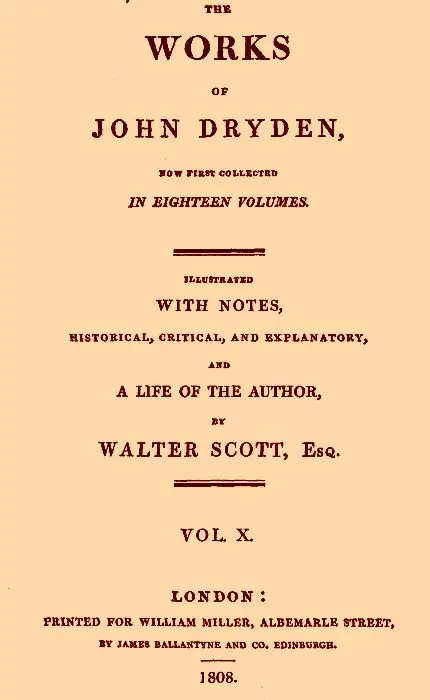
"The Works of John Dryden, now first collected in eighteen volumes. Volume 10" is a collection of literary works, specifically poetry and essays, compiled from the writings of John Dryden and published during the early 19th century. This volume includes Dryden's poem "Religio Laici," which discusses theological matters and presents his perspectives on faith and religion amidst the complexities of his time. The works likely engage with themes of Christianity, sectarianism, and personal belief. The opening of this volume presents "Religio Laici," an epistolary poem where Dryden articulates his beliefs as a layman amidst a tumultuous religious landscape. He navigates the contentious debates between various religious factions, aiming for a rational exposition of faith that reconciles differing viewpoints. Dryden addresses objections to revealed religion versus rational inquiry, emphasizing the importance of individual reason tempered with faith. His arguments suggest a yearning for a balanced perspective, advocating for personal conviction while also acknowledging the authority of the Church of England despite recognizing the shortcomings within traditions.
Introduction adapted from the source catalogue; source summaries may be automatically generated.
Free to read · English · 135,998 words · No account needed
MAKE TIME FOR A GOOD BOOK
On by default. Untick to stop anonymous reading totals. Each page counts after 10 seconds in view. How this works.
Anonymous counting is on unless you have switched it off.
[Footnote 140: Alluding to the Popish Plot. See Note I.]
[Footnote 141: James II. then Duke of York, whom Shaftesbury and his party involved in the odium of the plot.]
[Footnote 142: Plunket, the titular primate of Ireland, Whitebread, provincial of the Jesuits, and several other Catholic priests, suffered for the alleged plot. Derrick most absurdly supposes the passage to refer to the period of the Civil War.]
[Footnote 143: Quarry signifies, properly, "dead game ready to be cut up by the huntsman," which the French still call faire la curée. But it is often taken, as in this passage, for the game in general. Vermin comprehends such wild animals as are not game, foxes, polecats, and the like.]
[Footnote 144: Note II.]
[Footnote 145: The test-oath, against popery, in which transubstantiation is formally disavowed. See Note III.]
[Footnote 146: There was a dispute among naturalists, whether sight was accomplished per emissionem vel per receptionem specierum.]
[Footnote 147: Dolus versatur in generalibus, was an axiom of the
schools.]
[Footnote 148: Note IV.]
[Footnote 149: The Catholics interpret our Saviour's promise, "that he would be with the disciples to the end of the world," as applicable to their own church exclusively.]
[Footnote 150: Note V.]
[Footnote 151: By the doctrine of consubstantiation.]
[Footnote 152: Alluding to Lucan's description of the Roman civil war.]
[Footnote 153: Note VI.]
[Footnote 154: See Note XIV. Part I. page 156.]
[Footnote 155: The gallows.]
[Footnote 156: By the Blatant Beast, we are generally to understand slander; see Spenser's Legend of Courtesy. But it is here taken for the Wolf, or Presbyterian clergy, whose violent declamations against the church of Rome filled up many sermons.]
[Footnote 157: The Presbyterian church utterly rejects traditions, and appeals to the scripture as the sole rule of faith.]
[Footnote 158: Note VII.]
[Footnote 159: It is probable, that from this passage Swift took the idea of comparing the scripture to a testament in his "Tale of a Tub."]
[Footnote 160: By this asseveration the author seems to infer, that, because the church of Rome avers her own infallibility, she is therefore infallible.]
[Footnote 161: In a Polish Diet, where unanimity was necessary, the mode adopted of ensuring it was for the majority to hew to pieces the first individual who expressed his dissent by the fatal veto.]
[Footnote 162: "The church, according to the articles of faith, hath power to decree rites and ceremonies, and authority in controversies of faith; and yet it is not lawful for the church to ordain any thing that is contrary to God's word written, neither may it so expound one place of scripture, that it be repugnant to another." Article xx.]
Your reading position is saved on this browser. Take it to another device with a library code. Reading pages adapt to text, rather than matching a printed edition.
BEHIND THE BOOK
This eBook is for the use of anyone anywhere in the United States and most other parts of the world at no cost and with almost no restrictions whatsoever. You may copy it, give it away or re-use it under the terms of the Project Gutenberg License included with this eBook or online at www.gutenberg.org. If you are not located in the United States, you will have to check the laws of the country where you are located before using this eBook. Read the source licence.
The original source file, including credits and licence, is retained by this library. Request an original-format copy at no charge. Please include the book title and Project Gutenberg identifier #51652.
KEEP YOUR CURIOSITY GOING
David Patterson (Spirit) Hatch

David Patterson (Spirit) Hatch

David Patterson (Spirit) Hatch

Ralph Waldo Emerson

Maurice Baring

Oscar Wilde & James McNeill Whistler