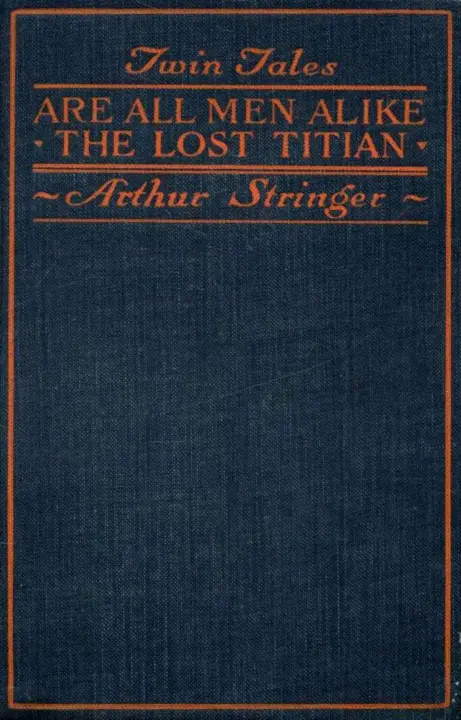
Twin Tales: Are All Men Alike, and, The Lost Titian
Arthur Stringer
THE CLASSIC COLLECTION · 1906
"The Wire Tappers" by Arthur Stringer is a novel written in the early 20th century. The story centers around Jim Durkin, a recently released prisoner with ambitions of reinventing himself as an inventor, as he navigates the seedy underbelly of New York City. The novel explores themes of desperation, ambition, and moral ambiguity as Durkin encounters MacNutt, a man involved in a wire-tapping scheme, and Frances Candler, a woman entangled in the dangerous world of gambling. The opening of the novel introduces Durkin as he steps out into the sunlight for the first time after his release, grappling with feelings of vulnerability and uncertainty about his future. He soon meets a corpulent stranger in an oyster bar who reveals his intention to recruit Durkin for illicit work involving wire-tapping, which sparks Durkin's interest despite his initial reluctance. As the narrative unfolds, the tension grows, bringing to light both Durkin's desperation to escape his past and the alluring danger of the criminal world. Frances enters the picture as a key figure, hinting at complex relationships and deeper motivations that evolve as the plot develops. The stage is set for a compelling examination of character and choice shaped by circumstances beyond their control.
Introduction adapted from the source catalogue; source summaries may be automatically generated.
Free to read · English · 70,673 words · No account needed
MAKE TIME FOR A GOOD BOOK
On by default. Untick to stop anonymous reading totals. Each page counts after 10 seconds in view. How this works.
Anonymous counting is on unless you have switched it off.
“Everything’s all right; you may go, miss,” said the sergeant, two minutes later. “I guess old Isaac’s had an early nightmare!” And the dispersing crowd laughed sympathetically.
The woman stepped into the motor-cab, and turned toward Broadway.
Safely round the corner, she picked up the waiting Durkin.
“That was a close one—but we win!” he murmured jubilantly.
“You’ve got it?”
“I’ve got it,” he exulted.
The woman at his side, for some vague reason, could not share in his joy. Intuitively, in that moment of exhaustion, she felt that their triumph, at the most, was a mere conspiracy of indifference on the part of a timeless and relentless destiny. And in the darkness of the carriage she put her ineffectual arms about Durkin, passionately, as though such momentary guardianship might shield him for all time to come.
She shook her abstractedness from her, with a long and fluttering sigh.
“Jim,” she asked him, unexpectedly, “how much money have you?”
He told her, as nearly as he could. “It’s hanged little, you see!” he added, not understanding the new anxiety that was eating at her heart,—“but I’ve been thinking of a plan!”
“Oh, what now?” she asked miserably, out of her weariness.
She knew, well enough, the necessity of keeping up, of maintaining both activity and appearances. She knew that wrong-doing such as theirs, when without even its mockery of respectability and its ironical touch of dignity, was loathsome to both the eye and the soul. But she found that there were moods and times, occurring now more and more frequently, when she dreaded each return to that subterranean and fear-haunted world. She dreaded it now, not so much for herself, as for Durkin; and as he briefly told her of his plan, this feeling grew stronger within her.
“Then if it must be done,” she cried, “let me do the worst part of
it!”
He looked at her, puzzled, not comprehending the source of her passionate cry, blindly wondering if her over-adventurous life was not getting a deeper and deeper hold on her. But her next question put him to shame.
“Jim, if I help you in this, if I do all that has to be done, will you promise me that you will make it bring you closer to your work on your amplifier, and your transmitting camera? Can’t you promise to get back to that decent work once more?”
“I’ll promise, if you’ll make me one promise in return,” said Durkin, after a moment of silent thought.
“What is it?” she asked.
“Will you let me hold over this Singford stone, for a few weeks?”
Your reading position is saved on this browser. Take it to another device with a library code. Reading pages adapt to text, rather than matching a printed edition.
Arthur Stringer
Arthur Stringer
Arthur Stringer
Arthur Stringer
BEHIND THE BOOK
This eBook is for the use of anyone anywhere in the United States and most other parts of the world at no cost and with almost no restrictions whatsoever. You may copy it, give it away or re-use it under the terms of the Project Gutenberg License included with this eBook or online at www.gutenberg.org. If you are not located in the United States, you will have to check the laws of the country where you are located before using this eBook. Read the source licence.
The original source file, including credits and licence, is retained by this library. Request an original-format copy at no charge. Please include the book title and Project Gutenberg identifier #50203.
KEEP YOUR CURIOSITY GOING
Coulson Kernahan

Maurice Baring
Frances Wright
Cécile Tormay

Frederic Jesup Stimson

W. H. P. (William Henry Pope) Jarvis