
Twin Tales: Are All Men Alike, and, The Lost Titian
Arthur Stringer
THE CLASSIC COLLECTION · 1906
"The Wire Tappers" by Arthur Stringer is a novel written in the early 20th century. The story centers around Jim Durkin, a recently released prisoner with ambitions of reinventing himself as an inventor, as he navigates the seedy underbelly of New York City. The novel explores themes of desperation, ambition, and moral ambiguity as Durkin encounters MacNutt, a man involved in a wire-tapping scheme, and Frances Candler, a woman entangled in the dangerous world of gambling. The opening of the novel introduces Durkin as he steps out into the sunlight for the first time after his release, grappling with feelings of vulnerability and uncertainty about his future. He soon meets a corpulent stranger in an oyster bar who reveals his intention to recruit Durkin for illicit work involving wire-tapping, which sparks Durkin's interest despite his initial reluctance. As the narrative unfolds, the tension grows, bringing to light both Durkin's desperation to escape his past and the alluring danger of the criminal world. Frances enters the picture as a key figure, hinting at complex relationships and deeper motivations that evolve as the plot develops. The stage is set for a compelling examination of character and choice shaped by circumstances beyond their control.
Introduction adapted from the source catalogue; source summaries may be automatically generated.
Free to read · English · 70,673 words · No account needed
MAKE TIME FOR A GOOD BOOK
On by default. Untick to stop anonymous reading totals. Each page counts after 10 seconds in view. How this works.
Anonymous counting is on unless you have switched it off.
It was one week later that Frances Candler wrote her second letter to Durkin. She wrote it feverishly, and without effort, impetuous page after page, until she came to the end. Then she folded and sealed it, hastily, as though in fear that some reactionary sweep of hesitation might still come between her and her written purpose.
“I was wrong—I was terribly wrong,” was the way in which she began her letter. “For as I told you in my cable, I am coming back. It is now all useless, and hopeless, and too late. And I thought, when I was once away from you, that it would be easy to learn to live without you. But during these last few weeks, when I have been so absolutely and so miserably alone, I have needed and cried for you—oh, Jim, how I have needed you! I have learned, too, how even an inflexible purpose, how even a relentless sense of duty, may become more sinister than the blindest selfishness. It was cruel and cowardly in me—for as you once said, we must now sink or swim together. I forgot that you, too, were alone, that you, too, needed help and companionship, even more than I. And I had thought that morality and its geography, that mere flight from my misdoings meant that they were ended, that here in some quiet spot I could be rid of all my past, that I could put on a new character like a new bonnet, that life was a straight and never-ending lane, and not a blind mole-run forever winding and crossing and turning on itself! I thought that I could creep away, and forget you, and what I had been, and what I had lived through, and what had been shown to me. But the world is not that easy with us. It defeats us where we least expect it; it turns against us when we most need it. I had always dreamed that my uncle’s high-walled home at Oxford could be nothing but a place of quiet and contentment. I had always thought of it as a cloister, into which I could some day retire, and find unbroken rest and a solemn sort of happiness. Then came the revelation, the blow that cut the very ground from under my feet. They had their troubles and their sorrows, as well as I. Life could hang as dark for them as it hung for me. My cousin Albert, a mere boy, reading for the Bar in London, had a friend in the City named Singford. I will try to tell you everything as clearly and as briefly as possible. Young Singford is rather a black sheep, of an idle and wealthy family. He involved Albert in a stock-gambling scheme—oh, such a transparent and childish scheme, poor boy!—and Albert, in despair, went to his father. He had to have money to cover his losses; it would be paid back within the month. His father, the soul of uprightness, borrowed the money from what was, I think, the Diocesan Mission Fund, in the belief that it would be promptly repaid. Then came the crash. I found them broken and dazed under it, helpless, hopeless, bewildered. It was so new to them, so outside their every-day life and experience! I went straight to London, and hunted up my cousin, who was actually talking about shooting himself. I found that young Singford, who had been sent down from Balliol, had blindly plunged with Albert on some foolish Texas Oil enterprise. I needn’t tell you more, except that the whole sum was not quite two hundred pounds. But it meant Albert’s giving up his study, and my uncle’s disgrace. I straightened it out for the poor boy—it all seemed so easy and natural and commonplace for my practised hand!—and I believe I brought some little peace and comfort back to that crushed and despairing household. But it all means, of course, that now I’ll have to go back to America. Still, whatever I may have to go through, or whatever happens to me, I shall always have the consolation of knowing that I made that one small sacrifice and did that one small kindness. But from the first I saw that my sanctuary was no longer a sanctuary. And when I saw that I should really have to go back, I was almost glad. The very thought of it seemed to give a new zest to life. I had been trying to tell myself that my future there would not be empty and lonely. But all along, in my secret heart of hearts, I knew better. I could not close my eyes to anticipation; I could not shut activity out of my life. It seemed suddenly to people all my lonely future with possibilities, that first thought of going back. And then there was you. Yes, I believe all along that it was you I wanted. I tried to argue myself away from the feeling that I was deserting you, but I knew it was true. It was this feeling that saved me, that made me feel almost elated, when I saw that fate was once more flinging me into the life from which I had been fighting to escape. You don’t know what the very word ‘America’ now means to me—it’s like the shrill of a call-bell, it’s like the double ‘i’ of our operating days, warning us to be ready! I want to go home; and home, now, is where you are. I can’t entomb myself yet—I am too young. I want to live, Jim, I want to live! Those feverish years must have left some virus in my veins, some virus of recklessness and revolt. And there is so much to do, so many things are challenging us, waiting for us. I can not be satisfied with memories, and Yesterday. I want Tomorrow, and You! It may be blind, and wrong, and wicked—but, oh, Jim, the wires are all down between my head and my heart!”
Your reading position is saved on this browser. Take it to another device with a library code. Reading pages adapt to text, rather than matching a printed edition.
Arthur Stringer
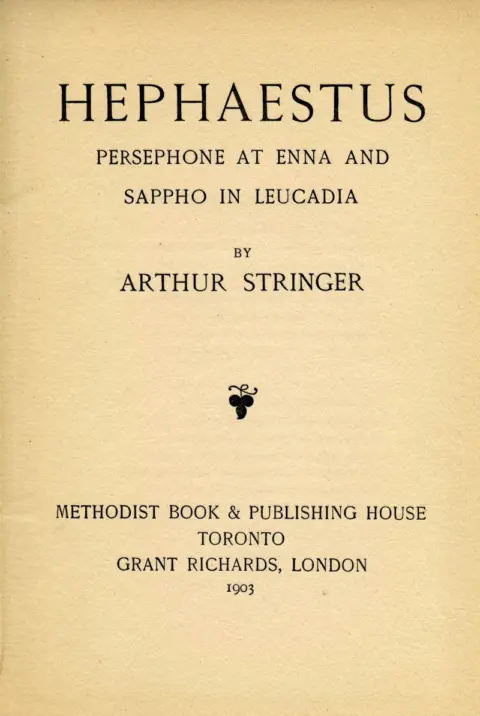
Arthur Stringer
Arthur Stringer
Arthur Stringer
BEHIND THE BOOK
This eBook is for the use of anyone anywhere in the United States and most other parts of the world at no cost and with almost no restrictions whatsoever. You may copy it, give it away or re-use it under the terms of the Project Gutenberg License included with this eBook or online at www.gutenberg.org. If you are not located in the United States, you will have to check the laws of the country where you are located before using this eBook. Read the source licence.
The original source file, including credits and licence, is retained by this library. Request an original-format copy at no charge. Please include the book title and Project Gutenberg identifier #50203.
KEEP YOUR CURIOSITY GOING
Coulson Kernahan

Maurice Baring
Frances Wright
Cécile Tormay

Frederic Jesup Stimson

W. H. P. (William Henry Pope) Jarvis