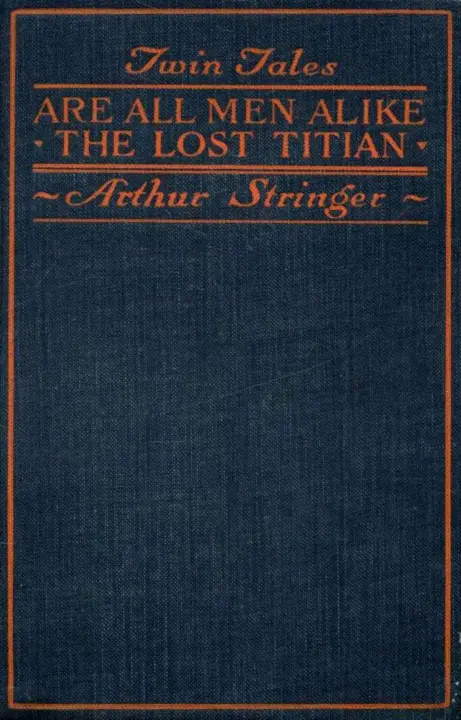
Twin Tales: Are All Men Alike, and, The Lost Titian
Arthur Stringer
THE CLASSIC COLLECTION · 1906
"The Wire Tappers" by Arthur Stringer is a novel written in the early 20th century. The story centers around Jim Durkin, a recently released prisoner with ambitions of reinventing himself as an inventor, as he navigates the seedy underbelly of New York City. The novel explores themes of desperation, ambition, and moral ambiguity as Durkin encounters MacNutt, a man involved in a wire-tapping scheme, and Frances Candler, a woman entangled in the dangerous world of gambling. The opening of the novel introduces Durkin as he steps out into the sunlight for the first time after his release, grappling with feelings of vulnerability and uncertainty about his future. He soon meets a corpulent stranger in an oyster bar who reveals his intention to recruit Durkin for illicit work involving wire-tapping, which sparks Durkin's interest despite his initial reluctance. As the narrative unfolds, the tension grows, bringing to light both Durkin's desperation to escape his past and the alluring danger of the criminal world. Frances enters the picture as a key figure, hinting at complex relationships and deeper motivations that evolve as the plot develops. The stage is set for a compelling examination of character and choice shaped by circumstances beyond their control.
Introduction adapted from the source catalogue; source summaries may be automatically generated.
Free to read · English · 70,673 words · No account needed
MAKE TIME FOR A GOOD BOOK
On by default. Untick to stop anonymous reading totals. Each page counts after 10 seconds in view. How this works.
Anonymous counting is on unless you have switched it off.
Durkin, with an officer at either elbow, tried to think far ahead and to think fast. Yet try as he might, his desperate mind could find no crevice in the blind wall of his predicament. Nothing, at any rate, was to be lost by talking.
“What’s this for, boys, anyhow?” he asked them, with sadly forced
amiability.
“Different things,” said Doogan’s man O’Reilly, noncommittally.
“But who made the charge—who laid the complaint, I mean?”
“’Tis an old friend of yours!” chuckled O’Reilly, thinking of other
things.
Durkin looked at the man studiously. “Not Robinson?”
“And who’s Robinson?—better try another guess!”
“Nor the Postal-Union people?”
“And what have you been doin’ to them?” retorted the officer, as he gnawed at the corner of his tobacco plug and tucked it away in his vest pocket again.
“They tried to soak me once, without cause,” lamented Durkin, indignantly. But his hopes had risen. After all, he felt, it might be only some old, unhappy far-off thing.
“Who the devil was it, then?”
“Twas MacNutt!” said O’Reilly, watching him. “MacNutt’s turned nice and good. He’s a stool-pigeon now!”
“MacNutt!” echoed Durkin, and as before, a great rage burned through him at the sound of the name.
Hope withered out of him, but he gave no sign. He wondered what, or just how much, MacNutt dare reveal, even though he did stand in with the Central Office.
It was dark a minute or two for him, as his mind still leaped and groped at the old blind wall. Then suddenly into the depths of his despair swayed and stretched a single slender thread of hope.
It was Custom House Charley’s saloon so artfully disguised as a soda-bar. There the second waiter was Eddie Crawford—the same Eddie Crawford who had worked with him on the Aqueduct pool-room plot, and had been discharged with him from the Postal-Union.
It seemed eons and eons ago, that poor little ill-fated plot with Eddie
Crawford!
Eddie had struggled forlornly on as an inspector of saloon stock-tickers, had presided over a lunch counter, and had even polished rails and wiped glasses. But now he mixed drinks and dispensed bootlegger’s gin for Custom House Charley.
If Eddie was there—
“Look here, you two,” cried Durkin decisively, coming to a full stop to gain time. “I’ve struck it heavy and honest this time, and, as you people put it, I’ve got the goods on me. I can make it worth five thousand in spot cash to each of you, just to let this thing drop while you’ve still got the chance!”
Your reading position is saved on this browser. Take it to another device with a library code. Reading pages adapt to text, rather than matching a printed edition.
Arthur Stringer
Arthur Stringer
Arthur Stringer
Arthur Stringer
BEHIND THE BOOK
This eBook is for the use of anyone anywhere in the United States and most other parts of the world at no cost and with almost no restrictions whatsoever. You may copy it, give it away or re-use it under the terms of the Project Gutenberg License included with this eBook or online at www.gutenberg.org. If you are not located in the United States, you will have to check the laws of the country where you are located before using this eBook. Read the source licence.
The original source file, including credits and licence, is retained by this library. Request an original-format copy at no charge. Please include the book title and Project Gutenberg identifier #50203.
KEEP YOUR CURIOSITY GOING
Coulson Kernahan

Maurice Baring
Frances Wright
Cécile Tormay

Frederic Jesup Stimson

W. H. P. (William Henry Pope) Jarvis