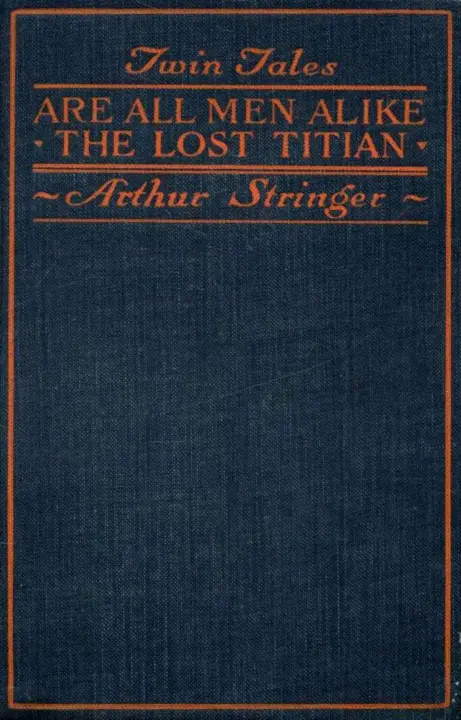
Twin Tales: Are All Men Alike, and, The Lost Titian
Arthur Stringer
THE CLASSIC COLLECTION · 1906
"The Wire Tappers" by Arthur Stringer is a novel written in the early 20th century. The story centers around Jim Durkin, a recently released prisoner with ambitions of reinventing himself as an inventor, as he navigates the seedy underbelly of New York City. The novel explores themes of desperation, ambition, and moral ambiguity as Durkin encounters MacNutt, a man involved in a wire-tapping scheme, and Frances Candler, a woman entangled in the dangerous world of gambling. The opening of the novel introduces Durkin as he steps out into the sunlight for the first time after his release, grappling with feelings of vulnerability and uncertainty about his future. He soon meets a corpulent stranger in an oyster bar who reveals his intention to recruit Durkin for illicit work involving wire-tapping, which sparks Durkin's interest despite his initial reluctance. As the narrative unfolds, the tension grows, bringing to light both Durkin's desperation to escape his past and the alluring danger of the criminal world. Frances enters the picture as a key figure, hinting at complex relationships and deeper motivations that evolve as the plot develops. The stage is set for a compelling examination of character and choice shaped by circumstances beyond their control.
Introduction adapted from the source catalogue; source summaries may be automatically generated.
Free to read · English · 70,673 words · No account needed
MAKE TIME FOR A GOOD BOOK
On by default. Untick to stop anonymous reading totals. Each page counts after 10 seconds in view. How this works.
Anonymous counting is on unless you have switched it off.
“Here, Jim, quick, take this and listen!” She placed the receiver close to his ear as she spoke. “Now, that’s Ottenheimer himself at the ’phone. Can you catch his voice distinctly? Well, do you notice what kind of voice it is—its timbre, I mean? A plaintive-toned, guttural, suave, mean, cringing sort of voice! Listen hard. He may not be at the ’phone again today. Is he still talking?”
“Yes, the old scoundrel. There, he’s finished!”
“What was it about?”
“Just kicking to some one down in Maiden Lane, because Judge Hazel, of the District Court, has overruled the board of appraisers and imposed a ten per cent. ad valorem duty on natural pearls coming in.”
“But his voice—Jim, you have got to learn to imitate that voice.”
“And then what?”
“Then cut in, presumably from Ottenheimer’s own house, and casually ask, say, Phipps, the second salesman, and head of the shipping department, just what your safe-combination happens to be. It has slipped your memory, you see?”
“And Phipps, naturally, in such a case, will ring up Central and verify
the call.”
“Not necessarily. At the first call from him we shall cut his wire!”
“Which cuts us off, and gives us away, as soon as a special messenger can deliver a message and a lineman trace up the trouble.”
“Then why cut him off at all? If that’s too risky, should the worst come to the worst, we can tell Central it’s a case of crossed wires, bewilder her a bit, and then shut ourselves off.”
“I believe you’ve almost got it.”
“But can you get anywhere near that voice?”
“Listen, Frank; how’s this?”
He drew in his chin, half-laughingly, and throwing his voice into a whining yet businesslike guttural, spoke through an imaginary transmitter to an imaginary Phipps.
“That would never, never do!” cried the other, despairingly. “He’s a German Jew, if you have noticed—he sounds his w’s like w’s, and not like v’s, but he makes his r’s like w’s.”
“Oh, I have it,” broke in Durkin, from a silent contemplation of his desk-’phone. “We’ll just release the binding-posts on our transmitter a little, and, let’s say, keep the electrode-bearing a trifle slack—fix things up, I mean, so that any voice will sound as tinny as a phonograph—decompose it, so to speak. Then, if necessary, we can lay it to the fact that the wires are out of order somewhere!”
“Good, but when—when can we do it?”
Your reading position is saved on this browser. Take it to another device with a library code. Reading pages adapt to text, rather than matching a printed edition.
Arthur Stringer
Arthur Stringer
Arthur Stringer
Arthur Stringer
BEHIND THE BOOK
This eBook is for the use of anyone anywhere in the United States and most other parts of the world at no cost and with almost no restrictions whatsoever. You may copy it, give it away or re-use it under the terms of the Project Gutenberg License included with this eBook or online at www.gutenberg.org. If you are not located in the United States, you will have to check the laws of the country where you are located before using this eBook. Read the source licence.
The original source file, including credits and licence, is retained by this library. Request an original-format copy at no charge. Please include the book title and Project Gutenberg identifier #50203.
KEEP YOUR CURIOSITY GOING
Coulson Kernahan

Maurice Baring
Frances Wright
Cécile Tormay

Frederic Jesup Stimson

W. H. P. (William Henry Pope) Jarvis