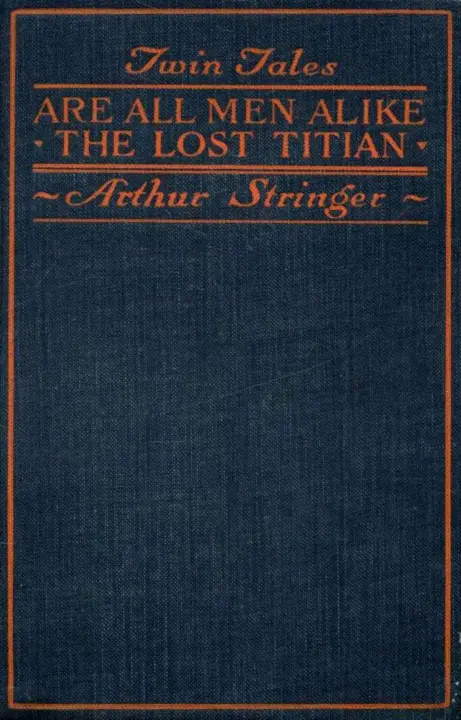
Twin Tales: Are All Men Alike, and, The Lost Titian
Arthur Stringer
THE CLASSIC COLLECTION · 1906
"The Wire Tappers" by Arthur Stringer is a novel written in the early 20th century. The story centers around Jim Durkin, a recently released prisoner with ambitions of reinventing himself as an inventor, as he navigates the seedy underbelly of New York City. The novel explores themes of desperation, ambition, and moral ambiguity as Durkin encounters MacNutt, a man involved in a wire-tapping scheme, and Frances Candler, a woman entangled in the dangerous world of gambling. The opening of the novel introduces Durkin as he steps out into the sunlight for the first time after his release, grappling with feelings of vulnerability and uncertainty about his future. He soon meets a corpulent stranger in an oyster bar who reveals his intention to recruit Durkin for illicit work involving wire-tapping, which sparks Durkin's interest despite his initial reluctance. As the narrative unfolds, the tension grows, bringing to light both Durkin's desperation to escape his past and the alluring danger of the criminal world. Frances enters the picture as a key figure, hinting at complex relationships and deeper motivations that evolve as the plot develops. The stage is set for a compelling examination of character and choice shaped by circumstances beyond their control.
Introduction adapted from the source catalogue; source summaries may be automatically generated.
Free to read · English · 70,673 words · No account needed
MAKE TIME FOR A GOOD BOOK
On by default. Untick to stop anonymous reading totals. Each page counts after 10 seconds in view. How this works.
Anonymous counting is on unless you have switched it off.
He tried to seize her ungloved hand in his, but she drew him up with a sudden monitory “Hsssssh!” Then he, too, remembered, and they took up their rôle of outward indifference once more.
“I had to come back, you see!” she confessed, with what seemed a shamed and mournful shake of the head.
“Something told me you would, all along, even after your first letter. I saw it, as surely as I see you now!”
“Oh, Jim, what I wrote you was true!—it showed me that we can’t bury our past, in a day, or a week or a month! It’s made me afraid of myself and taught me how weak I am!”
And again she looked at him, across the quiet but abysmal gulf of her
reawakening despair.
“But there is just where we make ourselves so unhappy—we’re so afraid about being afraid! Life without some fear—what is it?”
“Oh, I am without defence!” she lamented, indeterminately and inconsequently. She sighed again, and still again gazed into his face with her shadowy and unhappy and seemingly hungry eyes. Then, with a sudden abandoning uptoss of her reckless hands, that seemed to fling both solemnity and memory from her, she laughingly declared that it was already too late to cry over spilt milk. Yet the sound of her careless laughter fell, in some way, more lugubriously on Durkin’s ear than had all her earlier lamentation.
“But why did you ever write that first letter?” he persisted.
She knew she could not explain, satisfactorily. “It was the result of being lonesome, let’s say, and perhaps being morbid, after my illness!”
Durkin called the waiter and gave him an order, puffing his cigar with assumed unconcern, while the woman murmured across the table to him: “You look quite foreign, with that magnificent Vandyke! And, by the way, how do you like my English bang?”
“Why, it’s dyed!” said Durkin, for the first time missing the sunny glint in the familiar crown of chestnut.
“Jim,” said the woman, in lower tones, sobering again, “there’s trouble ahead, already!”
She drew her chair a little closer, and leaned forward, with her elbows on the table and her chin in her hands. Durkin lighted another cigar, and lounged toward her with the same careless pose, his face alert with new and different interest.
“MacNutt?”
“No, not him, thank heaven!”
“You don’t mean Doogan’s men?”
“Not so loud, dear! No, not Doogan’s men, either. It’s nothing like that. But tell me, quickly, has anything gone wrong over here?”
“Not a thing—except that you were away!”
Your reading position is saved on this browser. Take it to another device with a library code. Reading pages adapt to text, rather than matching a printed edition.
Arthur Stringer
Arthur Stringer
Arthur Stringer
Arthur Stringer
BEHIND THE BOOK
This eBook is for the use of anyone anywhere in the United States and most other parts of the world at no cost and with almost no restrictions whatsoever. You may copy it, give it away or re-use it under the terms of the Project Gutenberg License included with this eBook or online at www.gutenberg.org. If you are not located in the United States, you will have to check the laws of the country where you are located before using this eBook. Read the source licence.
The original source file, including credits and licence, is retained by this library. Request an original-format copy at no charge. Please include the book title and Project Gutenberg identifier #50203.
KEEP YOUR CURIOSITY GOING
Coulson Kernahan

Maurice Baring
Frances Wright
Cécile Tormay

Frederic Jesup Stimson

W. H. P. (William Henry Pope) Jarvis