
Twin Tales: Are All Men Alike, and, The Lost Titian
Arthur Stringer
THE CLASSIC COLLECTION · 1906
"The Wire Tappers" by Arthur Stringer is a novel written in the early 20th century. The story centers around Jim Durkin, a recently released prisoner with ambitions of reinventing himself as an inventor, as he navigates the seedy underbelly of New York City. The novel explores themes of desperation, ambition, and moral ambiguity as Durkin encounters MacNutt, a man involved in a wire-tapping scheme, and Frances Candler, a woman entangled in the dangerous world of gambling. The opening of the novel introduces Durkin as he steps out into the sunlight for the first time after his release, grappling with feelings of vulnerability and uncertainty about his future. He soon meets a corpulent stranger in an oyster bar who reveals his intention to recruit Durkin for illicit work involving wire-tapping, which sparks Durkin's interest despite his initial reluctance. As the narrative unfolds, the tension grows, bringing to light both Durkin's desperation to escape his past and the alluring danger of the criminal world. Frances enters the picture as a key figure, hinting at complex relationships and deeper motivations that evolve as the plot develops. The stage is set for a compelling examination of character and choice shaped by circumstances beyond their control.
Introduction adapted from the source catalogue; source summaries may be automatically generated.
Free to read · English · 70,673 words · No account needed
MAKE TIME FOR A GOOD BOOK
On by default. Untick to stop anonymous reading totals. Each page counts after 10 seconds in view. How this works.
Anonymous counting is on unless you have switched it off.
She moved her head from side to side, slowly, in dissent, and got up and went to the window, where she gazed out over the house-tops at the paling afternoon.
“No, I’m not his wife,” she said, in her quiet contralto.
“Then why won’t you tell me how you got mixed up in this sort of thing?”
“It’s all so silly and so commonplace,” she said, without turning to
look at him.
“Yes?” he said, and waited.
She wheeled about and wrung out with a sudden passionate “Oh, what’s the good of all this! I am here tapping wires, and you are here doing the same. Neither of us belongs at this sort of work, but—but, we’re here!”
“Can’t you tell me?” he asked, more gently, yet inwardly more dogged.
“Yes, I shall tell you,” she answered him, at last. “It began, really, six years ago when my mother died, in London, and my father went to pieces, went pitifully to pieces, and had to give up his profession as a barrister. I felt sorry for him, and stayed with him, through his months of drunkenness, and his gradual downfall. He started a little office for genealogical research—as we called it—digging up pretentious alliances, and suitable ancestors for idle and wealthy nobodies. This was bad enough, but little by little it degenerated into a sort of next-of-kin agency, and wrung its money from the poor, instead of the rich!”
She paused for a moment, before she went on, gazing at the man before her in grim and terrible candor, steeled with the purpose to purge her soul of all she had to say, and have it over and done with.
“But I stayed with father, through it all. I told myself I could live it down, the squalor, and the meanness, and the deceits, and even the drunkenness—I stayed with him because I pitied him. Even then he was a brilliant man. And I would have worked and fought for him to the end, only, at last, he wanted me to pose as a claimant for an estate then in chancery. That I would not and could not do. I went to Reading, and became an invalid’s companion. Then, after father’s death—after his horrible death—his older brother, at Oxford, offered to give me a home. He was an old man, a curate with five daughters, and I felt, then, that it would be unjust. So I answered an advertisement in a London paper, and came to America to be a governess in a New York family, in the house of a diamond importer named Ottenheimer. At the end of my first week there my mistress unjustly suspected me of—Oh, I can’t explain it all to you here, but she was a vulgar and unscrupulous woman, and said I was too good-looking to be a governess, and discharged me without even a reference. I was penniless in two weeks, and would gladly have crept back to my uncle in Oxford, if I had been able. Then, when I was almost starving, I was glad enough to become the secretary of an investment company, with an office in Wall Street. They had trouble with the Post-Office department in Washington, and then the police raided the office, for it turned out to be nothing more than a swindling scheme. . . . And then, oh, I don’t know, I seemed to drift from one thing to another, until I was the English heiress in a matrimonial bureau, and a French baroness in some foreign litigation scheme. But all the time I was only waiting to get enough money to creep back to Oxford. I kept telling myself that in a few weeks more I should be able to escape. I kept dreaming of it, until Oxford seemed to grow into a sort of sanctuary. But things went on and on, and still I waited.”
Your reading position is saved on this browser. Take it to another device with a library code. Reading pages adapt to text, rather than matching a printed edition.
Arthur Stringer
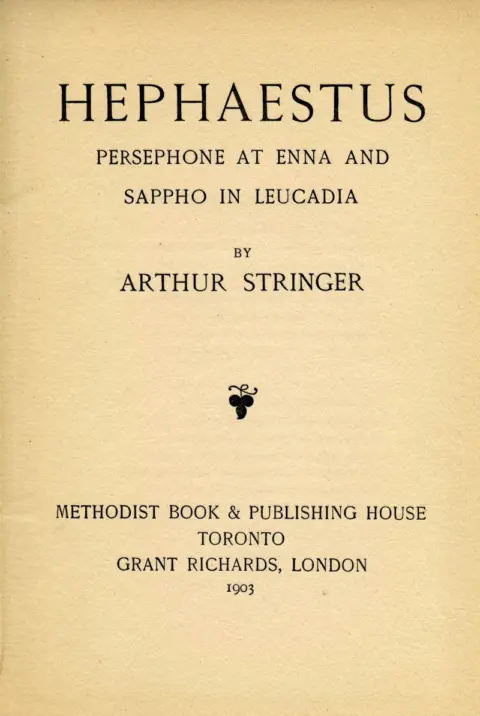
Arthur Stringer
Arthur Stringer
Arthur Stringer
BEHIND THE BOOK
This eBook is for the use of anyone anywhere in the United States and most other parts of the world at no cost and with almost no restrictions whatsoever. You may copy it, give it away or re-use it under the terms of the Project Gutenberg License included with this eBook or online at www.gutenberg.org. If you are not located in the United States, you will have to check the laws of the country where you are located before using this eBook. Read the source licence.
The original source file, including credits and licence, is retained by this library. Request an original-format copy at no charge. Please include the book title and Project Gutenberg identifier #50203.
KEEP YOUR CURIOSITY GOING
Coulson Kernahan

Maurice Baring
Frances Wright
Cécile Tormay

Frederic Jesup Stimson

W. H. P. (William Henry Pope) Jarvis