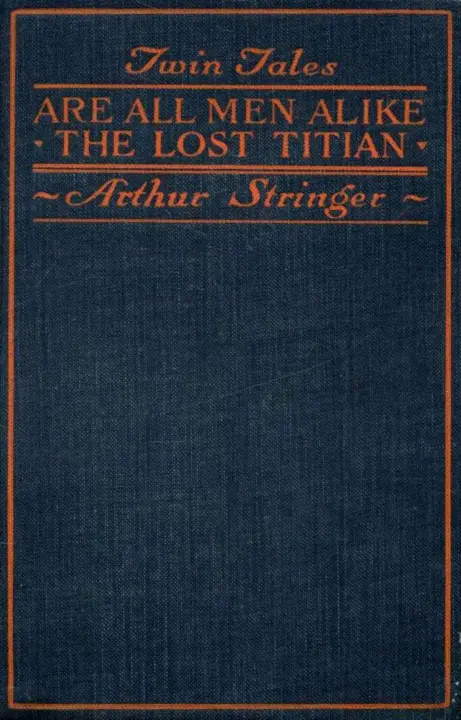
Twin Tales: Are All Men Alike, and, The Lost Titian
Arthur Stringer
THE CLASSIC COLLECTION · 1906
"The Wire Tappers" by Arthur Stringer is a novel written in the early 20th century. The story centers around Jim Durkin, a recently released prisoner with ambitions of reinventing himself as an inventor, as he navigates the seedy underbelly of New York City. The novel explores themes of desperation, ambition, and moral ambiguity as Durkin encounters MacNutt, a man involved in a wire-tapping scheme, and Frances Candler, a woman entangled in the dangerous world of gambling. The opening of the novel introduces Durkin as he steps out into the sunlight for the first time after his release, grappling with feelings of vulnerability and uncertainty about his future. He soon meets a corpulent stranger in an oyster bar who reveals his intention to recruit Durkin for illicit work involving wire-tapping, which sparks Durkin's interest despite his initial reluctance. As the narrative unfolds, the tension grows, bringing to light both Durkin's desperation to escape his past and the alluring danger of the criminal world. Frances enters the picture as a key figure, hinting at complex relationships and deeper motivations that evolve as the plot develops. The stage is set for a compelling examination of character and choice shaped by circumstances beyond their control.
Introduction adapted from the source catalogue; source summaries may be automatically generated.
Free to read · English · 70,673 words · No account needed
MAKE TIME FOR A GOOD BOOK
On by default. Untick to stop anonymous reading totals. Each page counts after 10 seconds in view. How this works.
Anonymous counting is on unless you have switched it off.
Darting back until he felt the plaster of the narrow hallway behind him, he flung himself madly forward against the door again. He kicked with the solid flat of his boot-sole as he came, against the light pine, painted and grained to look like oak.
It crashed in like so much kindling, and a second later, white to the very lips, he was in the room, facing MacNutt.
In his hand he held his revolver. It was of blue metal, with the barrel sawed off short. It had once been carried by a Chinaman, and had figured in a Mock Duck Street feud, and had been many times in pawnshops, and had passed through many hands.
As he faced the man he was going to kill it flitted vaguely through Durkin’s mind that somebody—he could not remember who—had said always to shoot for the stomach—it was the easiest, and the surest. He also remembered that his weapon had a rifled barrel, and that the long, twisting bullet would rend and tear and lacerate as it went.
“Before I kill you,” he heard himself saying, and the quietness of his voice surprised even his own ears, “before I kill you, I want to know, once for all, just what that woman is to you.”
The other man looked vacantly down at the pistol barrel, within six inches of his own gross stomach. Then he looked at his enemy’s face. A twitching nerve trembled and fluttered on one side of his temple. Only two claret-colored blotches of color remained on his otherwise ashen face.
“For the love of God, Durkin, don’t be a fool!”
MacNutt’s fingers were working spasmodically, and his breath began to come wheezily and heavily.
“I’m going to kill you!” repeated Durkin, in the same level monotone. “But what is that woman to you?”
MacNutt was desperately measuring chance and distance. There was not the shadow of escape through struggle.
“It’s murder!” he gasped, certain that there was no hope.
He could see Durkin’s preparatory jaw-clench.
“You—you wouldn’t get mixed up in cold murder like this!” MacNutt half pleaded, hurriedly and huskily, with his eyes now on the other man’s. “Why, you’d swing for it, Durkin! You’d go to the chair!”
Durkin uttered a foul name, impatiently, and closed out the picture with his shut eyelids as he thrust his right hand forward and down.
He wondered, with lightning-like rapidity of thought, if the blood would
stain his hand.
Then he felt a quick bark, and a sudden great spit of pain shot through
him.
Your reading position is saved on this browser. Take it to another device with a library code. Reading pages adapt to text, rather than matching a printed edition.
Arthur Stringer
Arthur Stringer
Arthur Stringer
Arthur Stringer
BEHIND THE BOOK
This eBook is for the use of anyone anywhere in the United States and most other parts of the world at no cost and with almost no restrictions whatsoever. You may copy it, give it away or re-use it under the terms of the Project Gutenberg License included with this eBook or online at www.gutenberg.org. If you are not located in the United States, you will have to check the laws of the country where you are located before using this eBook. Read the source licence.
The original source file, including credits and licence, is retained by this library. Request an original-format copy at no charge. Please include the book title and Project Gutenberg identifier #50203.
KEEP YOUR CURIOSITY GOING
Coulson Kernahan

Maurice Baring
Frances Wright
Cécile Tormay

Frederic Jesup Stimson

W. H. P. (William Henry Pope) Jarvis