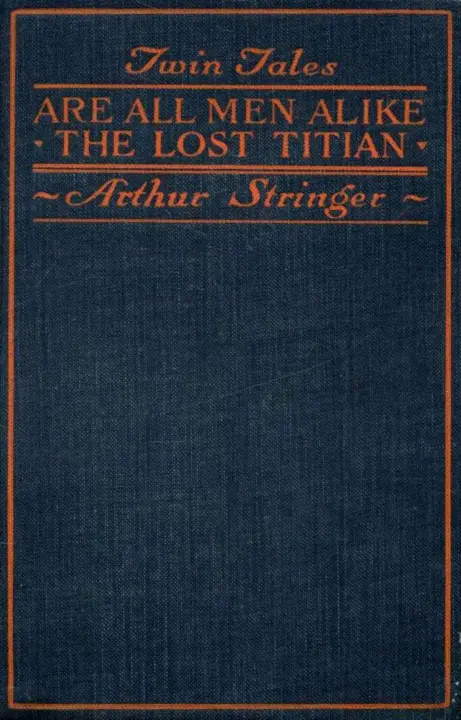
Twin Tales: Are All Men Alike, and, The Lost Titian
Arthur Stringer
THE CLASSIC COLLECTION · 1906
"The Wire Tappers" by Arthur Stringer is a novel written in the early 20th century. The story centers around Jim Durkin, a recently released prisoner with ambitions of reinventing himself as an inventor, as he navigates the seedy underbelly of New York City. The novel explores themes of desperation, ambition, and moral ambiguity as Durkin encounters MacNutt, a man involved in a wire-tapping scheme, and Frances Candler, a woman entangled in the dangerous world of gambling. The opening of the novel introduces Durkin as he steps out into the sunlight for the first time after his release, grappling with feelings of vulnerability and uncertainty about his future. He soon meets a corpulent stranger in an oyster bar who reveals his intention to recruit Durkin for illicit work involving wire-tapping, which sparks Durkin's interest despite his initial reluctance. As the narrative unfolds, the tension grows, bringing to light both Durkin's desperation to escape his past and the alluring danger of the criminal world. Frances enters the picture as a key figure, hinting at complex relationships and deeper motivations that evolve as the plot develops. The stage is set for a compelling examination of character and choice shaped by circumstances beyond their control.
Introduction adapted from the source catalogue; source summaries may be automatically generated.
Free to read · English · 70,673 words · No account needed
MAKE TIME FOR A GOOD BOOK
On by default. Untick to stop anonymous reading totals. Each page counts after 10 seconds in view. How this works.
Anonymous counting is on unless you have switched it off.
The busy waiter, with a nervous little up-jerk of the head, gave these restlessly tapping fingers a passing glance. Something about them carried him back many months, to his operating-desk at the Postal-Union. He listened again. Then he bent down over his glass, for he was mixing the silver fizz first.
It was the telegrapher’s double “i” that he had heard repeated and repeated by those carelessly tapping fingers, and then a further phrase that he knew meant “attention!”
Yet he worked away, impassive, unmoved, while with his slender little
sugar-spoon he signalled back his answer, on the rim of his
mixing-glass.
“Get a move on, boss,” said O’Reilly, impatiently.
“Sure,” said the waiter, abstractedly, quite unruffled, for his ear was a little out of practice, and he wanted to make sure just what those finger-nails tapping on the mahogany meant.
And this is what he read:
“Five—hundred—dollars—spot—cash—for—a—knock—out—to—each—of— these—two!”
“Too—expensive!” answered the sugar-spoon on the tumbler, as it stirred the mixture. “I—would—have—to—migrate.”
“Then—make—it—a—thousand,” answered the mahogany. “I’m pinched.”
“Done,” said the spoon, as the silver fizz was put down on the bar. Then came the gin rickey and the highball.
“They’ll—get—it—strong!” drummed the idle bartender on a faucet of his soda-fountain.
A moment later the three glasses that stood before Durkin and his guardians were taken up in three waiting hands.
“Well, here’s to you,” cried the prisoner, as he gulped down his drink—for that melodramatic little silence had weighed on his nerves a bit. Then he wiped his mouth, slowly and thoughtfully, and waited.
“But here’s a table in the corner,” he said at last, meaningly. “Suppose I count out that race money that’s coming to you two?”
O’Reilly nodded, the other said “Sure!” and the three men moved over to the table, and sat down.
Durkin had never seen chloral hydrate take effect, and Eddie Crawford realized that his friend was foolishly preparing to kill time.
“Here, boss, don’t you go to sleep in here,” called out Eddie, for already the Central Office man was showing signs of bodily distress.
Even the gaunt and threadbare-looking curb-broker was gazing with wondering eyes at the two lolling figures. Then, having satisfied both his hunger and his curiosity, the frugal luncher hurried away.
The hand of steel dropped from Durkin’s coat-sleeve.
“I’m—I’m queer!” murmured O’Reilly, brokenly, as he sagged back in his
chair.
Durkin was watching the whitening faces, the quivering eyelids, the
slowly stiffening limbs.
Your reading position is saved on this browser. Take it to another device with a library code. Reading pages adapt to text, rather than matching a printed edition.
Arthur Stringer
Arthur Stringer
Arthur Stringer
Arthur Stringer
BEHIND THE BOOK
This eBook is for the use of anyone anywhere in the United States and most other parts of the world at no cost and with almost no restrictions whatsoever. You may copy it, give it away or re-use it under the terms of the Project Gutenberg License included with this eBook or online at www.gutenberg.org. If you are not located in the United States, you will have to check the laws of the country where you are located before using this eBook. Read the source licence.
The original source file, including credits and licence, is retained by this library. Request an original-format copy at no charge. Please include the book title and Project Gutenberg identifier #50203.
KEEP YOUR CURIOSITY GOING
Coulson Kernahan

Maurice Baring
Frances Wright
Cécile Tormay

Frederic Jesup Stimson

W. H. P. (William Henry Pope) Jarvis