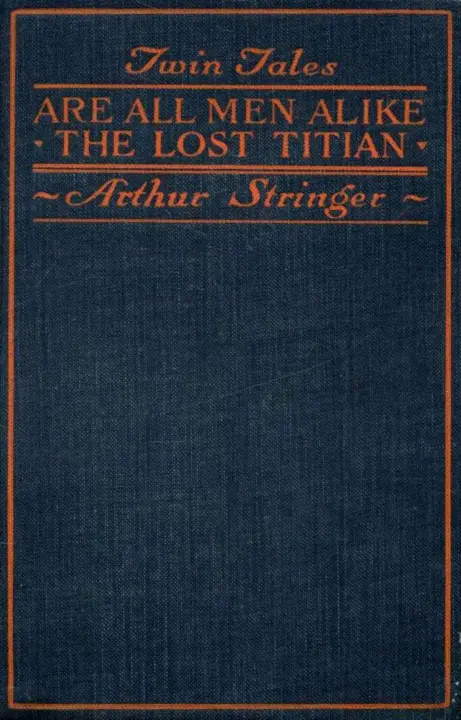
Twin Tales: Are All Men Alike, and, The Lost Titian
Arthur Stringer
THE CLASSIC COLLECTION · 1906
"The Wire Tappers" by Arthur Stringer is a novel written in the early 20th century. The story centers around Jim Durkin, a recently released prisoner with ambitions of reinventing himself as an inventor, as he navigates the seedy underbelly of New York City. The novel explores themes of desperation, ambition, and moral ambiguity as Durkin encounters MacNutt, a man involved in a wire-tapping scheme, and Frances Candler, a woman entangled in the dangerous world of gambling. The opening of the novel introduces Durkin as he steps out into the sunlight for the first time after his release, grappling with feelings of vulnerability and uncertainty about his future. He soon meets a corpulent stranger in an oyster bar who reveals his intention to recruit Durkin for illicit work involving wire-tapping, which sparks Durkin's interest despite his initial reluctance. As the narrative unfolds, the tension grows, bringing to light both Durkin's desperation to escape his past and the alluring danger of the criminal world. Frances enters the picture as a key figure, hinting at complex relationships and deeper motivations that evolve as the plot develops. The stage is set for a compelling examination of character and choice shaped by circumstances beyond their control.
Introduction adapted from the source catalogue; source summaries may be automatically generated.
Free to read · English · 70,673 words · No account needed
MAKE TIME FOR A GOOD BOOK
On by default. Untick to stop anonymous reading totals. Each page counts after 10 seconds in view. How this works.
Anonymous counting is on unless you have switched it off.
It was past midnight when he awoke with a start, a vague sense of
impending evil heavy upon him.
His first thought, on awakening, was that some one had knocked. He glanced at his watch, as he sprang to open the door. It was on the point of one.
Frank should have been back an hour ago. Then he had fallen asleep, of a certainty, he decided, with electric rapidity of thought.
But this was she, come at last, he conjectured. Yet, with that sense of impending danger still over him, he stepped back and turned off the lights. Then he quietly and cautiously opened the door.
No one was there. He peered quickly down through the gloom of the hallways, but still neither sound nor movement greeted him.
His now distraught mind quickly ran the gamut of possibilities. A baffling, indeterminate impression seized him that somebody, somewhere, was reaching out to him through the midnight silence, trying to come in touch with him and speak to him.
He looked at the motionless clapper of his transmitter signal-bell, where he had discreetly muffled the little gong with a linen handkerchief. It could not have been the telephone.
Yet he caught up the receiver with a gesture of half-angered impatience.
“. . . in this house—send an officer at once!” were the words that sped along the wire to his listening ear. An officer at once! Six quick strokes of conjecture seemed to form the missing link to his chain of thought.
“My God!” he exclaimed in terror, “that means Frank!”
There had been a hitch somewhere, and in some way. And that was the Van Schaicks telephoning for the police—yes, decided Durkin, struggling to keep his clearness of head, it would be first to the Sixty-Seventh Street station that they would send for help.
He had already learned, or striven to learn, at such work, not only to think and to act, but to essay his second step of thinking while he accomplished his first in action.
He rummaged through a suit-case filled with lineman’s tools, and snatched up a nickel badge similar to that worn by inspectors of the Consolidated Gas Company. It was taking odds, in one way, such as he had never before in his career dared to take. But the case, he felt, was desperate.
Once off the Avenue he ran the greater part of the way round the block, for he knew that in five minutes, at the outside, the police themselves would be on the scene. And as he ran he let his alert imagination play along the difficulties that walled him in, feeling, in ever-shifting fancy, for the line of least resistance.
Your reading position is saved on this browser. Take it to another device with a library code. Reading pages adapt to text, rather than matching a printed edition.
Arthur Stringer
Arthur Stringer
Arthur Stringer
Arthur Stringer
BEHIND THE BOOK
This eBook is for the use of anyone anywhere in the United States and most other parts of the world at no cost and with almost no restrictions whatsoever. You may copy it, give it away or re-use it under the terms of the Project Gutenberg License included with this eBook or online at www.gutenberg.org. If you are not located in the United States, you will have to check the laws of the country where you are located before using this eBook. Read the source licence.
The original source file, including credits and licence, is retained by this library. Request an original-format copy at no charge. Please include the book title and Project Gutenberg identifier #50203.
KEEP YOUR CURIOSITY GOING
Coulson Kernahan

Maurice Baring
Frances Wright
Cécile Tormay

Frederic Jesup Stimson

W. H. P. (William Henry Pope) Jarvis