
Twin Tales: Are All Men Alike, and, The Lost Titian
Arthur Stringer
THE CLASSIC COLLECTION · 1906
"The Wire Tappers" by Arthur Stringer is a novel written in the early 20th century. The story centers around Jim Durkin, a recently released prisoner with ambitions of reinventing himself as an inventor, as he navigates the seedy underbelly of New York City. The novel explores themes of desperation, ambition, and moral ambiguity as Durkin encounters MacNutt, a man involved in a wire-tapping scheme, and Frances Candler, a woman entangled in the dangerous world of gambling. The opening of the novel introduces Durkin as he steps out into the sunlight for the first time after his release, grappling with feelings of vulnerability and uncertainty about his future. He soon meets a corpulent stranger in an oyster bar who reveals his intention to recruit Durkin for illicit work involving wire-tapping, which sparks Durkin's interest despite his initial reluctance. As the narrative unfolds, the tension grows, bringing to light both Durkin's desperation to escape his past and the alluring danger of the criminal world. Frances enters the picture as a key figure, hinting at complex relationships and deeper motivations that evolve as the plot develops. The stage is set for a compelling examination of character and choice shaped by circumstances beyond their control.
Introduction adapted from the source catalogue; source summaries may be automatically generated.
Free to read · English · 70,673 words · No account needed
MAKE TIME FOR A GOOD BOOK
On by default. Untick to stop anonymous reading totals. Each page counts after 10 seconds in view. How this works.
Anonymous counting is on unless you have switched it off.
“Is it here, miss?” he persisted, with easy and masterful solicitude, reaching out as though to touch her with his intrepid and insolent hand. The woman drew back with a shudder, white to the very lips. This was the penalty, she told herself, for the ways she had fallen into! This was the possible degradation that even Durkin had been willing to lead her into!
She fell back from him, and stood against the wall, struggling to calm herself. For the feeling swept over her that she must scream aloud, to rend and scatter what seemed the choking mists of a nightmare. Yet her masterful tormentor, misjudging the source of her emotion, still stood blinking at her soulfully.
“Isn’t there anything I can do for you?” he wheedled, meltingly, yet
militantly.
It would have been laughable, under other circumstances, Frances tried to make herself believe—this solicitous tenderness of an unmannerly English butler, placidly extending to her the gallantries of the servants’ quarters. Now, she saw only the perils of the situation.
“You can leave this room,” she said, steadily, in answer to his question. She saw the look of stolid revolt that swept over his face, and she could have wrung her hands, in the extremity of her fear.
“Won’t you want anything fetched, later?” he still persecuted her.
“Yes, yes,” she cried, desperately; “but not now!”
“When?” he demanded, wagging his head, sagely.
“The later the better!” she answered, slowly, with a final and desperate craftiness, pointing to the door.
A sudden flame of audacious heat crept into the bloated face before her. He would still have tarried an admiring moment or two, but she returned his gaze, unfalteringly, for thirty resolute seconds. He wavered, mumbled something in his throat, flung one final melting leer at her, and then turned and crept from the room, nursing his two bottles in the crook of his arm as he went.
“Oh, thank God, thank God!” she cried, with a throaty little sob.
Then a second shudder, as momentarily benumbing as a chill, swept over her from head to foot. A sudden passion to get out where she could breathe and move took its place—at whatever ultimate loss—only to get away from that house of engulfing horrors.
The mood passed, with the passing of her fright, and she shook her tired nerves together with an effort. Then still once more she groped her way out through the darkness. Now, however, there was neither trepidation nor hesitancy in her silent movements, as she flitted through the hallway and passed like a shadow down the dark stairs.
Your reading position is saved on this browser. Take it to another device with a library code. Reading pages adapt to text, rather than matching a printed edition.
Arthur Stringer
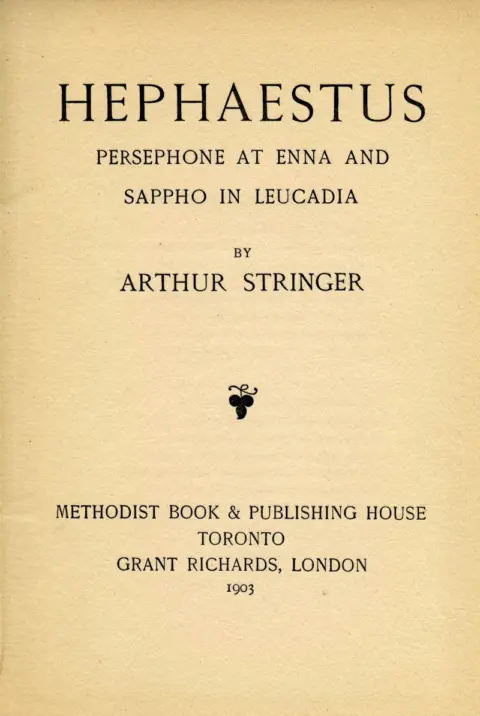
Arthur Stringer
Arthur Stringer
Arthur Stringer
BEHIND THE BOOK
This eBook is for the use of anyone anywhere in the United States and most other parts of the world at no cost and with almost no restrictions whatsoever. You may copy it, give it away or re-use it under the terms of the Project Gutenberg License included with this eBook or online at www.gutenberg.org. If you are not located in the United States, you will have to check the laws of the country where you are located before using this eBook. Read the source licence.
The original source file, including credits and licence, is retained by this library. Request an original-format copy at no charge. Please include the book title and Project Gutenberg identifier #50203.
KEEP YOUR CURIOSITY GOING
Coulson Kernahan

Maurice Baring
Frances Wright
Cécile Tormay

Frederic Jesup Stimson

W. H. P. (William Henry Pope) Jarvis