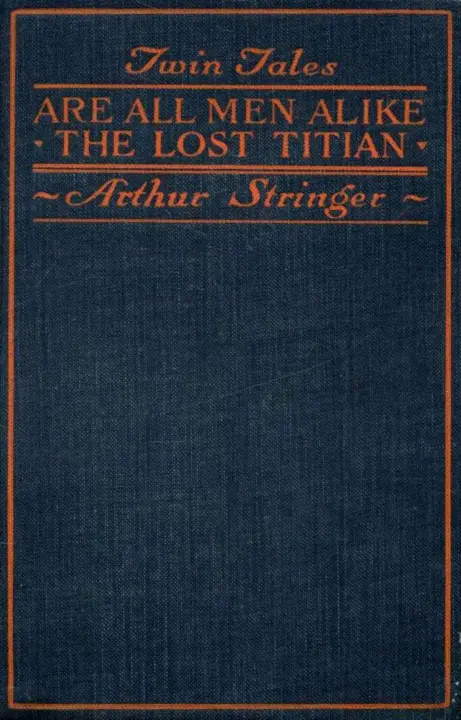
Twin Tales: Are All Men Alike, and, The Lost Titian
Arthur Stringer
THE CLASSIC COLLECTION · 1906
"The Wire Tappers" by Arthur Stringer is a novel written in the early 20th century. The story centers around Jim Durkin, a recently released prisoner with ambitions of reinventing himself as an inventor, as he navigates the seedy underbelly of New York City. The novel explores themes of desperation, ambition, and moral ambiguity as Durkin encounters MacNutt, a man involved in a wire-tapping scheme, and Frances Candler, a woman entangled in the dangerous world of gambling. The opening of the novel introduces Durkin as he steps out into the sunlight for the first time after his release, grappling with feelings of vulnerability and uncertainty about his future. He soon meets a corpulent stranger in an oyster bar who reveals his intention to recruit Durkin for illicit work involving wire-tapping, which sparks Durkin's interest despite his initial reluctance. As the narrative unfolds, the tension grows, bringing to light both Durkin's desperation to escape his past and the alluring danger of the criminal world. Frances enters the picture as a key figure, hinting at complex relationships and deeper motivations that evolve as the plot develops. The stage is set for a compelling examination of character and choice shaped by circumstances beyond their control.
Introduction adapted from the source catalogue; source summaries may be automatically generated.
Free to read · English · 70,673 words · No account needed
MAKE TIME FOR A GOOD BOOK
On by default. Untick to stop anonymous reading totals. Each page counts after 10 seconds in view. How this works.
Anonymous counting is on unless you have switched it off.
“Why, this Bryan is the man who took one hundred and ten thousand dollars out of the Aqueduct ring in one day. Since the Gravesend Meeting began, people say he has made nearly half a million. He’s a sort of race-track Curry. He keeps close figures on every race he plays. He has one hundred men and more on his pay roll, and makes his calculations after the most minute investigating and figuring. It stands to reason that he manipulates a little, though the Pinkerton men, as I suppose you know, have never been able to get him off the Eastern tracks. Now, Jim, my firm belief is that there is something ‘cooked up,’ as they say, for tomorrow afternoon, and if we could only find out what this Duke of Kendall business is, we might act on it in time.”
She waited for Durkin to speak. He tapped the top of his head, meditatively, with his right forefinger, pursing his lips as his mind played over the problem.
“Yes, we might. But how are we to find out what the Duke of Kendall and his mere running means?”
“I even took the trouble to look up the Duke of Kendall. He is a MacIntosh horse, the stable companion to Mary J., and ridden by Shirley, a new jockey.”
She could see that he had little sympathy for her suggestion, and she herself lost faith in the plan even as she unfolded it.
“My idea was, Jim, that this horse was going to run—is sure to run, under heavy odds, for what they call ‘a long shot.’”
“But still, how would we be able to make sure?”
“I could go and ask Sunset Bryan himself.”
Durkin threw up his hand with a gesture of angry disapproval.
“That beast! He’s—he’s unspeakable! He’s the worst living animal in
America!”
“I shouldn’t be afraid of him,” she answered, quietly.
“The whole thing comes too late in the game, anyway,” broke in Durkin, with a second gesture of disgust. Then he added, more gently: “Good heavens, Frank, I don’t want to see you mixed up with that kind of cur! It wouldn’t be right and fair! It’s infinitely worse than the thing I’m suggesting!”
“After all, we are not so different, he and I,” she responded, with
acidulated mildness.
Durkin took her hand in his, with real pain written on his face.
“Don’t talk that way,” he pleaded; “it hurts!”
She smoothed his hair with her free hand, quietly, maternally.
“Then you had rather that I—I borrowed this money from the Van Schaick house?” she asked him.
Your reading position is saved on this browser. Take it to another device with a library code. Reading pages adapt to text, rather than matching a printed edition.
Arthur Stringer
Arthur Stringer
Arthur Stringer
Arthur Stringer
BEHIND THE BOOK
This eBook is for the use of anyone anywhere in the United States and most other parts of the world at no cost and with almost no restrictions whatsoever. You may copy it, give it away or re-use it under the terms of the Project Gutenberg License included with this eBook or online at www.gutenberg.org. If you are not located in the United States, you will have to check the laws of the country where you are located before using this eBook. Read the source licence.
The original source file, including credits and licence, is retained by this library. Request an original-format copy at no charge. Please include the book title and Project Gutenberg identifier #50203.
KEEP YOUR CURIOSITY GOING
Coulson Kernahan

Maurice Baring
Frances Wright
Cécile Tormay

Frederic Jesup Stimson

W. H. P. (William Henry Pope) Jarvis