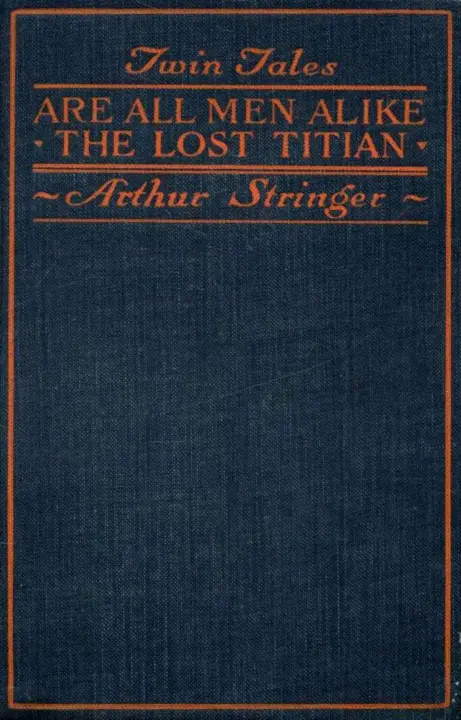
Twin Tales: Are All Men Alike, and, The Lost Titian
Arthur Stringer
THE CLASSIC COLLECTION · 1906
"The Wire Tappers" by Arthur Stringer is a novel written in the early 20th century. The story centers around Jim Durkin, a recently released prisoner with ambitions of reinventing himself as an inventor, as he navigates the seedy underbelly of New York City. The novel explores themes of desperation, ambition, and moral ambiguity as Durkin encounters MacNutt, a man involved in a wire-tapping scheme, and Frances Candler, a woman entangled in the dangerous world of gambling. The opening of the novel introduces Durkin as he steps out into the sunlight for the first time after his release, grappling with feelings of vulnerability and uncertainty about his future. He soon meets a corpulent stranger in an oyster bar who reveals his intention to recruit Durkin for illicit work involving wire-tapping, which sparks Durkin's interest despite his initial reluctance. As the narrative unfolds, the tension grows, bringing to light both Durkin's desperation to escape his past and the alluring danger of the criminal world. Frances enters the picture as a key figure, hinting at complex relationships and deeper motivations that evolve as the plot develops. The stage is set for a compelling examination of character and choice shaped by circumstances beyond their control.
Introduction adapted from the source catalogue; source summaries may be automatically generated.
Free to read · English · 70,673 words · No account needed
MAKE TIME FOR A GOOD BOOK
On by default. Untick to stop anonymous reading totals. Each page counts after 10 seconds in view. How this works.
Anonymous counting is on unless you have switched it off.
The discharged prisoner returned the other’s half-quizzical gaze of inspection. He did so with a look that was unmistakably belligerent. For, although they stood side by side, they were of two worlds, and the prisoner was no longer a prisoner.
The stranger, unabashed, merely smiled, and leaned amiably against the
stool-lined counter.
“What’ll you have, Durkin?” he asked, easily.
The other man still glared at him, in silence. Thereupon the stranger with the diamond stud thrust his hands deep down in his pockets, and rocking on his heels, laughed confidently.
“Climb down, my boy, climb down!”
Durkin buttoned up his coat: the gesture was as significant as the
slamming of a door.
“Oh, smoke up, and have something with me!”
“Who are you, anyway?” demanded Durkin, wheeling on him, jealous of his momentary isolation.
“Me?—Oh, I was just keepin’ an eye on you, over yonder!” The stout man jerked a thumb vaguely toward Jefferson Market, then turned to the attendant.
“Slip us a nip o’ that London Dry o’ yours, Terry, with a plate o’ hot beans and sandwiches. Yes, I was kind o’ lookin’ on, over there. You’re up against it, aren’t you?”
“What do you mean by that?” asked the other, hungrily watching a leg of boiled ham, from which the attendant was shaving dolefully thin slices.
“Here, brace up on a swig o’ Terry’s watered bootleg; then we can talk easier. Hold on, though—it won’t cost us any more to get comfortable, I guess!”
He ordered the luncheon over to a little round table in a corner of the room. Durkin could already feel the illicit London Dry singing through his veins; he was asking himself, wolfishly, if he could not snatch that proffered meal before taking to flight.
“Now, this isn’t monkey-work with me, it’s business,” announced the
newcomer.
“Indeed?” said Durkin, hesitating, and then taking up a fork.
“Now, first thing, I want to tell you something. That song and dance you threw up to the Old Boy over on the bench, about your bein’ an electric inventor in hard luck, caught my eye, first thing. Look here,—straight off the bat, d’ you want to get a cinch on a good job?”
“I do!” declared Durkin, through a mouthful of beans. “But doing what?”
“Same old thing!” answered the other, offhandedly.
Durkin put down his fork, indignantly.
“What same old thing?” he demanded.
“Operatin’, of course!”
Your reading position is saved on this browser. Take it to another device with a library code. Reading pages adapt to text, rather than matching a printed edition.
Arthur Stringer
Arthur Stringer
Arthur Stringer
Arthur Stringer
BEHIND THE BOOK
This eBook is for the use of anyone anywhere in the United States and most other parts of the world at no cost and with almost no restrictions whatsoever. You may copy it, give it away or re-use it under the terms of the Project Gutenberg License included with this eBook or online at www.gutenberg.org. If you are not located in the United States, you will have to check the laws of the country where you are located before using this eBook. Read the source licence.
The original source file, including credits and licence, is retained by this library. Request an original-format copy at no charge. Please include the book title and Project Gutenberg identifier #50203.
KEEP YOUR CURIOSITY GOING
Coulson Kernahan

Maurice Baring
Frances Wright
Cécile Tormay

Frederic Jesup Stimson

W. H. P. (William Henry Pope) Jarvis