THE CLASSIC COLLECTION✦Wild life under the equatorCLASSIC FREE BOOKS
Wild life under the equator
Paul B. (Paul Belloni) Du Chaillu
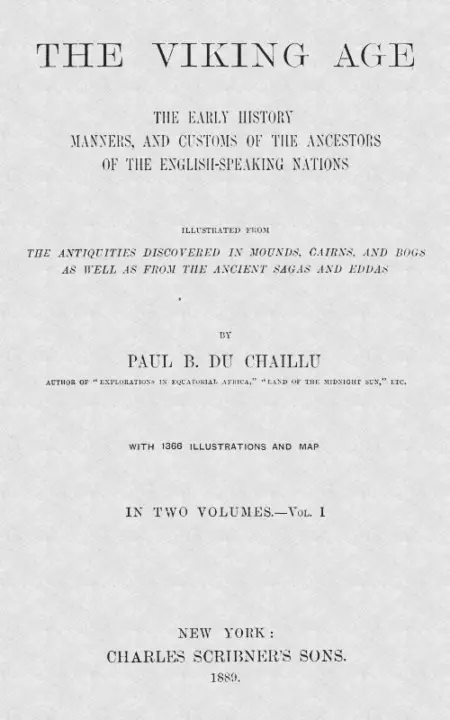
THE CLASSIC COLLECTION · 1889
"The Viking Age. Volume 1" by Paul B. Du Chaillu is a historical account written in the late 19th century. The book explores the early history, manners, and customs of the ancestors of the English-speaking nations, drawing from antiquities uncovered in various burial sites, as well as from ancient sagas and Eddas. It primarily focuses on the Viking civilization and its influence on the lands they settled, particularly in Britain. The opening of the volume sets the stage for an in-depth exploration of Norse civilization, emphasizing the wealth of archaeological evidence that paints a vivid picture of their social, political, and religious life. Du Chaillu discusses the motivations and characteristics of the Norse people, whom he describes as warlike, adventurous, and energetic, attributing their maritime prowess to their ancestry. He hints at the transformation of Britain through Viking influence, foreshadowing an extensive examination of their customs, literature, and mythology, which will be traced throughout the chapters.
Introduction adapted from the source catalogue; source summaries may be automatically generated.
Free to read · English · 172,836 words · No account needed
MAKE TIME FOR A GOOD BOOK
On by default. Untick to stop anonymous reading totals. Each page counts after 10 seconds in view. How this works.
Anonymous counting is on unless you have switched it off.
The belief in men having the power to change their shape is common in Africa to this day. See Ashangoland.
Footnote 382:
See hereditary dignity, p. 491.
Footnote 383:
See a house or room. Vol II., p. 259.
Footnote 384:
Meaning that the skin was torn.
Footnote 385:
Meaning that the skin could be touched with it.
Footnote 386:
There were two kinds of poison used. Cf. also Volsunga, c. 5.
Footnote 387:
The woman’s name means she-bear.
Footnote 388:
In ch. 27 we are told that Bera ate one bit and a little of another bit of the bear’s flesh, and bore three sons.
Footnote 389:
See p. 558.
Footnote 390:
From some stone tracings and many jewels we see the proof of this. Numerous instances are given in the Earlier Edda of birds speaking to persons.
Footnote 391:
Cf. also Volsunga, 19.
Footnote 392:
Same expression as of a ship.
Footnote 393:
Cf. also about Hrolf’s Champions, c. 31. (Ynglinga, c. 38.)
Footnote 394:
By magical drink, poisonous drink is often meant (Heimskr Harald Fairhair, 41). See Gudrúnarkvida ii., stanzas 21, 22, 23, 24.
Footnote 395:
Egil’s Saga, 44.
Footnote 396:
Egil’s Saga, 75. See p. 165.
Footnote 397:
Cf. Ynglinga, c. 7.
Footnote 398:
Cfr. Laxdæla, 57, 58, Njala, 30.
Footnote 399:
Cf. Landnama, pt. iii.
Footnote 400:
Cf. also Eyrbyggja, c. 20; and Fœreyinga, c. 40.
Footnote 401:
Ragnarök.
Footnote 402:
Chiefs.
Footnote 403:
From Odin.
Footnote 404:
Helgi.
Footnote 405:
Helgi.
Footnote 406:
Hawks as birds of prey.
Footnote 407:
Helgi.
Footnote 408:
We see it is so late that the eagles sit on the boughs for the night, &c. So they despair of Helgi’s coming.
Footnote 409:
One of the finest similes for sleep.
Footnote 410:
Here dis may be sister or guardian-spirit. Skjöldungs = kings.
Footnote 411:
The bondmaid calls Helgi and his men ghosts and fiends.
Footnote 412:
See description in Eyrbyggia. Each ghost was called by its name, and had to leave by the opposite door.
Footnote 413:
Cf. also Laxdæla, 24; Gretti, 34–37.
Footnote 414:
Snorri Harald Fairhair’s Saga, ch. 36.
Footnote 415:
Viga Styr, 102.
Footnote 416:
Njala, 72, 79.
Footnote 417:
Gandreid = wolf ride, wizard or witches’ ride.
Footnote 418:
Eyrbyggja, 52, where the moon moves all round along the wall.
Footnote 419:
Egil, 24.
Footnote 420:
A warrior.
Footnote 421:
Sister of the moon = sun.
Footnote 422:
The famous war custom.
Footnote 423:
I.e., raven.
Footnote 424:
Wound-thorn, sword; sweat of the sword, blood.
Footnote 425:
The raven was looked upon as very wise and prophetic.
Footnote 426:
I.e., a Valkyrja.
Footnote 427:
The birds of Odin were the birds of prey, or perhaps his ravens Hugin and Munin coming to tell him the news.
Footnote 428:
The hail-sprinkled gull, sprinkled with blood; hail—poetical expression used for arrows. The wave of the heap of slain—the blood of the slain making waves by its quantity. A gull is often used as meaning a bird of prey.
Footnote 429:
Your reading position is saved on this browser. Take it to another device with a library code. Reading pages adapt to text, rather than matching a printed edition.
Paul B. (Paul Belloni) Du Chaillu
Paul B. (Paul Belloni) Du Chaillu
Paul B. (Paul Belloni) Du Chaillu
BEHIND THE BOOK
This eBook is for the use of anyone anywhere in the United States and most other parts of the world at no cost and with almost no restrictions whatsoever. You may copy it, give it away or re-use it under the terms of the Project Gutenberg License included with this eBook or online at www.gutenberg.org. If you are not located in the United States, you will have to check the laws of the country where you are located before using this eBook. Read the source licence.
The original source file, including credits and licence, is retained by this library. Request an original-format copy at no charge. Please include the book title and Project Gutenberg identifier #56167.
KEEP YOUR CURIOSITY GOING
Cécile Tormay

Moritz Busch
John L. Ransom

Maurice Baring
Frances Wright
Cécile Tormay